Showing posts with label CIL2015. Show all posts

Wednesday, December 23, 2015

From the Lost & Found - CILDC : New Library Learning Experiences: STEAM and Video

In my end of the year cleaning - also known as the avoidance of grading papers - I found this draft blog post from the Computers in Libraries Conference, which I had never published.  As the saying goes, better late than never!


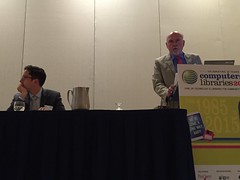
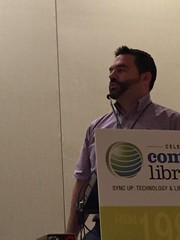
The presenters were:
  • Mikael Jacobsen - Skokie Public Library
  • Shauna Masura - Skokie Public Library
The library went through a realignment.  After the realignment, all of the departments overlap.  There are now departments on community engagement, learning experiences, customer service, access, youth services, IT and adult services.

They repurposed space to create new spaces for Learning Experiences, e.g., a media lab (an old office).

They now do pop-up programming, rather than formal programming.  Pop-up programming is when the drop into the space with a quick program that the kids can participate in.  By not announcing it in advance, they can change programs on the fly.

BOOMbox receives new tools every three months for fabrication, design, etc.  it is a flexible space for flexible learning opportunities.  Once an item is removed from the room, it might then circulate for a while.  The space allows kids to try new things actively.

Skokie is using badges to help students demonstrate that they have met their learning goals.  Their first badging system was the Maker Master Challenge Badge, which was paper-based.  Then the transferred what they learned into a digital badge system.  The system they used to build their badging system was Captain Up, which was learned earlier this year.  While it received limited use, the feedback will be incorporated into a new system.

An upcoming program will be on growing things and hydroponics.  (Bloombox)

The BOOMbox is staffed by student volunteers and staff.

They are also participating in MOOCs, using a flipped classroom approach.  

Wednesday, May 20, 2015

CILDC & LARC Wrap-up: Innovation, Implementation & Change

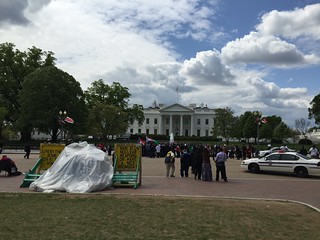
Protest in front of the White HouseIn  seven day period in April, I moderated a track the Computers in Libraries Conference and then spoke at the biennial conference for the Library Association of Rockland County (NY) (LARC).  I also was in the same hotel as President Obama, who was attending the White House Correspondents Dinner at the Washington Hilton, and I visited the grounds around Lafayette Square and the extended White House complex.  I was very busy and here is what I learned.

In a sample size of 80-100, most librarians did not consider themselves innovative.   This was shocking.  We have been talking for years that libraries and their staff need to be innovative, and you would think that talk would have turned to changed attitudes and actions.  However, it could be that we've talked a good game, but haven't changed how we act. 

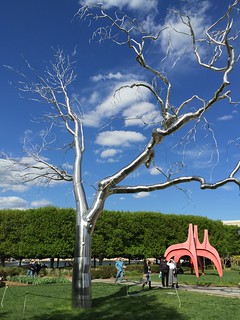
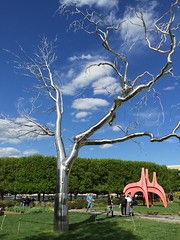
National Gallery of Art Sculpture GardenWe need to implement what we learn.  Those tools and techniques that we're learning in our libraries, at conferences, and during professional development event are things that we need to use.  If you have someone attending training session, you can help them implement what they learned by asking them what they learned, and asking then to teach others.

How we work is changing.  I learned this during a conversation and it shouldn't have been surprising, but it was.  Our younger colleagues are used to working in very different conditions than we are. They work in noisy cafes, open spaces, and informal offices.  That office environment, that we think is important, isn't important to them.  This impacts the space that we create for our new, young colleagues, as well as the work space that we create for our community members.  If you're creating work spaces for your community, I encourage you to talk to that community about what their needs really are. You might be surprised.

We need to challenge ourselves to be the best presenters possible.  Every conference has someone who needs more practice in giving presentations. If you're presenting at a local, national or international conference (or some other type of event), practice out loud and, if possible, in front of others. You don't have to do it perfectly when you practice, but you do have to hear yourself say the words and give the presentation as a first - and important step - for getting better.

Finally...in trivia...We don't know what "The White House" is.  Our news media mentions the White House every day, but is it a building, a group of buildings, an organizational structure, or...?  Walking around Lafayette Square and passed the White House and Executive Office Buildings, you come to recognize that how we describe concepts like "the White House" is inadequate.  If we're defining that badly, how are we doing on other concepts and ideas?

Tuesday, April 28, 2015

CILDC : National Digital Stewardship Residency Program

CILDC CIL2015
Kristopher Nelson and George Coulbourne
George Coulbourne - Library of Congress

Began planning the residency in 2013.  The NDSR pilot was had 10 residents,who have not been out of school for more than two years.  Began with a two week immersion program, then a nine months program,in cousin professional development and conference attendance.

The NDSR mission:
  • Create a community of professionals
  • Advance our capabilities
  • Make continuing accessible digital materials
84% of institutions has digital content that must remains accessible, but on 33% had dedicated staff for digital preservation.  

Why a residency program?
  • Digital projects have been lying dormant
  • Executive leadership nor prioritizing stewardship
  • Graduated are hungry for experience.  They have a gap between theory and practice.
  • Post graduate training has no standard model
  • Institutions need to collaborate through a professional network
They worked with 10 host institutions.  They wanted the projects to be challenging and deeply steeped in some part of the digital life cycle.  Projects needs to have impact on the external community.

Besides the normal applicants requirements, they also had to submit a 2-3 minute video talk about why they selected the projects that they did.

Dr. Howard Bresser did an independent evaluation of the program.

For the participants, being part of a cohort was very important.  Will this rank high for the virtual cohorts?

All of the residents landed jobs or fellowships by the end of the NDSR.

The institutions valued having the residents be new points of view.  

Challenges: (1) Frustrations with lack of resources, both advisory and administrative.  This was due to budget challenges at that time for the Library of Congress.  (2) The perception was that there was little or none digital preservation expertise in the host organizations.  This was due to that face that they weren't taken out to meet people outside of their mentors; this has been changed.  (3) Compensation during the pilot was too low.  (4) Expectations between residents and supervisors needs more definition.  (5) The two week immersion workshop needed to be shorter.

Kristopher Nelson - Library of Congress 

Program and challenges going forward.

There are similar programs in Boston and NYC, and there is a virtual program, all funded by IMLS.

The next class of residents has already been selected and they start in June.  The projects need to be completed in one year.

They had 18 project proposals this year.  They visited the top seven.

Info on 2016-2017 residencies will be posted at http://digitalpreservation.gov/ndsr

Changes to the program:
  • Shorter residency
  • Revamped curriculum
  • Five enrichment sessions - residents will help to put these together
  • WebEx presentations
  • NDSR symposium
  • Increased host/mentor participation
  • Professionals development plan and activities
  • Resident direct benefits
  • Increased time of the residency from 9 to 12 months
  • Increased pay to $40000
  • 2 set of 5 residents 
Feedback from the residents and hosts has been very positive.

Lessons learned:
  • Be transparent
  • Expect the unexpected
  • Maintain consistency
  • Foster growth through collaboration

CILDC : Game-based Learning

CILDC CIL2015
M.J. D'Elia
MJ D'Elia - University of Guelph

Confessions:
  • He is not a gamer
  • He has read a few books on this topic
  • He doesn't like the word "gamification"
Warnings:
He is not arguing for games and learning
He is not going to make best practice recommendations
His ideas are highly speculative

Had taught and tried to be engaging.  He decided to learn more about engaged learning and read:
  • Reality is Broken
  • Play at Work
What is alternate reality gaming (ARG)? Immersive game, networked narrative, chaotic fiction....

An example....The Beast - the viral marketing campaign for the movie A.I.   This was a deliberate attempt to build a new type of immersive experience.  Solving the mystery required collective intelligence.  Game designers remained unknown while the game was active.  Information presented in a variety of formats.

Four terms:
  • The rabbit hole - the initial clue or artifact that players stumble upon.
  • Puppet master - the people who design and run the ARG. They stay hidden.
  • The curtain - players do not interact with the puppet masters directly.  They interact with the fictional characters.
  • This is not a game - refusal to admit that there is a game at all.
This ARG was a marketing technique, but it didn't produce more customers.  This fatal flaw is an opportunity for learning.

Observations: 
  • ARG is non-linear.  In a course, the content is linear.
  • In an ARG the narrative is essential for engagement.  In learning, it is typically about facts (disciplinary learning).
  • In an ARG there are no boundaries.  In elearning, it occurs in a constrained system.
  • ARGs require collective effort.  In elearning, individual effort is required. 
  • An ARG has ine big goal.  In elearning, there are many litle goals.
  • In an ARG, Information gets pushed to players at any time.  In our contained elearning systems, students pull information at themselves.  They must fit learning into their schedules.
  • ARGs are a dynamic experience in real time.  In elearning, the strategy is predetermined and static.  
  • In ARGs, the focus is on real world exchanges.  Fictional elements are incorporated in the real world.  In elearning, learning experiences are planned and controlled (laboratory like).
Spongelab created the "History of Biology" which is ARG-like.  

An ARG makes it the learner's journey.

The hero's journal:
  • The ordinary world
  • Call to adventure
  • Refusal of the call
  • Meeting with the mentor
  • Crossing the threshold
  • Tests, trials, etc.
Jill's commentary: Three of the sessions today (thus far) have gone well together and might cause me/us to do things a bit differently in terms of training.

CILDC : Mobile 23 Things

CILDC CIL2015
Bill Spence and Jan Holmquist
Jan Holmquist - Guldborgsund Public Library

Being from Denmark, Jan started off with a short fairy tale about mobile 23 things. 

Mobile 23 things began in his library and had spread around the world.  Holmquist noted that we have the same challenges in libraries globally.

The losers of the future are the people who cannot unlearn and relearn.  People need to be able to hack their own learning.  

Basic library skills: To be aware of and be able to adapt to changes in society surrounding the library.

They did "23 things" and then got questions about other (mobile) technologies.  Choosing just 23 was hard.  They were purposeful in how they selected the apps.  

"He who wants the world to remain as it is doesn't want it to remain at all." - unknown

The project had one blog. They used professional development money to buy iPad minis for staff.  The project was for all staff.  They used Twitter for communication and discussion.  They also hosted a "support cafe."

Findings - most important was that staff saw a need for applications on a table device as being a way to enhance library services.  Michael Stephens did a survey (to learn the findings) and had published the findings.

They are now working in a version of the Guldborgsund.

Global versions in USA, Australia, New Zealand, France, Germany, Russia, Norway, and more.  Without the ability to control the mobile environment, people need a bit more skills before starting the program.  New versions build upon previous versions and so keep getting better.

23mobilethings.net includes links to other versions.  Global project used one blog, used Twitter for support/communication/discussion, some hangouts for discussion topics, and a lot of emails.

Different from a MOOC:
CILDC CIL2015
Jan Holmquist
  • Less structured
  • Everyone can join
  • Self paced
  • You can pick and choose your things
  • There are no exams
  • Harder to belong to a study group
23 things allows people to face their fears and to be comfortable with being uncomfortable.  It also helps people to connect across library systems.

A thing has an introduction, the a discovery task, a way to explore (learn more), and a time to reflect (thinking points).

Key learnings:
  • A way to sharpen our skills
  • Connect with librarians worldwide
  • Steal ideas from other libraries
  • Hope our communities get smarter

CILDC : MOOCs 101

At the last minute, Sandy Hirsch (SJSU) was unable to be at the session and she was missed.

CILDC CIL2015
Wendy Newman
Jill Hurst-Wahl (track moderator) started the session with a background on MOOCs.  In other words, what is a MOOC? Each word has many definitions: massive, open, online, course.

Wendy Newman (Univ. of Tornoto) 
OCLC report "At a Tipping Point".  Yes, we're at a tipping point in massive learning experiences.

There are many schools doing MOOCs, but no directory to refer to.

Many considerations: 
  • Hope about reducing higher education costs
  • Concerns about models and roles in jeopardy
  • Optimism about global learning and sharing
  • Skepticism about authority and accreditation
One of the less important points about MOOCs are their low retention rates.
Is there is sustainable MOOC business model.

Why offer a MOOC:
  • Build/strengthen reputation
  • Provide professional development
  • Explore delivery and business models
  • Strengthen relationships and recruitment
  • Explore and evaluate pedagogy and open platforms
  • Contribute to innovation
Newman created the UT iSchool first online course.  

Why do people do MOOCs? The primary reason is professional development.  Secondary - curiosity, credentials (EDx honor code certificate), and credits. 

The sweet spot for a MOOC is 6-8 weeks with weekly "packages" of information.

Some MOOC systems offer a certificate for a fee.

UT has clear rules for creating a MOOC.  She had to create a new course with new learning outcomes.  It was not an exact copy of her online course.  She had to decide what the assessment were and how they were implemented.  Is the assessment self-assessment?  Peer assessment?

How do you facilitate the community within the course?  They created tribes and also had an open category.

It takes a long time to create MOOCs.  They believe that it took their three person team 300 hours to create their six-week MOOC.

They did outreach and promotion for the MOOC.  There was lots of lively discussion outside of the MOOC.

Weekly units:
  • Objectives
  • Short video lectures - 5-10 minutes
  • Readings - core and suggested (open)
  • Quizzes - some computer graded
  • Discussion questions (some graded)
  • Guest video interviews - 20 people
Impacts of MOOCs on LIS:
Need more assessment, however...
  • High professional demand and uptake
  • Sparking conversations
  • Integrating research into professional development
  • Faculty learning, too
  • Visibility of LIS schools in continuous professional development
  • Forthcoming book on MOOCs in LIS 
Impacts on participants:
  • Compelling qualitative data
  • Need more assessment data 
She would like to see research in confidence levels.

Now what?
  • Enable deeper dives that conferences, blogs
  • Help recruitment into the profession
  • Connect programs and practitioners
  • Mil roles of librarians in design and implementation
  • Investigate models for sustainability 

CILDC : Creating a New Nostalgia

CILDC CIL2015
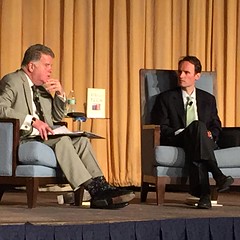
David Ferriero and John Palfrey
This was the keynote conversation between:
  • David Ferriero - Archivist of the U.S. (AOTUS)
  • John Palfrey - President of the Board for Digital Public Library of America (DPLA) and author of Biblio TECH; Head of School for Phillips Academy
Although not a librarian (he was a law professor), Palfrey is a fan of libraries.  He was director of the Harvard Law School Library.  He believes that as citizens, we have the requirement to support libraries.  He believes that libraries are at risk because we have forgotten how essential they are.  

In lots of communities, there is a feeling of nostalgia around libraries, yet libraries have a huge role ahead of them. The question is what is the library's mission?  Can they serve everyone?

He used the phrase "omnivore" to describe those people who want materials in both paper and digital formats.

Digital makes libraries more potent.  While we don't know what libraries will be in the future, we need to build the structure so that they will persist and be fabulous. We need to be create the new nostalgia.  

Libraries need to do more than that "one" function that is in people's heads. 

Libraries need to take time to ask the hard questions about how patrons (clients, users, customers, humans) are looking for and acquiring information.

Palfrey is a fan of human-centered design.  Most libraries, museums and archives do that.

Palfrey believes that the digital divide is serious. It is is skills divide.  It is a quality of space (where you access broadband) divide.  It is a technology divide.  It is a quality of broadband divide.  Students should not have to go to a noisy coffee shop for Internet access.  They should be able to work in a supportive space, where they can work with their fellow students.

Libraries should be a space where things like job creation happens.  Libraries can be a natural partner to business incubators.  

Ferriero talked about students at Duke taking him and his staff around campus at midnight to show them where students study when the library isn't open.  He found it very informative.

We need a design charettes for our digital spaces.

DPLA currently has 1600 contributing institutions, including the National Archives (but not the Library of Congress).  They are creating open source data and open source code.  Palfrey hopes that the DPLA will be a "rising tide that lifts all boats."

Libraries should inform, engage and delight (fun).

Our flavor of participatory democracy requires libraries.  Libraries help those that are the 99% to have the information that they need, in order to participate in democracy.

President Franklin D. Roosevelt established the National Archives.  Ferriero said that Roosevelt had a passion for collecting and preserving materials.  He asked that his memorial be at the National Archives.

Palfrey believes that teachers are not skilled in teaching digital literacy and are not preparing our children in that area.  He believes that this is a natural area for libraries.  He believes that school libraries are under appreciated.  School libraries require a small amount of capital and the return on investment (ROI) is high.

Ferriero notes that public libraries and school libraries historically have not collaborated well.

If students are turning to their devices to ask reference questions, then libraries need to develop mobile apps to connect students with information.

"The law is a stumbling block on the road to a bright future for libraries." That includes copyright, which needs some reform.  The combination of copyright law (Section 109) and contract law is where things get interesting.  Ebooks are leased, not owned.  He would love to see a contract for an ebook that gives that ebook "owner" the same rights as the owner of a physical book.

Librarians have a huge role in advocating for changes to copyright law, including orphan works legislation. Orphan works legislation would free up many items for use.

Are the current MSLIS programs recruiting and educating the right people for creating the new nostalgia? He believes that the people needed to create the new nostalgia already work in the profession.  He said that we need more professional development opportunities. 

If everyone works toward our common goals, we will make great strides.  There is power to be unleashed.

Phillips Academy has students/applicants from 90 countries, from all different social-economic backgrounds. He has taught a class where they focused on hacking libraries.  

Phillips Academy looks for students who are interesting in other people, and not just focused on their selves.

Monday, April 27, 2015

#CILDC : What do you do when you can't just Google it?

National Gallery of Art Sculpture Garden
Jill Meyer (Dykema Gossett - law firm)

Moving from print to digital, and fee-based digital resources.

Who needs to research when you have Google?
  • 48,500 searches are run every second on Google.
  • 64% of Internet searches are run on Google.
When digital collections came into law libraries, they were initially able to keep the print resources.  After 2008, the economic shift caused law libraries to move more towards digital and to drop the print equivalents.
Now attorneys want to access information wherever and whenever.
What are attorneys looking for?  Everything from case law to expertise witness info, to client news, to legislative history.  Everything must be current.
The transition has not been easy. Some attorneys have come into the 21st century kicking and screaming.

Their goal is to make things as easy to find as possible, and she admits that they aren't there yet. They also want to modernize their local catalogue.  

In the catalogue, they put links in the records to the digital version of the source, along with sign-in info, if necessary.

Current awareness is a big deal for attorneys.  They are doing a lot on current awareness for their attorneys, including email alerts from their content providers.  These emails are causing attorneys to check out resources and get comfortable with them.

Transitioning users:
  • Communication - need to communicate more and in different ways
  • Pesky passwords - using OneLog.com, mostly for research tools
  • Training...training...and even more training!  
Moving forward:
  • Single search access of all accessible content
  • Ebook transition ideas
  • Current awareness platform
  • Dynamic and interactive intranet page
Jill's commentary: It was interesting to hear her and people in the audience talk about things that public and academic libraries have already faced. We think that different libraries are learning from each other, but how do we really make that so?

CILDC : Building eBook Platforms: by and for libraries

Michele Farrell (IMLS)
Funding from IMLS is being used to 

  • purchase ebooks
    • Overdrive was purchased and now owned by a Japanese company.
    • Consolidation in the industry 
    • Including resources for young people
      • AWE stations
      • Tumble books
  • Funding is used to train staff and users
  • Ebook reader have been purchased with IMLS funding
  • Make sure that the readers have accessibility features
Monique Sendze (Douglas County Libraries, Colorado) 
  • DCL ebook model project
  • They developed their own ebook platform
  • Did it as a reaction to things happening in the industry
  • Guided by (pros)
    • Discounts (25-50% from publishers)
    • Ownership (don't have to worry about mergers in the industry)
    • Integration (helped to break silos for the patrons)
  • Went after small, emerging and self-published content, library created content, and larger distributor titles.
    • It was a pro that the library could be a platform - a content producer
  • They are still an Overdrive and 3M library
  • They work with 45 titles, 900 imprints, 45000 titles
  • Took $600000 to run the program - tech, content, development and staff
  • Launched in 2011
  • In 2012 and 2013 other libraries in Colorado wanted to adopt the model
    • eVoke Colorado
    • Received funding from IMLS
    • Alpha deployed in 2014
    • Opening day collection
      • Dedicated $11,000
      • 1200 titles
      • 462 titles from Project Guttenberg
  • How do other libraries do this?
  • It takes people, technology and processes - and a lot of each
  • It is not easy 
  • No one library system should take this own without considering the return on investment
  • Among the pros, they have access to all of their data, which they can use to understand and better serve their community.
  • Cons
    • Are you serving your patrons or a software development shop?
    • The time and effort needed for negotiating with publishers.
    • Managing the other ebook content.
    • Curating content from the self-publishing efforts.  Few review sources.  Need to keep an eye on quality.
  • Suggestions
    • Who really owns the contents that is purchased, if your in a consortium?
    • Partnerships - join forces with neighboring libraries.
    • Consider all business models
    • Establish good measures of success
      • Circulation is not a measure of success
  • Created a crosswalk for the creation of MARC records. Having given the tool to OCLC so others can use it.
  • What's next?
    • Need to figure out how to keep eVoke going.
    • Hoping that their model will become a national model.
Amanda Jacobs Foust (Califa Library Group)
  • Enki - enkilibrary.org - an ebook platform by libraries for libraries.
  • Began in 2011.  Followed the Douglas County Model.
  • 80 libraries
  • Did it for less money than Diuglas County
  • Launched in beta in 2013
    • Open source code
    • Nelly 40000 titles, including 5000 self published titles 
    • They own their content
  • Have moved out of beta
  • Tip - Need to educate staff on why this is the way to go, and get them to tell patrons about it.
Questions:
  • What do think about the Ebooks is forever collection?  Seems promising. The book needs to have a significant number of reviews, in order to be included in the collection.
  • Question on the purchase of ebooks with federal funds.  Organizations need to meet the federal regulations, e.g., accessibilty.  Yes there are strings attached.
  • [complicated question] Answer: Want to pursue a national marketplace for acquisitions.  Need to negotiate contracts that allow for better use.
  • What does the indie publisher community need to know?  DCL is working with the community to teach them about being good publishers, so their works can be used by Iibraries.  (Library as publisher) 


CILDC : EBSCO eBook Trending (lunch meeting)

EBSCO - EBook trending

Business model options
  • Direct purchase
  • Subscription
  • Patron driven acquisition
  • Concurrent access
How are business model options trending?

Then... 18 months ago:
  1. Subscriptions
  2. Purchase
  3. Other
Now:
  • Subscription and purchase continue to grow.  Other models are shrinking.
  • More subscription and purchase models.
  • Patron drive purchase is trending relatively well.  Not as positive as subscription and purchase.
Not trending: (negative trending)
  • PDA short term loan
  • PDa loan to own
  • PDA concurrent access
  • Concurrent access
Short term loan direction
  • Price increases
  • Embargoes (1-5 years)
CAM/Non linear lending
  • Limited participation 
  • Not participating
EBSCO
  • Fully supports all models
  • Exploring new models
Should use more volatile models selectively.

EBSCO subscription
  • Large predefined collections
  • All unlimited use
  • Subscriptions rate is a small fraction of purchase price
What is the latest with ebook technology and formats?
  • ePub
    • More optimal end user experience
    • An open standard
    • Allows for flexibility in terms of embedded content
    • Most widely adopted ebook format
    • EBSCO offers 120000 ePub titles
      • Growing rapidly
      • ePub & PDF dual delivery 
      • Moving from EPub2 to ePub3 - ePub3 better handles non-Roman languages
  • Full text quality
    • Extensive production quality control 
    • True full text, not scanned images
    • Crisp, clear, high quality full text
    • Fully searchable, read aloud technology
User experience - Digital Rights Management (DRM)
  • Continue to work towards a more relaxed DRM
  • Trying to be responsible and coordinate with publisher partners
  • Trying to push publishers to relax DRM
User experience - recent
  • Concurrent user level in Detail record
  • Dual delivery - ePub and PDF
User experience - forthcoming

  • Adding publisher permission info to the detail record
  • Offline: mobile app
  • Online: ebook viewer redesign
    • Includes full text display without a browser plug-in
    • Updated search within feature
    • Automatic including citations in copied text
    • Scroll option for PDFs
  • Single sign-on - at some point will work with EZ proxy
Year end money & ebooks
  • Consider subject sets