Showing posts with label Conference. Show all posts

Tuesday, December 12, 2023

Conference: The Religious Origins of White Supremacy: Johnson v. M’Intosh and the Doctrine of Christian Discovery

Cover of the conference program

Earlier this year I wrote about my new role as the executive director of Widerstand Consulting. Widerstand works with organizations that are trying to dismantle racism within their institutions. Accepting that role has changed what I pay attention to, what I read, the conference sessions I attend, and more. This past weekend I attended the conference entitled, The Religious Origins of White Supremacy: Johnson v. M’Intosh and the Doctrine of Christian Discovery. This was an international conference held at Syracuse University and it was packed with information. I want to use this post to share some of it. (There is no way I can share all that I learned. Wow!)

Introduction

Much has been written - and will continue to be written - about Johnson v, M'Intosh, which is a court case heard by the U.S. Supreme Court in 1823. CaseBriefs has a short synopsis. Notice that it says:

The United States holds absolute title with the exclusive right to convey land while the Native Indians only had a right of occupancy that can be extinguished at any time.

The Supreme Court opinion in this case was written by Chief Justice John Marshall and is part of the "Marshall Trilogy"that became the basis for U.S. Indian Law (also known as U.S. Anti-Indian Law). The ruling in this case - and in many others including City of Sherrill v. Oneida Indian Nation of New York (2005) where Justice Ruth Bader Ginsburg wrote the majority opinion - use the Doctrine of Discovery as their foundation, even if not named specifically.  

What is the Doctrine of Discovery? The Doctrine is part of a framework established in the 15th Century by Catholic Popes and European Kings to acquire land. According to the Cornell Legal Information Institute:

The doctrine of discovery refers to a principle in public international law under which, when a nation “discovers” land, it directly acquires rights on that land. This doctrine arose when the European nations discovered non-European lands, and therefore acquired special rights, such as property and sovereignty rights, on those lands. This principle disregards the fact that the land oftentimes is already inhabited by another nation. In fact, this doctrine was used in order to legitimize the colonization of lands outside of Europe.

The doctrine has affected Indigenous people around the world. It was this doctrine, the Johnson v. M'Intosh decision, and the ongoing effects of both that were the basis for this 2 1/2 day conference.

Indigenous-Centered Space

Haudenosaunee Social Dancers
I need to note that this conference was held on the unceded ancestral and current land of the Onondaga Nation at Syracuse University. Many sponsors supported this conference, including the Henry Luce Foundation. The Onondaga Nation and speakers from other Indigenous communities - including Māori creatives and activists from the land we know as New Zealand - were ever present to provide their point of view. They helped the rest of us see the deep impact of the Doctrine of Discovery. Because of them, I learned more than I could have imagined.

Maori art projected on a digital screen
Besides the numerous and intense conference sessions, I'm glad that I was able to participate in the social dances on Friday evening, view Māori art on Saturday, and partake in a Māori event on Sunday.  Those, along with a play (mentioned below) gave respite from the overwhelming amount of information I was ingesting, while also keeping me focused on my Indigenous siblings.

Legal Perspectives

Several attorneys and law school faculty presented at the conference including - and likely not limited to - Robert J. Miller, Steven Newcomb, Joe Heath, Beverly Jacobs, Nicolas Robinson, Paula Johnson, Dana Lloyd, and Peter d’Errico. These are people who have been studying Indian Law, fighting against the impact of the Doctrine of Discovery and Johnson v. M'Intosh, and working nationally and internationally on Indigenous rights. Their command of the facts and of court cases was amazing. 

What really stood out to me is that we can't just look at recent history and the Doctrine of Discovery. We must go back to the 1400s and understand what the Papacy, Spain, France, Portugal, and England were doing and why. Then we must follow the impact of those intentions, and see how the Doctrine of Discovery continued to have impact, including in the Louisiana Purchase and other actions that the U.S. has taken. The Doctrine needs to be a constant lens that we use to view what is happening around us. And since the Doctrine was used worldwide, we should use that lens as we view politics, conflicts, etc. in other regions.

By the way, the Doctrine of Discovery is also referred to as the Doctrine of Christian Discovery, since the Papal Bull (papal decree) was issued by the Christian/Catholic Church (and before the Protestant Reformation). It is also referred to as the Doctrine of Domination, since its result was that one group (Europeans) used it to dominate those they encountered in other parts of the world.

The Doctrine of Discovery website contains information on relevant court cases. I believe that Steven Newcomb, Robert Miller, and others have written books on this and there may be relevant talks available on YouTube. For example, a quick Internet search shows that Robert J. Miller has a number of articles and videos on this.

Sebastian Modrow
Re-translating the Papal Bulls

Sebastian Modrow, from Syracuse University, is interested in the papal bulls and  has visited the Vatican Library where they are held. And he is translating them from Latin to English, mindful that how we think about the Latin now will be different than how they were translated years ago. One document is already available on the Doctrine of Discovery website.

During his presentation, Sebastian showed a map of the known world in the early 1400s, which helped to set the stage for speaking about the various papal bulls. We don't think about what the world looked like to those European explorers and what they hoped to be sailing to...and what they wanted to do once the arrived. We learn that Columbus, for example, was trying to get to India. However, would he have laid claim to land in India as explorers did in the Western Hemisphere? We they "just" exploring or were they trying to blatantly expand the empires of Spain, Portugal, France, and England.

At any rate, I look forward to reading Sebastian's work and hearing what he learns. I'm sure his translations will be important for those opposing what those papal bulls did.

Lutheran, Episcopal, and Catholic Bishops along with Freida J. Jacques
Religious Racism

There were several sessions on religion and the Doctrine of Discovery, including a panel with the Episcopal Bishop DeDe Duncan-Probe, Lutheran Bishop Lee Miller II, and Catholic Bishop Douglas Lucia. All of the bishops are from Central NY. The session was moderated by Turtle Clan Mother Freida Jacques (Onondaga). Jake Haiwhagai’i Edwards offered replies to the statements made by the bishops.

This session stood out because the bishops were guarded, as might be expected. While information was flowing freely in the other sessions, this group was mindful - I think - of their role in their larger denominations. They can't go further or go faster than their denominational colleagues.  

Bishop Lucia did ask how we can live out the repudiation issued by the Vatican. One person in audience asked the bishops about rematriating land that their churches hold, which would be one way doing more than just saying words.  Both the Lutheran and Episcopal bishops said that they are in the process of giving back land and hope to have something to announce in the (near) future. The Catholic bishop noted that it is the parishes who hold the land and so he will work to convince them to rematriate land as they can. 

I'll note that Bishop Lucia did not mention the statue of Columbus which stands in front of the Catholic Cathedral in Syracuse. That statue has been hotly discussed by many.  As of Nov 20, 2023, a NYS appellate court has ruled that the statue can be removed. Syracuse Mayor Ben Walsh wants to move the statue to a different area.

It would have been wonderful if the bishops had talked about how they are confronting the ongoing impact of the Doctrine of Discovery in their religious structures. And if they had nothing to point to, perhaps they could have talked about what they want to do in the future. What are their plans?

Episcopal Bishop DeDe Duncan-Probe said that she had told her congregations that they cannot do a land acknowledgement without having done some action to support the Indigenous communities. That seems wise.

Poster Sessions and Student Papers

On Saturday, three students from Northern Virginia Community College presented on the political origins of the January 6, 2021 event which occurred at the U.S. Capitol. Professor Joel Harrison uses that event to engage students in how religion is impacting politics. It was good to see students thinking about this. They mentioned ideas and images that date to the Crusades as well as modern imagery. As undergraduates, their work was not as in-depth as what a master's or doctoral student would do, but it was still thought-provoking.

On Sunday, several SUNY Environmental Science and Forestry students, from the Diversity and Knowledge of the Environment Class, presented posters from their class taught by Sarah Nahar. I spent a lot of time talk with one student (I believe Duncan Spatz) about his poster which showed what Manhattan might look like if it had never been colonized. Wow!

In the Court of the Conqueror

George Emilio Sanchez
Writer and performance artist, George Emilio Sanchez, in collaboration with Patty Ortiz, performed his one-person play on Saturday evening. In the Court of the Conqueror:
...confronts the history of how the courts have diminished the Tribal Sovereignty of Native Nations, juxtaposed against sanchez’ experiences navigating generational trauma and Indigenous identity in an Ecuadorian immigrant household.

It is an amazing piece, which reinforced what I had heard during the day. I laughed as I heard Sanchez talk about aspects of his life and then left speechless as he talked about the impact of the Doctrine of Discovery. This is a play that should be performed on college campuses as a way for students to think about U.S. law and its impact. I could imagine a performance being followed by an extended conversation, perhaps with law professors and Indigenous activists. 

Because of an images that Sanchez showed, one of the things that occurs to me is that we do not learn in K-12 schools that the United States has land within its borders that is occupied by Indigenous nations. The U.S. is not a contiguous land, but has "holes" in it that are other nations. Imagine if children learned that?!  That is something I learned as an adult and I should have learned it in fourth grade history.

Only Scratching the Surface

I wanted to get some thoughts written in a place where I could share them, but this post only scratches the surface of what I heard and experienced.  One person likened the weekend as providing more information than an academic class and that is true. It was overwhelming.  And because there was so much to say and discuss, nearly every session ran long and every break was eliminated! Very full days!

I'm looking forward to talking with some folks I know who attended the conference and sharing what we learned. I think the more I talk about it, the more it will become working knowledge and the more I may find ways of helping to counter the harm done by the Doctrine of Christian Domination.

Thanks goes to Philip Arnold and Sandra Bigtree for organizing this conference. Thanks also to everyone who helped with the event and to all of the sponsors. Organizing an event like this requires many hands.

One final note. I have not inserted which nation specific speakers were from, because I do not want to be incorrect. I mean no disrespect and hope they and you who read this post will understand.

Resources

There are MANY resources - books, websites, articles, videos - so this are just a few to get you started. 

Tuesday, November 08, 2022

#NYLA2022 : "They don't need you" and other lessons from the Annual Conference

Board and staff are representative OF our community. Programs are cocreated BY our community.  Organization is welcoming FOR our community.

Last week was the New York Library Association (NYLA) Annual Conference in Saratoga Springs, NY. Saratoga is a gorgeous community and always a great place to hold the NYLA conference. This conference was our first "normal" conference since COVID turned everything upside down. There were no restrictions and registration was close to what it was in 2019. (The conference in 2020 was virtual and it was scaled back in 2021, due to COVID restrictions.) 

There were many enticing sessions - often at the same time. Rather than writing about each session, I want to capture a few highlights and share some resources.

Courtney Harge: The Beautiful Revolutionary Future

The keynote was given by Courtney Harge (she/her), who is the CEO of OF/BY/FOR ALL. OF/BY/FOR ALL helps to equip "civic and cultural organizations to become of, by, and for their communities." Her slides are available and I recommend looking at them. Included in her presentation was an overview of their Change Network system.

What stood out to me is how they coach organizations to reach out into their communities, recognizing that gathering information and building relationships is paramount. Harge noted that we often rush to present a solution without knowing what the community wants or truly needs. People want to be listened to, heard, understood, and partnered with. Rushing in with a fully formed idea means that we are saying that we know best, even if we know nothing about that group or community.

Harge did say, "They don't need you." Those folks and groups who aren't using the library are existing without the library. We might rush in and exclaim, "you need us" or "we have a solution", but do we really know what those folks need? Spending time - a lot of time - getting to know the community and its sub-communities is vitally important. 

How do you get to know your community? Attend their events (without talking about the library). Walk through the neighborhoods and visit different businesses (and don't talk about the library). Perhaps try different places in those neighborhoods for coffee or lunch. Ask your staff to introduce you around, if they are willing. However you do it, Harge noted that we cannot immediately pitch an idea, rather we need to listen and learn. We need to understand what our community wants, rather than focusing on the solutions we already have. We need to focus on building trust.

Her presentation was full of wise words (many captured on her slides) including, "Make sure your space isn’t actively harmful.” For me, this also requires a lot of deep listening. Your staff and patrons need to trust you in order to tell you why your organization is actively harmful (if it is) and that trust does not occur overnight. It takes time.

There is a saying, "work at the speed of trust." Trust allows things to happen faster. However, trust takes time to be established and it can be ruined in an instant.

Creating Remote Access to Library Collections

John Raymond, Matthew Kopel, and I did a session on "Creating Remote Access to Library Collections," where we talked about digital lending in a controlled environment. Good to see public and academic librarians in the audience, who are interested in using Copyright Law (Sections 107 and 109), digital technology, and DRM to provide digital access to some of their print collection. We provided lots of information and emphasized the details of CDL (controlled digital lending) including maintaining the owned-to-loan ratio.

NYS Minimum Standards for Public Libraries

I found the session on the New York Public and Association Libraries Minimum Standards to be eye-opening and helpful. While I've studied the minimum standards, it was useful to hear others talk about how they are applied and what happens if a library is not meeting one (or more) of them.

One eye-opening tidbit is that all public library trustees need to fulfill the annual NYS mandated sexual harassment prevention training requirement. If a trustee takes this training in their workplace, they can use that training to fulfill their requirement as a trustee. Not having to take the training twice is good news. The bad news is that some of the sexual harassment training that is being used to fulfill this requirement is structured to meet the requirement and not to be truly helpful (in my opinion).

Mary Lou Carolan, from the Newburgh Free Library, shared their strategic plan during this session. (Having a strategic plan is one of the 14 minimum standards.) I like looking at library strategic plans and this one contains interesting activities.

Carolan noted that the Newburgh Free Library serves a community that is 50+% Hispanic. By hiring someone from the Hispanic community, translating the website, etc. into Spanish, & better outreach, they have increased the number of people from the Hispanic community who are engaged with the library. 

Combating Racism in Libraries: Creating Spaces to Educate and Inform Our Communities

I believe these archived webinars were mentioned in the "Reinventing Ethnic Library Services."  On this page are:

  • Community and Communication in the Dialogue on American Racism - Past, Present & Future
  • Using Collection Development and Readers Advisory to Introduce Race Relations 
  • Inclusive Programming - Every Race, Every Month 
  • I Write about Race - a panel discussion
  • Equity, Diversity, and Inclusion (EDI) in Human Resources & Microaggressions in the Workplace
  • Teaching Equity, Diversity, and Inclusion (EDI) and American Culture in ESOL Classrooms 

And on this page are:

  • Let's Talk About Anti-Asian Hate
  • Reintroducing R.A.C.E. with Teens (Racial Awareness and Community Education)
  • Evaluating for Inclusive Programming
  •  Impact of Racism on Community Health
  • Microaggressions in Academic Libraries

Little Free Library for Banned and Challenged Books
Good Weather, People, and Food

The weather this year was warm and gorgeous, and everyone took advantage of it! So nice to not have to take a winter coat or worry about rain.

One of the benefits of being in Saratoga is all of the good food. I didn't have one bad meal! Since NYLA will be in Saratoga again next year, I look forward to visiting places like Walt Cafe and Darling Doughnuts again. 

Of course, NYLA brings people together from across NYS (and beyond) who are interested in the sessions and then who find a myriad of other library-related things to talk about. The sessions and the conference structure become the backdrop for powerful conversations with existing and new library buddies.  I'm thankful to have seen folks whom I only see at NYLA and to make new friends!

Future Conference Locations

Finally, here is where the NYLA Conference is scheduled for the next five years. Yup, alternating between Saratoga and Syracuse!

2023: Saratoga Springs, November 1-4
2024: Syracuse, November 6-9
2025: Saratoga Springs, November 5-8
2026: Saratoga Springs, November 4-7
2027: Syracuse, October 27-30

Tuesday, July 19, 2022

Clark Quinn: Writing (And Reading) Conference Session Descriptions

Clark Quinn starts this 2011 blog post by stating:

Have you ever been to a conference session, and realized that there was a mismatch between what you read, and what you experienced? On the other hand, how often have you written a conference submission that has been rejected? In the middle is a lesson about what a good conference submission is. 

Yes, writing a good conference description and proposal takes a bit of work, and it is worth it! It means that you know what you're going to present and the audience knows what they are going to hear. And as Clark notes, a well written proposal will get the conference committee's attention! 

I know this is an old post, but I also know some people could benefit from reading it, so... 

Friday, April 22, 2022

AIIP Pre-conference conversation with Jennifer Burke

As part of Association of Independent Information Professionals' (AIIP) annual conference, I am giving the Roger Summit Award Lecture, where I'll be speaking on Moving Beyond Hope in terms of diversity, equity, inclusion, accessibility, and belonging. That occurs on April 29. On April 13, I sat down with for a live online conversation with Jennifer Burke to talk about the conference and my presentation. In addition that, we had fun talking about elements of an in-person conference people might incorporate into their virtual conference attendance. The recording is below.

Jennifer used StreamYard for this interview, which I had not used before. People were able to interact with us on StreamYard itself, and the stream was also carried live on Facebook and LinkedIn. StreamYard looks like something many people and organizations could use to stream live events. I like that it does have a free option, although clearly Jennifer has a paid account!


Tuesday, December 28, 2021

2021 Year in Review: Conferences

Jill Hurst-Wahl and Andrea Snyder

In most years, I can easily list the conferences I have attended, because they were events I traveled to. And when you need to travel to attend a conference or most professional development events, you aren't going to multiples each month. However, the move to online events in 2020, because of the COVID pandemic, changed how conferences were run and how many events a person could attend.

Soon after March 13, 2020 - the last day I worked on-site before being sent home because of the pandemic - organizations began hosting events online. Early in the pandemic, the thought was to give people learning opportunities as something to do. Then there became a need for learning opportunities which addressed challenges occurring during the pandemic. However, rather than attending these learning opportunities, I was involved in creating them by giving webinars or being on webinar panels. 2020  opened up new opportunities and I'm grateful for all of them.

Now in 2021, in addition to being involved in giving webinars, I found myself attending many online professional development events and conferences. Yes, some events were free or low-cost, while still providing top quality content.  Having virtual events made it easy to go from event to event, when it would have been impossible to do so if I needed to attend in person.  (On Oct. 22, I attend parts of the Central NY Library Resources Council Annual Meeting, the South Central (NY) Regional Library Council Annual Meeting, and Library Research Round Table event - back to back events - without leaving my office!) Memorable to me was that I was able to attend the 2021 Miami University Libraries Copyright Conference, which had Kenneth Crews and Jack Bernard among its speakers.

The ShapingEDU Winter Games in January are worth noting, because I think more people should be paying attention to this group. From its first on-site conference in 2018 to now, ShapingEDU has been gathering people together to talk about the education and work towards changing it. The Winter Games had presentations and panels from a wide variety of people who are involved in education, including speakers from specific companies that are shaping how we learn. I sat enthralled in front of my computer! Yes, this was a free event!

The ShapingEDU Unconference in July was an event where people engaged in conference-long learning and envisioning activities. It was structured in a way that made it possible for people to dip their toes into specific topics, if they didn't have time for a deep dive. Sessions were led by people who are deeply involved in the areas covered by the Unconference, which meant that you had an opportunity to learn from the best. And did I say this was free? Yup. 

If you are interested in education, I encourage you to look at ShapingEDU. Their next event - Pente Pitch Challenge - will be in February 2022. Check it out!

The Special Libraries Association (SLA) had its annual conference online in August and I was on a panel entitled "Work-Life Pivots: Tales from the Trenches" with Julie Edwards and Eugene Giudice. Marydee Ojala was the moderator.  All of us had pivoted our careers at least once - if not multiple times and this allowed us to share our experiences, talk about what we had learned, and provide tips. 

Everyone can pivot their careers. Everyone. I know some people think it is impossible, but it isn't. Yes, it might take time and effort to achieve. Yes, you might have to learn new things. Yes, it might be scary. Yes, you can do it.

During the SLA Conference, I received the John Cotton Dana Award for lifetime achievement. I'm still stunned by that!  I've already written about it, if you want to know more.

My first in-person conference of 2021 happened in November, when the New York Library Association Annual Conference came to Syracuse.  Besides the in-person component, NYLA also held a virtual conference in October and had recorded on-demand content available. I've written a number of posts about this conference already. For me, it was wonderful to be at an in-person event. Because we were in a county conference facility, we had to wear masks all the time, except when eating or drinking. Seating in the sessions was spaced out, so we could keep at a distance from each other.  

Next year, NYLA will return to having an in-person conference only in Saratoga Springs, NY on Nov. 2-5. I hope that COVID is under control by then, meaning that the number of cases are much lower and we can meet without the need for masks or the fear of getting COVID. I plan on being there and hope to see many of my NYS library buddies there, too.

2021 Lessons Learned:

  • Online conferences can be quite good! They do need a lot of planning, as well as good software, so don't think that hosting an online conference will be easier. One of the best things about them is that you can have a wider variety of speakers, because they do not need to travel.
  • Attending an online conference is easier, because you don't need to travel. However, it is easy to get distracted because you're sitting in front of your computer. It is up to you to stay engaged, because there is no one sitting next to you to poke you when you clearly are not paying attention. 
  • During 2020-2021, online conferences were held at a number of different price points. Don't assume that a conference will be too expensive for you to attend. Read the details! You might be surprised. 
  • Offering online events at a low cost or free is likely a finance burden for the event organizer. However, I hope that organizations will continue to find ways of making some of their events widely available, so that they have a larger impact.
  • Staring at people through a virtual event portal is fine, but it is not the same as being in-person. I think that people will want to attend a mix of virtual and in-person events each year, because the in-person events really do engage people differently.

Thursday, December 31, 2020

Wrapping Up 2020: A Pandemic Influenced Year

Librarians Threaten IgnoranceThis has been quite a year, which will be reflected in this look back on 2020. 

Diversity, Equity and Inclusion

Those three words became more important this year. The library and information professions were already examining themselves and how to become more diverse in terms of people within the professions, content, programs, etc. We need and want to be more representative of the communities we serve. We need to include all voices. This is an ongoing struggle and one in which every ally needs to remain vocal and active. We cannot leave this work to other people. 

In October, I wrote four posts on the struggle to diversify library staff, which have been widely shared and I think have helped to inform some conversations. If you are interested in increasing the diversity of your staff - whether your in a library or not - I encourage you to read these posts. 

By the way,  many people read the first post with fewer reading the remaining ones. Yet it is parts 2 and 3 which provides ideas for improving the situation.  (I think part 3 offers a radical idea.)

Racism in the Profession

In November, an article pointed to someone in the library and information profession as being a member of a right wing extremist group. This led to a lot of chatter on Facebook and in other places about the values of the library profession and how this person did not seem to have those values. However, the truth is that the profession contains a breadth of personal values and opinions, some of which are at odds with the values practitioners believe the profession has.  

This is an area where we all need to listen to those who have been - and continue to be marginalized in the profession. After that listening, we all need to think deeply about the changes that need to be made, and then make them.

I encourage you to read the ALA's Code of Ethics and consider how that code is helping or hindering us as we try to become more inclusive.  I also encourage you to read "This Is Who We Are" by Fobazi M. Ettarh.

If you head a library, look at your meeting room policy and consider if they would allow racist or extremist groups to use a room. Is that what you want?  Then look at your collection development policy. Does it support the inclusion of racist materials into your collection?  Is that what you want? You may need to update your policies. If you want racists to use your meeting rooms and be reflected in your collection, then you need to think about what that means to your community and likely you should document your rationale and decision. Finally, start a conversation with your staff about the values of your library, as well as about diversity, equity and inclusion.  Make this a long-term conversation. You will not be able to surface concerns or problems - or create solutions - in just a few sessions. You and your staff will need to get comfortable with each other and with the conversation, before people are willing to really open up. Everyone will need to see that conversation as safe space for all opinions.

BTW I have purposely not included links to articles, etc. about the LIS person who is associated - loosely or tightly - with a right wing extremist group. Why? Because this is not about scrutinizing one person, but about looking at the entire profession. 

My Most Shared Facebook Post

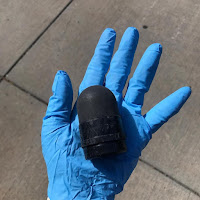
Rubber bullet

Much of the conversation around racism in 2020 was due to the Black Lives Matter protests. After a protest in Syracuse in May, a colleague helped pick up the debris and found a "rubber bullet." The term rubber bullet is used to describe a range of projectiles of varying sizes, including large ones that are used on our city streets. With permission, I created a public Facebook post about rubber bullets, noting that they can do serious damage, which other attested to. A few people disagreed, because there is a smaller version, which I know are used in police training instead of "live rounds," but these large projectiles are not those. I'm glad to know that Facebook post has been shared over 2,000 times, because it surely has educated some people.

A Push to Change the Pathways to Librarianship

There is a group in ALA and in the New York Library Association which are each focused on what needs to change in LIS education or the pathways to librarianship (I see these as being entwined).  

The work of the NYLA Pathways to Librarianship Task Force is just beginning and their timeline is ambitious. As stated:

This first charge of the task force will be to work towards the development of a Statement of Principles on the topic of Alternative Pathways to Librarianship. Particular emphasis will be placed on creating sustainable practices that allow historically discriminated groups to more easily enroll in library and information science graduate programs, attain graduate degrees in librarianship, retain employment in their chosen field, and advance through the profession.  These Principles will be used to create a white paper advocating for systemic reforms and the subsequent creation of a new framework to address inequities.

In ALA, nearly 100 people have come together  as part of the Librarian Education Reform Discussion Group (within the ALA Connect platform). This group is talking "about education requirements in the future of librarianship." Members of this group are also focused on other aspects that could help to diversify the profession.  

Talking about changing LIS education or pathways to librarianship is a complicated discussion. There are more opinions than people, and there is truth in every opinion shared.  Because there are so many valid opinions (or options), selecting which one to focus on can be problematic. Do you select the one advocated by the loudest voices?  It is the one that the group selects?  Do you select the easiest to tackle? Or perhaps your research leads you to the one that will have the biggest impact? If the focus is on making changes which will help the profession become more diverse, do you have representatives from those diverse communities in the discussion and are you listening to them?

I'm involved in the ALA Connect group, but have decided not to get directly involved in the NYLA effort. I've enjoyed the ALA discussions to-date and look forward to what they continue to surface and what ideas they might bring to the profession.

Digital Lending of Library Materials

After everything began shutting down in March, due to COVID-19, the number of copyright questions library staff increased. ALA did two webinars with me, Kenneth Crews and Lesley Ellen Harris. (Part 1 post and Part 2 post contain links to the recordings.) People had questions about fair use, storytime, the digital lending of materials, and more, and we answered all of their questions.

The digital lending of library print materials is the cause of many discussions and disagreements. Yet there are libraries - more than you realize - who are engaged in digitally lending their print materials. The simplest example are academic libraries who have digital course reserves. Ecourse reserves are done in a controlled environment. Making materials available in an accessible format for those who are blind or other people with disabilities (Title 17 Section 121), is a form of controlled digital lending. Libraries are also digitizing some of their print works and making those copies available in a "lend like print" fashion.  In other words, that one digital copy can be loaned to one person at a time, and when that digital version is out on loan, the print copy cannot be loaned. Below are related blog posts and I know I'll be writing about this more in 2021.

Related blog posts: 

Report: Public Library Survey Data: Some Answers, Many Questions

As I've written about before, two years ago, the Syracuse University iSchool Public Libraries Initiative (IPLI) became interested in the IMLS Public Library Survey (PLS) data. At the time, the IPLI was doing some work on the data in conjunction with the EveryLibrary Institute. Seeing the data from every public library in our 50 U.S. states, the District of Columbia, and our U.S. territories raised questions in us. Exploring those questions took time and required adding some skills to our team, while also understanding which of our questions were answerable and how many were not. Fast forward and earlier this fall I finished a 17-page report using the 2017 PLS data entitled Public Library Survey Data: Some Answers, Many Questions (free download).  I am still proud of this report and hope that public libraries across the U.S. will continue to use it.  

Conferences?

I really enjoyed the ALA Midwinter Conference in Philadelphia in January.  Now I look back at it as not only being a wonderful conference, but also my last trip before the pandemic. (Relevant ALA blog posts) That in-person conference was definitely a high point of the year, as was the virtual conference held by the New York Library Association in November. (Relevant NYLA blog posts) The NYLA Annual Conference us!ed the PheedLoop platform, which provided space for broadcasted and pre-recorded sessions, real-time chat, and a trade show.  It was more interactive than I expected, which was a huge plus. Of course, NYLA had excellent content as always.

Sticky bun from Beiler's in the Reading Terminal Market

My Last 2020 Flight

A travel highlight of being in Philly is the Reading Terminal Market. On the last day, I bought a half-dozen Amish sticky buns to bring home and put them in my backpack. A security person at the convention center wondered - as I was stuffing them in my backpack - if I could get them on the plane, which was an odd question. But later, there I was at the airport security checkpoint watching my backpack being scanned and the TSA agents staring at the screen.  One brought my backpack to me, opened it up, pulled out the bag of sticky buns and asked, "What is this?" Evidently, they did not recognize sticky buns on their scanner! (Yes, I got them home with me.) That was the highlight of my last flight of 2020.

A Change in Work!

The stay-at-home orders in March flowed nicely into my retirement from academia at the end of June. I am now Professor Emerita!

Yes, I am retired and just as busy as before. I am serving on several boards including the EveryLibrary Institute and the Onondaga County Public Library (OCPL) Board of Trustees. Being on the OCPL Board during the pandemic has been very "interesting" (in every sense of the word). Like nearly every library in the U.S., all of the libraries in the OCPL system shut their physical locations for many weeks or months due to the pandemic. However, like many other libraries, the OCPL libraries have been online for many years, including the ability to search from home for a book to reserve, access to online databases which contain high quality verifiable information, ebooks, audio books, and much more. While online programs are not new for any library, they multiplied in 2020 when meeting in-person was not possible. The OCPL libraries used storytime, performances of Shakespeare, online book clubs, craft sessions, summer reading, staff generated podcasts and YouTube videos, and much more in online formats to give people respite from the stress that 2020 provided. While many people focused on the doors being closed,  but the staff at the libraries were still working to meet the needs of our communities. We cannot forget that our libraries are very digital and are always open.

Besides serving on several boards, I'm continuing to give webinars on a wide variety of topics, including copyright (running again in February), communications, using SMART goals, productivity, and mentoring (March 2021). In terms of consulting I am talking with prospective clients about copyright projects and projects related to innovation. Innovation is something I've focused on for a long time and I look forward to putting my knowledge to work with a new organization. 

Besides my website, this blog, and LinkedIn, I've been using a new service called Lunchclub as a way of thinking about "what's next." Lunchclub provides curated one-on-one professional connection, and smart introductions to relevant people. What an interesting way to meet other people who are interested in copyright, and from difference perspectives. Paul Signorelli has written about this platform, so you can go there to read more. Lunchclub does not allow people to automatically join, but instead looks for people to be referred in some fashion.  If you're looking for a new or different networking platform, here is a link so you can signup for Lunchclub.

What else?

I'm sure there is more I should write.  I haven't talked about what I've learned about Zoom, or about the site Gather.Town (which has more functionality than you can imagine), or discovering Sardek Love's Monday "Ask a Master Facilitator" videos...or Tom Haymes' book Learn at Your Own Risk, or Paul Signorelli's book Change the World Using Social Media (which includes information from an interview with me)...or about the days I sat in front of the TV watching in disbelief all that was happening in the world. I am thankful for the light, for the good...and I look forward to what I hope will be a better 2021.

Happy New Year!


Thursday, January 30, 2020

#ALAmw20 Day 4: Advocacy, Wrap-up, and EveryLibrary Institute

Making the News: Library Advocacy and Local Media

Speakers: Shawnda Hines (moderator), Christi Buker, TyLisa Johnson, John O'Brien

Christi Buker (Pennsylvania Library Association):
  • Use traditional advocacy and social media
  • Make sure their legislative community is fully engaged
  • Focused your limited time and resources
  • The Pennsylvania Library Association  (PLA) have created handout that provide information on the good, bad, and what’s possible (the ask)
  • In 2018, PLA focused on awareness
  • In 2019, PLA focused on positive revenues within the state
  • Suggested that you get your county to acknowledge National Library Week
  • Do media training
TyLisa Johnson (journalist):
  • Use data to supplement stories on people. Marry anecdotal stories with data.
  • Educate your journalists about the library
John O’Brien, (Pennsylvania State government staff):
  • Revenues have not recovered from the Great Recession
  • There is a lot competing with libraries in the budget
  • Libraries must prove their worth
  • What is your return in investment?


Wrap-Up

Book Nook inside the Reading Terminal Market Like other associations, American Library Association is a period of change.  Our reliance on our professional associations is different than it was, partially due to the Internet (for training and information) and the economy.  The fact that our vendors (sponsors) have consolidated hasn't helped either.  This all has placed financial pressure on ALA.

I have not tracked information on how ALA might change in the future. My impression is that is still being worked through.  However, ALA has announced that it will be changing its Midwinter event in the future. So this may have been the second to last one.  According to information posted to Twitter, total attendance for this Midwinter was 8,099 (2020). This is compared to 9,211 in 2019 (Seattle) and 8,036 in 2018 (Denver). These registration numbers are similar to the Midwinter conferences in the early 1990s.

ALA still does important work for our libraries across the U.S. and in other countries. ALA accredits our MSLIS programs. ALA advocates for our libraries and sets standards.  No matter what happens in the months to come, ALA will still be an important force.

EveryLibrary Institute 

I ended the conference by attending a meeting of several board members for EveryLibrary Institute (ELI). (Yes, I'm on their board.)  ELI conducts research on libraries, which libraries can then use to help discuss their value with their constituents, political representative, and those who vote on library budgets.  ELI's available research includes a Library Funding Map, information on U.S. Library Funding Change Rate, and the Crime and Library Report. They also push out relevant information produced by other organizations.  If you are interested in understanding or articulating the value of libraries, check out EveryLibrary Institute.

ELI also does training for library staff to increase their political literacy skills. If you're approaching a vote on your library's budget, you might want to top-off your political literacy skills through a workshop or webinar.

EveryLibrary Institute is interested in understanding why people vote for or against library budgets. You might think that you know exactly which way people lean politically and how that impacts their vote on a library's budget, but it is much more complicated than that.  We know that it would help every library vote across the U.S. and so one of things we discussed is how to fund and support this research. If you know of an organization - or group of people - that would be interested in funding this work, please contact John Chrastka and Patrick Sweeney.

The Art of Philly

Philadelphia has increased the amount of public art on its streets and in its airport.  Here are a few pieces for your enjoyment.

Mural on Sansom Street by Amy Sherald
Mural on Sansom Street with the theme of biochemistry
Art sculpture at the Philadelphia International Airport made from suitcases
Mural on Arch Street near Convention Center with the theme of water

#ALAmw20 Day 3: Tech Trends, Future of Libraries, and More

LITA Top Technology Trends

Speakers:  Ida Joiner (moderator), Victoria Blackmer, Marshall Breeding, Elisandro Cabada, and Alison Macrina

This Top Tech Trends session was focused on privacy.

What is causing the privacy concerns?
  • Internet of things - the connection of the entire world 
  • Inclusion of sensors in many things that are collecting personal data
  • Not all libraries have secure websites - what a person does on a library's website should be private
  • A need for libraries to use more encryption
  • A recognition that a library's website may be secure, but the ads on it track user activity
  • Analytics which capture user information
  • Virtual reality and augmented reality
  • Data storage
  • Facial recognition - they have been some conversations about using facial recognition instead of library cards
  • Consumer surveillance devices
  • Vendor privacy issues
  • People using Alexa, etc., for quick reference questions
  • The use of drones
Libraries cannot assume that others will figure this out in a way that suits them and their patrons.  Libraries need to get involved and assure that the privacy concerns of their community are being met.

Libraries at the Nexus of Migration

Speakers: Julie Botnick, Derek Johnson, Alex Gil Fuentes, Adriana Blancarte-Hayward, and Christian Zabriskie

Lots of good information in this session and a resource list.  One effort mentioned was the Nimble Tents Toolkit, which is library people combining their efforts on specific, quick response initiatives. Another effort was "Torn apart / seperados". Volume 1 is a "rapidly deployed critical data & visualization intervention in the USA’s 2018 'Zero Tolerance Policy' for asylum seekers at the US Ports of Entry and the humanitarian crisis that has followed."  Volume 2 is "a deep and radically new look at the territory and infrastructure of ICE’s financial regime in the USA. This data & visualization intervention peels back layers of culpability behind the humanitarian crisis of 2018."

Okay...so why are libraries getting involved?  Libraries are trusted spaces in their communities. They are welcoming places for everyone.  Libraries offer information, programs, and resources to everyone. We often do civic engagement because we want to help our communities improve.

What specifically are we doing?
  • Providing health information in multiple languages
  • Focusing on offering inclusive materials
  • Training ourselves to do this work and then building capacity
  • Learning about cultural competence and practicing cultural humility 
  • Building collection in non-English
  • Creating program in other languages
  • Providing access to legal resources
  • Giving information to help people know their rights
  • Holding town halls
The work these groups - and others - are doing is admirable and needed.  Let's urge other public libraries to get involved.

FUTURE-READYing Your Library: Preparing for the Future Today

Speaker: Marcellus "MT" Turner

Marcellus Turner is the Executive Director and Chief Librarian of the Seattle Public Library.  During his introduction of the topic, he said that this might not be what people expected and that it was okay to get up and leave.  That made me even more intrigued!

MT and Seattle Public Library are preparing the library of today for tomorrow.  While Seattle Public is well-known, that library was built to be the library of tomorrow, but rather to liberate our ideas about what a library can be.  Now SPL is working hard to figure out the trends that point to the future needs and what the library must do to meet those needs.  The goal is to be proactive, rather than being reactive.

Our Opportunity to Become Future Ready
Thinking Out Loud


SPL has been  on this project for about 18 months and are now at a point where they can begin sharing information. They are still gathering information and do want to engage a futurist, so the work is not yet done. They hope in sharing that they can also learn from others.  MT promised that as they continue to learn, they will continue to share.  He noted that they have hired a policy officer to help with this effort.
Steps SPL is using

MT showed us this information on their strategic direction, noting that what they do will touch on these three areas: Individual, Community, and the Institution. 

SPL Strategic Direction

This was an interactive session.  When we sat down, MT gave each of us a color-coded card, which related to 12 different areas.  These are areas that other industries are thinking about, and he emphasized that we need to think about them too. The areas are:
  • Emerging Technologies
  • Future of Work and Education
  • Changing Demographics
  • Financial Sustainability
  • Corporate Influence and Consumer Expectations
  • Climate Change
  • Growing Inequality and Inequity
  • Urbanization and Density
  • Institutional Trust, Privacy, and Big Data
  • Library as Concept
  • Librarianship and Staffing
  • Customer Service and Engagement
This was a session where my mind was fully engaged and I wished it could have gone on longer. Yet my notes are minimal.  Not every library has the funding and support to engage in strategic thinking like this and so it was inspiring to hear from a library that can take the time and resources to do this.  I cannot wait to hear what MT and SPL learn.  I do hope that some of those lessons will come while my own public library is working on its strategic plan!

Wednesday, January 29, 2020

#ALAmw20 Day 2: Sustainability, Diversity, Change, and More

Sustainability Is Now a Core Value. So... Now What?

Speakers: Rebekkah Smith Aldrich and Matthew Bollerman

As the session description says, "In 2019 ALA Council voted to make sustainability a core value of librarianship. So what's next? How do we embed this new core value in our work as a profession, in our libraries, and in our association?"

Smith Aldrich and Bollerman took turns talking about sustainability.  They noted that we - as individuals - want the people we care about the most to have the best possible lives...and that we want the same for our communities, too. Sustainability is one way of providing the best possible future for those around us and our communities. As libraries, however, we are late to this game.

Smith Aldrich and Bollerman are working to get sustainability as a topic in the MSLIS programs and in ALA accreditation. They noted that three MSLIS programs have already inserted sustainability into their coursework (Syracuse University, San Jose State Univ., and Rutgers).

Image of the triple bottom lineThey see sustainability as having a triple, interconnected impact, which they call the triple bottom line:
  • Environmentally sound (earth)
  • Social equitable (people)
  • Economically feasible
ALA has adopted 52 recommendations related to sustainability (2018) and provides information about this in a guide and elsewhere (like the Sustainability Round Table). Smith Aldrich and Bollerman recognize that using sustainability thinking can feel overwhelming, so they encourage people to empowered to start small.
They provided examples of what organizations are doing, including the City of Santa Monica (CA) Ofice of Wellbeing.

One final thought was that we all should be advocates for the ground we are on.  For me, that thought of focusing on the ground we are on, makes this all even more important.

Making Real Change: Moving beyond the Interpersonal to Create Actual Diverse, Inclusive, and Equitable Environments for Both Library Users and Employees

Speakers: Erin Elzi and Elia Trucks

Description:
Anti-oppressive practices (AOP) grapple with power inequities that uphold structural forces like racism and sexism. Librarianship has primarily focused on individual expressions of AOP. However, AOP must include institutional and ideological change, which can be more challenging.

This session will discuss the AOP framework, explore examples of AOP in libraries, and give participants tools for starting larger conversations at their own institutions. Participants will discuss what their institution is doing that focuses on the individual, and explore how theories of organizational change can be used towards institutional AOP.
First of all, it is important to note that their resource list is available and is being updated.  That resource includes a link to their presentation slides.

Second, a significant part of this session was conversation at our tables, where we talked about our institutions and other situations.  I wrote down these things to remember:
  1. Archives save the past, but do not confront it.  We need to confront and discuss the past, not just preserve it.
  2. We need to do bystander training.  People may not naturally know what to do if they witness bias or racism.  By stander training can help.
  3. People need training on how to talk about race, gender, etc.  This should include discussion and training related to pronouns.
  4. Some of the events we hold in our libraries should include a training element for staff.  For example, staff may need training in order to support a controversial event or an event that new for them and the library.  A colleague at my table mentioned the need to hold conversations and training with staff ahead of a drag queen story time event.  Staff may not have interacted with drag queens and may not know how these story times can open positive conversations about gender and gender

Big Shifts: Libraries, Collections, Networks

Speaker: Lorcan Dempsey

Description:
Academic libraries increasingly define themselves in terms of student success, research support, and community engagement. We are seeing a major shift from the centrality of the collection, to services and to deeper engagement with changing research, teaching, and learning practices. This presentation will frame important changes, identify patterns in library responses, and discuss how they can use trends to their advantage. It will draw on an extensive record of OCLC Research work on the future of libraries, on the shifting boundaries and character of library collections, on research support, on library collaboration, and on the shift to open.

Map of geographic regions with large print collections

Dempsey said that we used to have limited resources and an abundance of attention.  This is when you needed a lot of patience to locate needed information.  Now we have an abundance of resources and a deficit of attention. Everyone wants information quickly.

Dempsey moved quickly through his presentation and my notes feel very incomplete.  I want to note, though, that he mentioned: 
  • Pluralizing collections
  • Analyzing collections at scale
  • Optimizing collections
  • The rise of the collective collection  
  • Shared collection
  • Specialized collection
  • Facilitated collection
He said how we have moved from owned collection to collective collections:
  • From owned collections to
  • Borrowed collections to
  • Licensed collections to
  • Demand driven collections to
  • Shared collections to
  • Facilitated collections to
  • The collective collections
We need to understand the impact of our networked and digital environment on our collections, our staff, and the users of those collections.  We now have a blurring of workflow and a complex research infrastructure.

Finally, the identity of our libraries has been tied to their collections.  That is no longer true. Rather we need to focus on the services that bring those collection to those who need them, and on the needs of our communities. This will impact how we talk about how collections, our work, our budgets, etc.  In this environment, people skills are move important.

From Non-Voters to New Voters: How Libraries Can Engage Their Communities in the 2020 Elections and Beyond

Speakers: Nancy Kranich (moderator), Gavin Baker, Kendra Cochran, Maggie Bush, Jean Canosa Albano, Michelle Francis. Abby Kiesa

All of these speakers talked about how they have taught other about voting in our elections. 

Notes/ideas:
  • Talk with people about the daily impact of their vote (or their decision not to vote).
  • Education whomever comes to a program on voting.  It does not matter how many people come, because even educating one more people is important.
  • Focus on young people.  People who vote once are likely to continue to vote, so getting young people to vote could launch them to become life-long voters.
  • People need to learn that they have a voice and power.
  • People's traumatic interactions with the government can stop them from voting.
  • Basic information about voting (where, how to, etc.) can be very helpful.  Some have held dry runs, e.g., taking people to where the polls will be, showing them in advance how to use the voting equipment, discussed who is on the ballot.
  • Civic education is important.  Educate people on the law.
  • Educate people about the issues.
  • Hold sessions on what is it like to run for office.
  • Host events so people can meet and greet the candidates.
  • Train your staff to do voter registration.
Helicopter book storage and seating area from Brodart

#ALAmw20 Day 1: Wes Moore, the Exhibit Hall, and Librarians of the year

I have returned from attending the American Library Association (ALA) Midwinter Conference in Philadelphia. It was a packed four days for me and I'll be providing highlights in several blog posts, beginning with this one about day 1 (Friday, Jan. 24).

Opening Keynote

ALA President Wanda Brown opened the conference.  In her remarks, Brown noted that "we are the heartbeat of our communities."  That is something that we - libraries and library staff - know, but is something that our communities rediscover on occasion and then think that this relationship between us and them is new.

Wes Moore leaving the Convention Center
Wanda Brown  introduced Wes Moore, who was our opening keynote.  This was the second time that I've been able to hear Wes Moore speak and he was as engaging as he was at IFLA.

Moore began by talking about his early life and his connection to the public library. When he was  in fifth grade, he read at a third grade level.  His mother used Brown's love of sports to connect him with books, and his love of reading was born.  (That first book was on the Michigan Fab Five.)

He then talked about writing The Other Wes Moore, which was a book about individual choice and societal dynamics. He then moved to talking about his upcoming book, Five Days: The Fiery Reckoning of an American City, which is about the protests and activities in Baltimore after the death of Freddie Gray in police custody.  Moore calls this a story about poverty.

Freddie Gray had led a tragic life. He was born underweight to a mother who was an addict, and that means he was born an addict.  He got lead poisoning from his environment before he was 2 years old.  Freddie's life did not get better and it was not a peaceful one.  Moore believes that the week Freddie Gray was in a coma may have been the most peaceful week of Gray's life.  That is heartbreaking.

Moore asked if poverty was the cause of the problem's in Freddie Gray's life or the result. Then he wondered:
  • How did we get here?
  • What do we do next?
Those are questions, I believe, for which we are still seeking answers.

Important to Moore - and to the story - was the location and role of the Enoch Pratt Library. That library is in the area that was racked by protests, yet it was untouched.  People in the local community viewed it as a meeting place and a place that tried to lift people up.  Moore said that we (library workers) are where the people are, and that our role is to help those people realize that they are not alone.

Wes Moore left us wondering what we each can do in our own way to make the world a better place, and to heal the pain. As I look at our communities - no matter their economic status - this is a question we all should be wrestling with.

The Exhibit Hall

Indie Press Collective bag
I know that an important funding stream for an association is its conference and that the vendors are critically important to that. So I do believe in going to the exhibit hall.  I'm always pleased to see new products and will send relevant info to colleagues, when I can.  And yes, the exhibits can just be fun!

On Friday, one booth that stood out to me was the Islamic Circle of North AmericaThey had copies of the Quran and other books available for free, and were more than willing to talk about Islamic culture.  I'm heartened to see exhibitors like this, who are at the conference to extend the educational content into the vendor area.

Short Edition had short story dispensers around the conference site.  These dispensers contained locally-curated content of one-minute, three-minute, and five-minute stories.  A dispenser in the exhibit hall contained comics and stories specifically for young adults.  I was fascinated and printed several stories over the four-day event.  Yes, I am reading them.

Colleagues wondered if this functionality could be done using existing technology and whether children/young adults would print many stories - creating piles of papers - without reading them.  I agree that both questions are good ones.  Concerning too many people printing stories, I'll note that I saw very few people printing stories, which felt strange since most people at the conference would describe themselves as readers. I do think this functionality could be quite interesting in some environments.  I hope I run across one again, so I can print/read more!


Booth backdrop for the Islamic Circle of North America

Library Journal Librarians of the Year

Christian Zabriskie and Lauren Comito receiving the Librarian of the Year Award
Friday evening, Christian Zabriskie and Lauren Comito - founders of Urban Librarians Unite - received the Library Journal Librarian(s) of the Year Award.  The more I get to know Christian and Lauren, the more impressed I am with their work.  If you are unfamiliar with them, please read the LJ article.

Christian is now the executive director of the Onondaga County Public Library (system), where I am now the president of its Board of Trustees.  I am thrilled that he is in Syracuse and that I'll be working with him in the weeks and months to come.