Friday, July 02, 2021

Webinar: The CASE Act for Libraries

I attended the ESLN webinar, "Understanding the CASE Act and the Implications for Library Liability and Projection," by Dr. Tomas A. Lipinski. This was a content dense webinar. Lipinski noted that some aspects of the CASE Act implementation are still unknown.  In addition, the Copyright Claims Board (CCB) is not yet up in running. Lipinski also noted that the CASE Act contains 35 references to forthcoming regulations. In other words, operationalizing the statute is in progress. 

Because there are still unknowns about the CASE Act implementation and because my notes were definitely incomplete, I am providing a reference list rather than notes.  If you need to understand the CASE Act, you might focus on the specific aspects that are important to you and your situation, rather than the entire act. If you decide to take a webinar, recognize that there is a lot to be covered! Perhaps someone will develop a series on the Act, so there is time to absorb the details and talk through scenarios.

References

Thursday, July 01, 2021

Personal Good News and Contributing to Your Profession

John Cotton Dana

In 1909, John Cotton Dana started a new library association. It began as an act of inspiration at a library conference in New Hampshire. John Cotton Dana and a several others went out to the veranda and held what is now called the "Veranda Conference." The  conference was the birth of a new association, which became called the Special Libraries Association. SLA has an award named after Dana, which is given each year to recognize the lifetime achievement of an SLA member. It is SLA's highest honor.

A couple of weeks ago, the president of the Special Libraries Association called me. This phone call was unexpected and what Tara Murray Grove told me was shocking. This year, I'm receiving the John Cotton Dana Award from SLA. Wow!  SLA gives out several awards and honors during its annual conference and I never expected to be among them. Congratulations to ALL of the recipients! Thank you for your contributions to the profession and to the Association. You can read about all of the recipients in this SLA announcement. I'll put at the bottom of this post the text that is specific to the John Cotton Dana Award.

Why am I getting this award?

That is a  great question that I have been asking myself. I think it comes down to three things, which I hope can help others - you - think about their future in whatever profession they are in.

Volunteer

Every person who gives career advice says that people should volunteer, because it is a great way of interacting with others in your profession and perhaps locating a position that you want. The idea is that others get to know you and are willing to share information about job openings and even recommend you. While that is true, volunteering allows you to expand your circle of influence and can eventually put you in the rooms where important decisions are made. That doesn't happen overnight, but if you continue to volunteer it will.

For me, volunteering to be on a committee or to work the door at the SLA IT Division Dance Party helped me to know more about what was happening in the Association. Sometimes that volunteering came as a push from a colleague like Judy Field, who wanted to get me more deeply involved in the Association. Outside of SLA, volunteering has caused me to learn more, meet professional colleagues that I would not have met otherwise, and opened doors. Indeed volunteering has kept me busy as I tend to say "yes" more than I should.

For anyone who is starting out in their career, I encourage you to volunteer. Yes, it might be stuffing envelopes at first, but stick with it and soon you'll be serving on committees where important work is being done.

Start Early

When you are new in your career, you may be hesitant to volunteer because you think you have nothing to offer. However, you do have energy and some time, and often that is what a committee or organization needs.  Perhaps you you have a skill that will be helpful, even if that skills seems unimportant to you.

Admittedly, when you start volunteering, you will have no idea what that will lead to in 5, 10, or 30 years and that's okay. Even when you think your efforts are not making a difference, they are and doors that you do not even know exist are being opened for you.

Put Others First

Finally, put others first. If you're volunteering to make yourself important, that will be apparent and likely be a turn-off. Rather volunteer to make an event, organization, or situation better. Be in it for them. If you're in it "for them", then you won't mind taking notes, helping to organize an event, serving on a board (or multiple boards), helping people find where a conference session is, or ensuring that people know how to get to/from the airport. 

I heard a speaker a few years ago who talked about all of the different work he had done, including rising through the ranks in one organization. His secret was figuring out what help people needed and then doing it. He was in it for them. His coworkers and bosses learned his skills and knew they could count on him. He benefitted from putting others first. You will too.

By the way, I know that some volunteer in order to learn or perfect a skill. Yes, a volunteer opportunity can help you do that as your working to improve an event, organization, or situation. Focus on helping and you'll develop the skills you need to do that. 

And Still I Volunteer

Let me end with an admission, I'm still volunteering, besides the work I do in my consulting practice. I am on five different boards - Onondaga County Public Library Board of Trustees, St. Francis Farm Board of Directors, Alden Street Foundation Board of Directors, EveryLibrary Institute Board of Directors, and Library Futures Board of Directors. I'm also involved in the Poor People's Campaign. Clearly, I like being busy and I'm still learning from the work I do, as well as growing my network.  I have friends who are still volunteering in their 70s and 80s, and I think that's going to be me!

 Finally, congratulations to:

I look forward to sharing the virtual stage with you at the awards ceremony!


John Cotton Dana Award

Named for SLA’s founder and first president, the John Cotton Dana Award is SLA’s highest honor. It is granted to an information professional to recognize a lifetime of achievement as well as exceptional service to SLA and the library and information profession.

Jill Hurst-Wahl, professor emerita in Syracuse University’s School of Information Studies and a widely respected speaker, writer, researcher, educator, and consultant, is receiving the Dana Award this year. An SLA member since 1990, Hurst-Wahl has served on the association’s board of directors, held leadership positions in SLA’s Upstate New York and Information Technology Communities, and served on numerous committees, advisory councils, and work groups. She received a presidential citation in 2008 for her work with the SLA Second Life project.

Tuesday, June 22, 2021

Digitization 101 email subscriptions moving from Feedburner to Feedblitz

If you have an email subscription to this blog, that subscription is either through Feedburner or Feedblitz. At some point, I registered to use both of those services, but now Feedburner (owned by Google) is changing. By the end of this week, I will move all of the Feedburner subscriptions to Feedblitz. Yes, I'll email people so they know it is happening, but also thought it best to post something here.

Yup... Ch-ch-changes.


Monday, June 21, 2021

In the reading mood? Here are some book recommendations

Brattle Book Shop

Today is the summer equinox, which means that summer really is in full swing. For many - especially those of us who have received the COVID-19 vaccine - the pandemic restrictions are lifting, and that means we might be looking for books to take to the park, beach, or a coffee shop. I don't do many book recommendations here, but thought I'd stop for a moment and recommend these below. I'll describe why.

  • Kenneth Crews. (2020) Copyright Law for Librarians and Educators: Creative Strategies and Practical Solutions 4th Edition. As I continue to speak, teach, write and focus on U.S. copyright law, this book, written by Kenny Crews, remains my "go to" resources when I want to understand how someone else has discussed an element of the law. This edition was a long time in the works, which actually benefited the text with the edition of changes made to the law in 2019. If your library or educational institution is talking at all about copyright, I think you should have this book on your shelves.

  • Paul Signorelli (2021) Change the World Using Social Media. This is another book that was in the works for a few years.  Paul, who is a colleague on the T is for Training podcast, interviewed a wide range of people for this book, which covers various social media tools and what they can do for you. This book is truly focused on how these tools can help you change the world.

  • Tom Haymes. (2020) Learn at Your Own Risk: 9 Strategies for Thriving in a Pandemic and Beyond. Tom is another T is for Training colleague, who is passionate about the systems and techniques teachers and trainers use when delivering materials to their learners. This book was born out of what occurred during the COVID-19 pandemic and how it impacted teaching, training and learning.

  • Matthew Desmond. (2017) Evicted: Poverty and Profit in the American City. This week, I am helping to facilitate a library book discussion on this book. This book connects with some of the volunteer work I do with the Poor People's Campaign. This was a timely read because it helped me understand some of the housing problems that are occurring in my community. Now I see poorly maintained housing as part of the "eviction industry" (my own phrase).  Desmond is an academic, but this book is the story of specific people and the impact evictions had on them and their community.  There are some statistics sprinkle throughout the book, which support what was occurring in the lives he followed.

  • Karen Renee Weaver. (2020) Reaching Up For Comfort: Caregiver Experiences, Questions, and Prayers. This book is not like any of the ones above, because it is for people who are going through care-giving experiences. Karen is a cousin who I first met two years ago and I hope this book of hers does good in the world.

That's it! People are always exchanging book recommendations, so - tell me - what are you reading this summer? 


FTC Disclaimer: Digitization 101 is an Amazon affiliate and receives a small commission if you purchase a product or service from an Digitization 101 Amazon link.

Wednesday, June 16, 2021

Wayback Wednesday: Building a Team

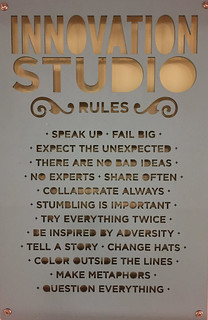
Innovation Studio rules

In 2018, I wrote a blog post that was really for my new student workers.  It was entitled "Building a Team." Honestly, putting something in writing to guide my new team in how to work with me was one of the smartest things I've done. And it is something that all teams should do, in some fashion.

Recently, Anthony Brooks-Williams wrote a post on Medium entitled "Want People to Understand How to Work With You? Write Them a Manual." If the idea of writing tips or a manual to help people understand how to best work with you is something you want to pursue, then the questions Brooks-Williams has in his article will help to guide you. Really, this could be the best thing you do, especially as your work transitions this year to whatever the "new normal" is.

Oh...let me say that in 2018 I gave that post to my student workers and it really did help guide us.  It also had us think about how to keep some conversations out of email. We adopted Slack for most of our communications and it worked really well. Besides in-between meeting communications, Slack was a great way of sending meeting reminders or sending a quick update when someone was running late.  Slack may not be the best tool for everyone, but it worked for us.

Finally, I've asked a few people some version of "how do you work" and it is a foreign question. However, if we really want to work together - and work together well - we need to be able to tell each other how we each work. Again, the questions Brooks-Williams asks can help all of us answer that.