Thursday, August 18, 2016

WLIC2016 : Privacy Law in the Digital Age: Governments rethink the meaning of information access policies

Roberta Shaffer (moderator) - we've come a long way historical. The right to privacy is not a new one.   The right of privacy is infused with many type of relations.  She questioned whether we can be forgotten, which is part of the right of privacy.  It may not be technically possible.

Dennis Hirsch - blending the European and American approaches
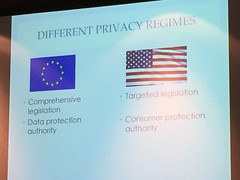
Different privacy regimes

In the US, privacy is often controlled by the Federal Trade Commission.

In Europe, the right to be forgotten.  In Europe, the right to be forgotten makes a lot of sense.  In the US, we see this as true information, which should be available.  He mentioned lawsuits in France and Italy, where the right to be forgotten or the right to privacy had been upheld.

Is US privacy law adequate when dealing with data sharing across country boundaries.  People in other countries are not covered by the Fourth Amendment:
The right of the people to be secure in their persons, houses, papers, and effects, against unreasonable searches and seizures, shall not be violated, and no Warrants shall issue,but upon probable cause, supported by Oath or affirmation, and particularly describing the place to be searched, and the persons or things to be seized.

This conflict is relevant outside of the US and Europe.  Many countries has adopted the European model.

How to think about this conflict?  One way of thinking about it in terms of economic competition.
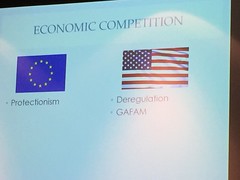
Economic competition

GAFAM = Google, Amazon, Facebook, Apple and Microsoft.

In Europe, the privacy regulations are seen as protectionism.

But the US and Europe have two different cultures of privacy.  Europe is focused on dignity, while the US is focused on liberty. 
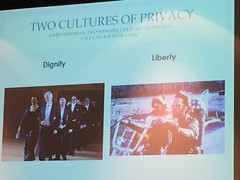
Two cultures of privacy

There is a long tradition in Europe of reputation and honor; your public face.  This was a right of the noble classes, which became a right of everyone.  It became a human right.  Each has a right to personal dignity. 

In the US, we got rid of the monarchy.  We believe that we have the right to make decisions free of state interference.  Our anxiety is that the government would get a hold of all of our private information.  We do not want an overbearing government in our private lives.

In the US, we don't want the government to limit what we can know.

How dose resolve the conflict over privacy?  Both come out of a western tradition.  Can we blend dignity with liberty?  Perhaps there is something in the Universal Declaration of Human Rights.

What about intellectual privacy? There is a book on that.

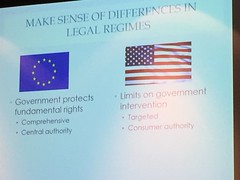
Make sense of differences in legal regimes

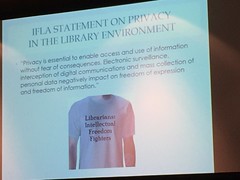
IFLA statement

Anne Klinefelter - Privacy law in the digital age: information access and the US law library

The privacy of library users is shrinking.  The private information of individuals, whom a library user might be researching, may be increasing.
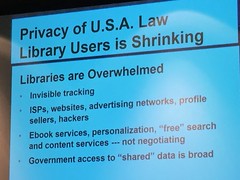
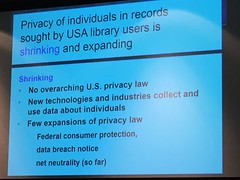
Privacy of USA Law Library Users is Shrinking

We want to increase the privacy of our users as well the privacy of the people on our content.  We want to increase access to content.  We want to limit surveillance, including watching what people are accessing.

Areas affecting privacy:
  • Privacy of law library users
  • Library laws and ethics
  • Attorney-client confidentiality
  • Judge/legislator traditions
In the US, privacy laws are at the state level.  Some were passed in the wake of the Freedom of Information Act.  Laws in 48 states, the District of Columbia, and attorney general opinions form the basis for this.

Some states have laws about digital book services.  There is a new law in Delaware, for example.

Legal research itself is part of the client-lawyer confidentiality.
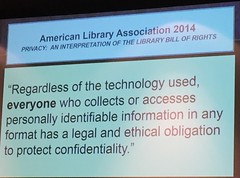
ALA and privacy

Privacy as shrinking

Data shared with any third party in the US can be monitored without a warrant.  There is a thin barrier between what Google knows and what the US government knows.  (The Third Party Doctrine)

There has been growth of data brokers, who combine information from across the web, and then sell the resultant information.  Data brokers may create discriminatory sounding categories, which can harm a person's dignity.
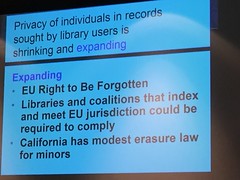
Privacy rights expanding
 

Adam Eisgrau - ALA Office of Government Relations

They address key library legislative issues with Congressional representatives.

What data does the US government get? They get it all.  He noted that USA PATRIOT Act and how much was lost in terms of civil liberties.  Librarians took exception to one section, which has become know as a library provision (the national security letter).  (Section 215)

Section 215 expired briefly and then was renewed by the USA Freedom Act on 2015.  This Act ended the bulk collection of the NSA, but requests can be made.  The gag order of Section 2015 now is subject to judicial review. 

The secret court rarely said "no" to requests.  Now advocates/watchdogs can be at the proceedings.

The cybersecurity Information Sharing Act now makes the NSA the collector of information, she something fishy happens,and that information is shared with other agencies.

The Electronic Communications Privacy Act - This act was passed in 1986 and it has not been amended since then.  In 1986, people dod not store long term.  If data is over 180 days old, a warrant is not needed.  There is activity in a congress to change this act, however, people are also looking to expand the PATRIOT Act.

What about encryption or digital "back doors"? This is a huge debate currently in the US.  People want stronger encryption. The government wants to get around encryption.  Can the government compel a company to break encryption?  Will the government study this to death?

Student Privacy and FERPA - The real action around student privacy has been in the states. One of the leading states on this is California.  https://ferpasherpa.org
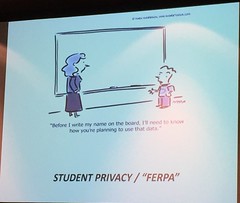
FERPA

He noted that the President in the US can issue an Executive Order, which can impact privacy.  He mentioned Rule 41, which is about hacking.

Resources:

Http://www.districtdispatch.org
Http://www.ala.org/ogr
Comment:

  • Hirsch - in the privacy of readers, dignity and liberty are combined.  When it comes to content, dignity and liberty are in conflict.  We need to find creative ways to synthesize liberty and dignity.
  • Eisgrau - expunging versus contextualizing.  What about providing more information in order to provide context?  Given our technology, is an expunging possible? 
  • Shaffer - there is a balance in people's minds between privacy and convenience.  In the US, we have felt that the government would protect our privacy.  However, security breaches in the US demonstrate that the Government is not protecting our privacy.  In Germany, they do not trust the government and felt that corporations would protect their privacy.  However, breaches show that corporations are not adequately protecting people's privacy.
  • Hirsch - privacy has political and cultural contexts in different countries. 

WLIC2016 : National Libraries and Digital Collaborations

All of these papers are available through the digital program on the IFLA web site.

Julia Brungs and Vincent Wintermans - Digitally reassembling scattered collections

Commons terminology:

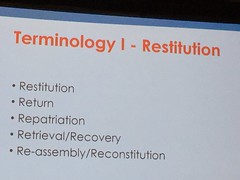
Restitution - Each term means something different.  Often used for physical materials.

Terminology - Restitution

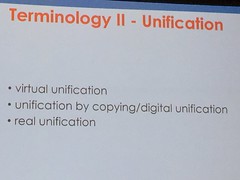
Unification - some of these terms are used with digital collections

Terminology - Unification

Digital unification - what role can IFLA play?
Yes, documentary heritage items are in countries or institutions different from the county of origin.

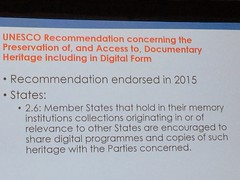
UNESCO recommendations


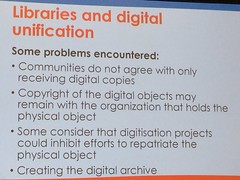
Libraries and digital unification

People are positive about the fact that this conversation is happening.
What should IFLA's role be in this? What role can each of us play?

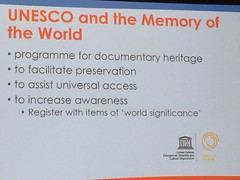
UNESCO and the Memory of the World:

UNESCO and Memory of the World>

Jaesun Lee - Digital Reunification of Dispersed Collections: National Library of Korea Digitization Project

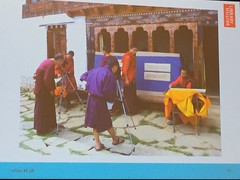
Over its history, Korea has been overtaken and people have immigrated to other countries.  Korea's cultural items became scattered across many countries. Korea is currently a divided country.
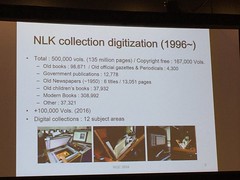
The National Library of Korea began in 1945.  It began digitizing in 1996.  (See photo below.) Digitization has helped the library save the content of items which were deteriorating.

NLK collection digitization

Digitization of rare books held abroad. There are five steps:
  • Planning: Target materials list preparation (photo)
  • Planning: Prior consultation at the working level - this is part of the selection prices
  • Visit / examination - this is also part of the selection process
  • MOU/agreement between NLK and partner institution (Memorandum of Understanding)
  • Digitization - both NLK and the partner institution play important roles
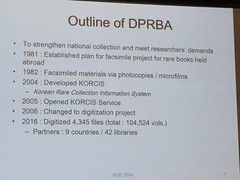
Outline of DPRBA>

#wlic2016

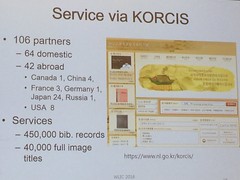
NLK is also collaborating with overseas Korean studies librarians, oversees Korean cultural heritage foundation, the a Cultural Heritage Administration, and others.  NLK is working with the Korean Association for the Preservation of Old Books.

She noted that many materials on Korea have been digitized by NARA in the United States, and which are available online. 

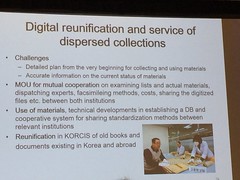
Digital reunification and services of dispersed collections

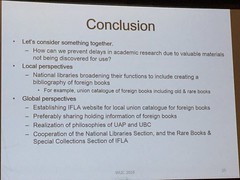
Conclusion

Driss Khrouz - Digital preservation and access on collaborative platforms
Please note that you can use Google Translate to obtain a translation of this paper. The paper is available on the IFLA web site.

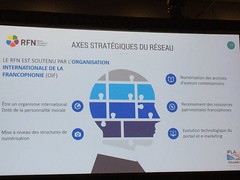
Why this project?  The answer can be found in a quote in the paper, where it is stated that the presence of the French language in the digital space is at stake.  This project has brought together people from 19 countries.  Please read the paper for information on it.
What is at stake, right now, is the presence of the French language the digital space. Tomorrow, which will not be digitized and made ​​accessible online risk to simply be overshadowed, if not forgotten. Now our community has large wealth sharing and to share. -  Abdou Diouf
Axes strategiques du Reseau

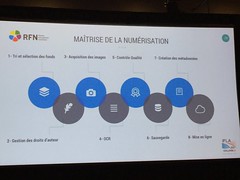
Maitrise de la numerisation

Caroline Brazier - Digital access and cooperation of shared collections: The British Library and its international collections

The British Library collections reflect global history, not just British history.

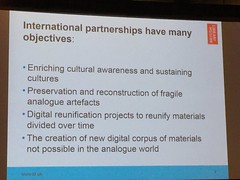
Objectives

Some collaborators are small scale, yet they can still have a large impact.  Some collaborative projects come out of support from philanthropic support provided to other national libraries.  She noted that sometimes the digitization project is part of a larger project.

The impact of mass digitization  project can take time to be realized.  As an example,she spoke about a digitization project of Hebrew manuscripts where a copy of the digital files will be given to a library in Israel.

One of their largest partnerships is with the Qatar National Library which is interested in materials on the Gulf region.  This partnership has included technical collaboration and the creation of school/academic materials.

Digitization allows access to be given to fragile items that are physically housed around the world.

They have also done 3D digitization/modeling which has allowed people then to engage in 3D printing.

She noted that they are entering into a partnership with the National Library of Korea, its newest partnership.  This will help to provide digital reunification of Korean materials held in the British Library.

They are part of the endangered archives program.  The physical items remain in situ.  A coy of the digital file is given to the owner of the physical item.  She noted that digitization does not need to use high tech setups.

You don't need a high-tech setup

Future priorities:
  • Shared priorities for mass digitization
  • Continually improve the service of discover, access, and reuse
  • Realize the full potential of digital research technologies (future proofing)

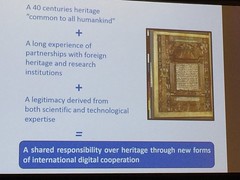
Isabelle Nyffenegger - A national library, a universal heritage
Again, you can use Google translate to read this paper (which is available on the IFLA web site), which is written in French.

A shared responsibility

Wednesday, August 17, 2016

WLIC2016 : Academic & Research Libraries Hot Topics

It was noted that this IFLA section puts its presentations on the IFLA web site.  You can go there for more information.

Lorcan Dempsey - A New Service Configuration
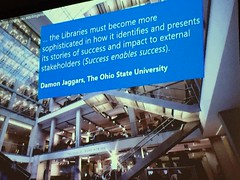
Telling a library story
The role of an academic library is to solve university-level problems.
We are now increasingly thinking about d library in the life of the user.  What does out constituency want to do?  How can we help them do that?
Collections -> network logic.  Facilitate - acquired, collaborative, external.
People -> partner and advocate. To be seen as an expert, your expertise has to be visible.
Systems -> managing workflows and relations.  CRM. digital scholarship, social.
Place -> configured around user experience.  This impacts our collections.

#wlic2016

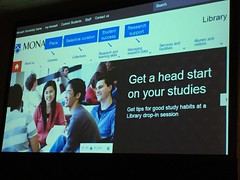
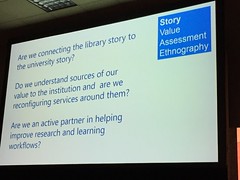
Most library web sites are focused on discovery and a few services.  Does the web site capture they value the library creates for its community?  The Monash University library web site is organized around four sources of value.

#wlic2016

We need to begin our discussion of value about what our sources of value are.  Yes, this plays into assessment.  We need to understand the life of our users, so we can place the library in their context (Ethnography).

#wlic2016Questions to ponder (see photo):

Uwe Resch - Libraries in a World of Cloudbased Services
Lessons and insights from the German project, a collaborative project.

The projects is based on two convictions.

 #wlic2016

There are preconditions for a new infrastructure.

Challenges: Data
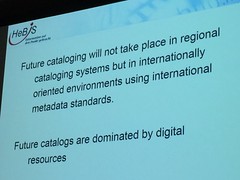
Local cataloging resources
Working on an integrated authority file and placing missing data in records.

Challenges: Data Privacy
Cloudbased systems evoke new problems in data privacy.
Serious concerns: access from outside the European Area of a Justice.
Technical support from outside the European Area of Justice should be possible.

Challenges: Partner Model
Need standardization of services in order to support a global partner model.  Services need to be integrated.

Challenges: Structure
Ways out of cataloguing silos?
Want to create a unified German data space.
Tried to sync data across platforms, but it didn't work.
Do not manage complexity, reduce it.
What about doing primary cataloging in WorldCat?
This would reduce complexity.  Needs enhancements in WorldCat.  Not everyone sees this as a a plus.
Need national data sovereignty in order to assure your ability to innovate.

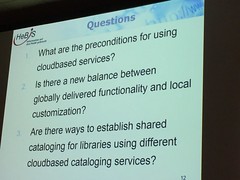
#wlic2016Questions to ponder (see photo):

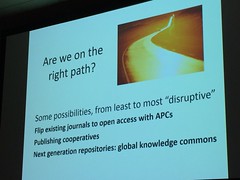
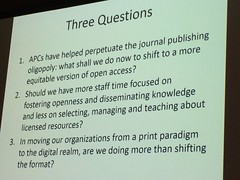
Martha Whitehead - Accessing information and disseminating research: are we on the right path?

#wlic2016

Retain our values: supporting local culture in a global knowledge commons.

Scholarly record for today and tomorrow
Open - science, government, education
Publications - they feel like ads for the research
Data - this and code are increasingly important as well as the publication itself
Code

Three broad ideas.

  #wlic2016

APC = article publishing charge

At each of our instructions?
Information resource digital strategies versus research collections
Portion of staff resources focused on research dissemination
Open access information literacy
Acting locally and advancing globally

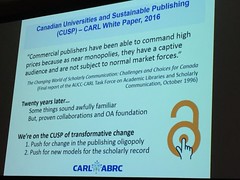
#wlic2016Questions to ponder (see photo):

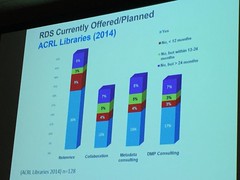
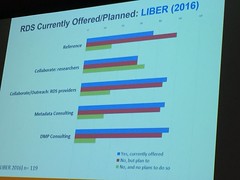
Susie Allard - Educating, coaching, mentoring, partnering: the role of research data services (RDS)  in the research enterprise

These are roles that are starting to play and which we will need to play into the future.

The data she is showing is about science and scientists. 

#wlic2016
#wlic2016

DMP = data management plans

Should we be part of the larger research enterprises?

#wlic2016Questions to ponder (see photo):

Table discussion: (9 people)
  • The questions posed to us can be divided into local and global.
  • The change to focusing on a domain.
  • The collaborative role of libraries in data management.  What does collaboration mean?
  • Some of these problems are not new.  The question is who is in charge?  Who will get us all on board?  We do not want data to be placed behind pay walls. 
  • Can we have more white papers on how data is being managed?
  • Metadata is a key area where librarians need to step up.  Some researchers are turning to the library for help with their metadata.
  • We need to have repositories data identified that will handle specific types of data. They then can create standards.
  • Workflow is the new content.  People will follow a convenient path.  Elsevier, through acquisitions, is trying to create end to end work flow that people will use and depend on.  Springer/Nature is working to compete with Elsevier. Whoever is managing the workflow will get the content.
  • Can we work with agencies to get them to require funded research projects to work with the library on keeping data?  Will agencies enforce the rules they have out into place?
  • Who will researchers listen to for advice?  Could the listen to other researchers who have had a positive experience with Elsevier, for example?
  • Is managing data the right thing for libraries to do?  A proactive question.
  • Teachers and policy makers want to have access to data.
  • Is this something that every library needs to do?  Perhaps a local library interfaces with the larger repository and assures compliance with/for local projects.
  • Should all data be kept? What is our collection policy? Some data may be test data and could be discarded.
  • It was noted that data may be reformatted when it enters a repository and placed in a standard format.  It is then not the original data.  It is not a backup of the original data. Provenance is very important.
  • Should / could a standards organization get involved?

WLIC2016 : David Ferriero, Archivist of the U.S.

David FerrieroDavid Ferriero spoke about open government from the local, national, and international perspective.

The National Archives (NARA) opened its doors in 1935.  It supports all three branches of the U.S. Government.  It has 33 facilities across the country.  It is an archive, library and museum combined.

The National Archives plans a role in the President's open government agenda.  Openness includes transparency.  Transparency also means that government does not have all of the answers.  Ferriero wants to tap the thoughts of those outside of government, because those people may have answers that the government needs.

Government information is published online.  Government information quality will be improved.  All agencies were asked to submit open government plans, including the Archives.  The Archives has created more than 140 commitments to open government.  It is now working on its fourth open government plan.  The draft plan has been published on github, where people can submit comments.

In March 2016, the Archives held an open government webinar.  There is also an open government blog.

Included in getting more people invoked is having user generated finding aids.

These plans must be made info a cohesive national plan.  It is this that can be a model for others.  More than 70 countries have made commitments to make their governments more open and accountable.

The last national action plan for the US was released in October  2015.

The five commitments of the US that the Archives claims ownership:
  • The use commits to improve the management of government records.  The is proper records management.  This includes digital records and email, as well as an improved
  • The US commits to improve the implementation of Freedom of Information Act (FOIA). The Act is 50 years old.  They want to explore technology to improve FOIA, improve proactive disclosure, improve tools for teaching about FOIA.
  • The US commits to improve the declassification process.  There is a national declassification center which is working with materials that are older than 25 years.  Democrats promises require that governments be transparent whenever possible.  They want to build automated
  • The US commits to the creation of a controlled unclassification information program. 
  • The Office of the Federal Register commits to the creation of a machine readable government organization chart across all federal agencies, including contact information.
Ferriero encourages more governments to embrace transparency, participation, and collaboration.  He also encourages IFLA participants to exchange information about their open government efforts.

Questions:
  • How does the Archives deal with web publications?
  • Are their initiatives to bring national archives together?  There is a group of international national archivists.  International Council of Archives - these are his peers.
  • How do we get people to use the information we have available so we vote smart? He is concerned about the disappearance of civics in K-12 education.  The Archives has a robust education program across the US as well as resources online.
  • Information on archiving web resources?  It is a huge concern.  They provide guidance and it is available online.  For example, they have to think about capturing original social media.  The biggest challenge is that nine years ago the National Archives wasn't doing much with social media.  They are catching up.  They need to be using the tools so they can learn how to access, appraise, and capture information from these sources.
  • How do they make declassification decisions? The first mandate was to review documents going back to World War I.  What was to remain classified were two areas around national security.  400 million pages reviewed.  The first staff created a process,which includes having the original classifieds review their work and try to make bulk decisions.
  • Can he speak more about the work they are doing with Wikipedia?  He is a huge supporter of Wikipedia and open encyclopedias.  Wikipedia affords us a why of connecting users with information.  At New York Public Library (NYPL), they would connect their collections to Wikipedia pages.  At the National Archives they have 4500 pages with heavy NARA content with 1.3 billion hits.  They host Wikipedia conferences and edit-athons.
  • What are the challenges and opportunities with physical objects versus digital objects?  Paper doesn't bother him.  He believes that they have it under control.  They will not accept any paper after 2019.  Then everything submitted to NARA will need to be digital.  He wants NARA to digitize everything they own, in order to increase access.  For people today, content must be online for it to "exist."  It is the digital stuff currently that scares him the most, due to the poor technology infrastructure in some agencies.  And in some agencies, the management of records was not a professional position but that has/is changing. They are working on raising the profile of records management in every government agency. 
  • IFLA is starting a digital humanities special interest group. Will NARA being connecting to digital humanities?  Ferriero knows of digital humanity scholars  who are using their connect.  They have not, yet done anything to coordinate working with digital humanities.
  • Question about the use of municipal data, open government data.  There is a project at Boston Public Library.  Ferriero would like to know more about projects like that.
  • How does NARA make itself known?  They are in 16 platforms. They do a lot of outreach.  They try to be creative.

Tuesday, August 16, 2016

WLIC2016 : IFLA Highlights Session

This was a fast-paced session.  I captured what I could.  Unfortunately, I did not capture the names of some of the speakers.

Highlights of the 2016 Conference - Pleased with all of the pre-conference activities.  The opening session was a highlight and a clear highlight was Wes Moore. Moore received a standing ovation.  Tomorrow David Ferrieo, Archivist of the US,  is speaking.  Tonight is the cultural event.  There are also library and sponsor visits on Friday.

Highlights of the IFLA Year - Donna Scheeder - four priorities: (more info on the IFLA web site)
Libraries and society - "literate, informed and participative societies".  Universal literacy.  Campaign for literacy within the UN 2030 agenda.  Provide tool kits for library advocacy at the national level.  It has been translated into several languages.  The booklet is available online.  The importance of information and communication technologies (ICT).

Information and knowledge - IFLA will be building a framework.  Noted the treaty of Marrakesh.  Without further action, information in the future is at risk.  Advocating for copyright exceptions and favorable policies for libraries.

Cultural heritage - Establishment of two new conservation centers.  Are working within the guidelines of UNESCO Persists.  Want to save cultural negotiate worldwide no matter its format.

Building compacity - Raise the voice of librarians at regional and national levels.  Advocacy.  Working to build strong library associations.  That workshop had 60 participants. 

Want to create a more connected IFLA.

#wlic2016A Vision for IFLA - Gerald Lietner
  • A strong IFLA is needed more than ever.
  • Global Vision: Local Impact
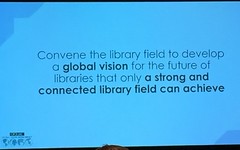
  • We need a global vision for libraries.  (See photo)
  • Will be convening regional meetings and workshops.
International Advocacy Programme-
Working with UNESCO is important.  We are able to get on their agenda.  Now we cannot stop. 
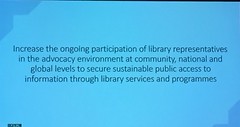
(see photo)

#wlic2016Activities:
  • Trainer development - deliver train the trainer meeting
  • Awareness raising and workplan development - deliver regional workshops
  • Identify and deliver activities
  • Undertake global review
  • Feed into Legacy planning
They have funding available for library associations to do work in their regions.  They also want to bring more representatives from the library community - including public libraries - at future UNESCO meetings.

President-Elect Theme - Librarians, the gears of the motors of change.

IFLA International Leaders Program -
There are 12 people gong through this program, which is geared to develop librarians as international leaders.  It is a two-year cohort.  This is an important initiative.  Want to continue to expand those who are representing us.  Want our leadership to mirror our membership.

IFLA Jay Jordan IFLA/OCLC Fellows - Skip Prichard
Early career fellowship.
Four week program at OCLC.
They spend time in libraries and other cultural heritage organization.
They attend leadership sessions.
The 2017 fellowship class was announced.  This will be the 17th class.  In total 85 librarians from 38 countries will have gone through the program.