Wednesday, August 17, 2016

WLIC2016 : Academic & Research Libraries Hot Topics

It was noted that this IFLA section puts its presentations on the IFLA web site.  You can go there for more information.

Lorcan Dempsey - A New Service Configuration
Telling a library story
The role of an academic library is to solve university-level problems.
We are now increasingly thinking about d library in the life of the user.  What does out constituency want to do?  How can we help them do that?
Collections -> network logic.  Facilitate - acquired, collaborative, external.
People -> partner and advocate. To be seen as an expert, your expertise has to be visible.
Systems -> managing workflows and relations.  CRM. digital scholarship, social.
Place -> configured around user experience.  This impacts our collections.
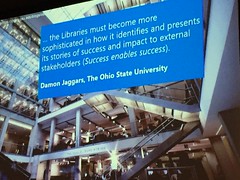
#wlic2016

Most library web sites are focused on discovery and a few services.  Does the web site capture they value the library creates for its community?  The Monash University library web site is organized around four sources of value.
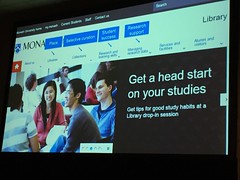
#wlic2016

We need to begin our discussion of value about what our sources of value are.  Yes, this plays into assessment.  We need to understand the life of our users, so we can place the library in their context (Ethnography).
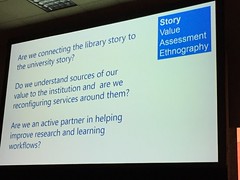
#wlic2016Questions to ponder (see photo):

Uwe Resch - Libraries in a World of Cloudbased Services
Lessons and insights from the German project, a collaborative project.

The projects is based on two convictions.
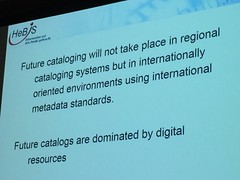
 #wlic2016

There are preconditions for a new infrastructure.

Challenges: Data
Local cataloging resources
Working on an integrated authority file and placing missing data in records.

Challenges: Data Privacy
Cloudbased systems evoke new problems in data privacy.
Serious concerns: access from outside the European Area of a Justice.
Technical support from outside the European Area of Justice should be possible.

Challenges: Partner Model
Need standardization of services in order to support a global partner model.  Services need to be integrated.

Challenges: Structure
Ways out of cataloguing silos?
Want to create a unified German data space.
Tried to sync data across platforms, but it didn't work.
Do not manage complexity, reduce it.
What about doing primary cataloging in WorldCat?
This would reduce complexity.  Needs enhancements in WorldCat.  Not everyone sees this as a a plus.
Need national data sovereignty in order to assure your ability to innovate.
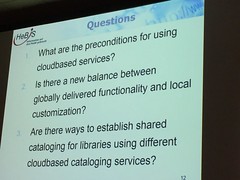
#wlic2016Questions to ponder (see photo):

Martha Whitehead - Accessing information and disseminating research: are we on the right path?
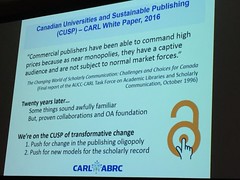
#wlic2016

Retain our values: supporting local culture in a global knowledge commons.

Scholarly record for today and tomorrow
Open - science, government, education
Publications - they feel like ads for the research
Data - this and code are increasingly important as well as the publication itself
Code

Three broad ideas.
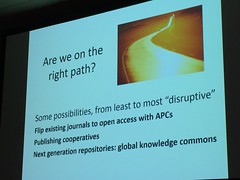
  #wlic2016

APC = article publishing charge

At each of our instructions?
Information resource digital strategies versus research collections
Portion of staff resources focused on research dissemination
Open access information literacy
Acting locally and advancing globally
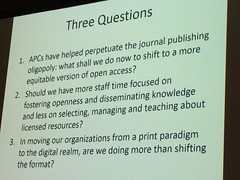
#wlic2016Questions to ponder (see photo):

Susie Allard - Educating, coaching, mentoring, partnering: the role of research data services (RDS)  in the research enterprise

These are roles that are starting to play and which we will need to play into the future.

The data she is showing is about science and scientists. 
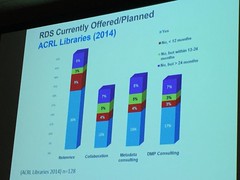
#wlic2016
#wlic2016

DMP = data management plans

Should we be part of the larger research enterprises?
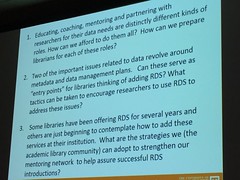
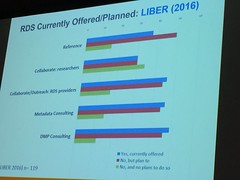
#wlic2016Questions to ponder (see photo):

Table discussion: (9 people)
  • The questions posed to us can be divided into local and global.
  • The change to focusing on a domain.
  • The collaborative role of libraries in data management.  What does collaboration mean?
  • Some of these problems are not new.  The question is who is in charge?  Who will get us all on board?  We do not want data to be placed behind pay walls. 
  • Can we have more white papers on how data is being managed?
  • Metadata is a key area where librarians need to step up.  Some researchers are turning to the library for help with their metadata.
  • We need to have repositories data identified that will handle specific types of data. They then can create standards.
  • Workflow is the new content.  People will follow a convenient path.  Elsevier, through acquisitions, is trying to create end to end work flow that people will use and depend on.  Springer/Nature is working to compete with Elsevier. Whoever is managing the workflow will get the content.
  • Can we work with agencies to get them to require funded research projects to work with the library on keeping data?  Will agencies enforce the rules they have out into place?
  • Who will researchers listen to for advice?  Could the listen to other researchers who have had a positive experience with Elsevier, for example?
  • Is managing data the right thing for libraries to do?  A proactive question.
  • Teachers and policy makers want to have access to data.
  • Is this something that every library needs to do?  Perhaps a local library interfaces with the larger repository and assures compliance with/for local projects.
  • Should all data be kept? What is our collection policy? Some data may be test data and could be discarded.
  • It was noted that data may be reformatted when it enters a repository and placed in a standard format.  It is then not the original data.  It is not a backup of the original data. Provenance is very important.
  • Should / could a standards organization get involved?

WLIC2016 : David Ferriero, Archivist of the U.S.

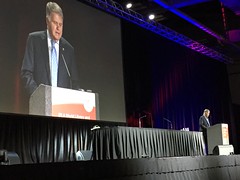
David FerrieroDavid Ferriero spoke about open government from the local, national, and international perspective.

The National Archives (NARA) opened its doors in 1935.  It supports all three branches of the U.S. Government.  It has 33 facilities across the country.  It is an archive, library and museum combined.

The National Archives plans a role in the President's open government agenda.  Openness includes transparency.  Transparency also means that government does not have all of the answers.  Ferriero wants to tap the thoughts of those outside of government, because those people may have answers that the government needs.

Government information is published online.  Government information quality will be improved.  All agencies were asked to submit open government plans, including the Archives.  The Archives has created more than 140 commitments to open government.  It is now working on its fourth open government plan.  The draft plan has been published on github, where people can submit comments.

In March 2016, the Archives held an open government webinar.  There is also an open government blog.

Included in getting more people invoked is having user generated finding aids.

These plans must be made info a cohesive national plan.  It is this that can be a model for others.  More than 70 countries have made commitments to make their governments more open and accountable.

The last national action plan for the US was released in October  2015.

The five commitments of the US that the Archives claims ownership:
  • The use commits to improve the management of government records.  The is proper records management.  This includes digital records and email, as well as an improved
  • The US commits to improve the implementation of Freedom of Information Act (FOIA). The Act is 50 years old.  They want to explore technology to improve FOIA, improve proactive disclosure, improve tools for teaching about FOIA.
  • The US commits to improve the declassification process.  There is a national declassification center which is working with materials that are older than 25 years.  Democrats promises require that governments be transparent whenever possible.  They want to build automated
  • The US commits to the creation of a controlled unclassification information program. 
  • The Office of the Federal Register commits to the creation of a machine readable government organization chart across all federal agencies, including contact information.
Ferriero encourages more governments to embrace transparency, participation, and collaboration.  He also encourages IFLA participants to exchange information about their open government efforts.

Questions:
  • How does the Archives deal with web publications?
  • Are their initiatives to bring national archives together?  There is a group of international national archivists.  International Council of Archives - these are his peers.
  • How do we get people to use the information we have available so we vote smart? He is concerned about the disappearance of civics in K-12 education.  The Archives has a robust education program across the US as well as resources online.
  • Information on archiving web resources?  It is a huge concern.  They provide guidance and it is available online.  For example, they have to think about capturing original social media.  The biggest challenge is that nine years ago the National Archives wasn't doing much with social media.  They are catching up.  They need to be using the tools so they can learn how to access, appraise, and capture information from these sources.
  • How do they make declassification decisions? The first mandate was to review documents going back to World War I.  What was to remain classified were two areas around national security.  400 million pages reviewed.  The first staff created a process,which includes having the original classifieds review their work and try to make bulk decisions.
  • Can he speak more about the work they are doing with Wikipedia?  He is a huge supporter of Wikipedia and open encyclopedias.  Wikipedia affords us a why of connecting users with information.  At New York Public Library (NYPL), they would connect their collections to Wikipedia pages.  At the National Archives they have 4500 pages with heavy NARA content with 1.3 billion hits.  They host Wikipedia conferences and edit-athons.
  • What are the challenges and opportunities with physical objects versus digital objects?  Paper doesn't bother him.  He believes that they have it under control.  They will not accept any paper after 2019.  Then everything submitted to NARA will need to be digital.  He wants NARA to digitize everything they own, in order to increase access.  For people today, content must be online for it to "exist."  It is the digital stuff currently that scares him the most, due to the poor technology infrastructure in some agencies.  And in some agencies, the management of records was not a professional position but that has/is changing. They are working on raising the profile of records management in every government agency. 
  • IFLA is starting a digital humanities special interest group. Will NARA being connecting to digital humanities?  Ferriero knows of digital humanity scholars  who are using their connect.  They have not, yet done anything to coordinate working with digital humanities.
  • Question about the use of municipal data, open government data.  There is a project at Boston Public Library.  Ferriero would like to know more about projects like that.
  • How does NARA make itself known?  They are in 16 platforms. They do a lot of outreach.  They try to be creative.

Tuesday, August 16, 2016

WLIC2016 : IFLA Highlights Session

This was a fast-paced session.  I captured what I could.  Unfortunately, I did not capture the names of some of the speakers.

Highlights of the 2016 Conference - Pleased with all of the pre-conference activities.  The opening session was a highlight and a clear highlight was Wes Moore. Moore received a standing ovation.  Tomorrow David Ferrieo, Archivist of the US,  is speaking.  Tonight is the cultural event.  There are also library and sponsor visits on Friday.

Highlights of the IFLA Year - Donna Scheeder - four priorities: (more info on the IFLA web site)
Libraries and society - "literate, informed and participative societies".  Universal literacy.  Campaign for literacy within the UN 2030 agenda.  Provide tool kits for library advocacy at the national level.  It has been translated into several languages.  The booklet is available online.  The importance of information and communication technologies (ICT).

Information and knowledge - IFLA will be building a framework.  Noted the treaty of Marrakesh.  Without further action, information in the future is at risk.  Advocating for copyright exceptions and favorable policies for libraries.

Cultural heritage - Establishment of two new conservation centers.  Are working within the guidelines of UNESCO Persists.  Want to save cultural negotiate worldwide no matter its format.

Building compacity - Raise the voice of librarians at regional and national levels.  Advocacy.  Working to build strong library associations.  That workshop had 60 participants. 

Want to create a more connected IFLA.

#wlic2016A Vision for IFLA - Gerald Lietner
  • A strong IFLA is needed more than ever.
  • Global Vision: Local Impact
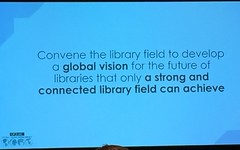
  • We need a global vision for libraries.  (See photo)
  • Will be convening regional meetings and workshops.
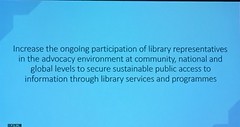
International Advocacy Programme-
Working with UNESCO is important.  We are able to get on their agenda.  Now we cannot stop. 
(see photo)

#wlic2016Activities:
  • Trainer development - deliver train the trainer meeting
  • Awareness raising and workplan development - deliver regional workshops
  • Identify and deliver activities
  • Undertake global review
  • Feed into Legacy planning
They have funding available for library associations to do work in their regions.  They also want to bring more representatives from the library community - including public libraries - at future UNESCO meetings.

President-Elect Theme - Librarians, the gears of the motors of change.

IFLA International Leaders Program -
There are 12 people gong through this program, which is geared to develop librarians as international leaders.  It is a two-year cohort.  This is an important initiative.  Want to continue to expand those who are representing us.  Want our leadership to mirror our membership.

IFLA Jay Jordan IFLA/OCLC Fellows - Skip Prichard
Early career fellowship.
Four week program at OCLC.
They spend time in libraries and other cultural heritage organization.
They attend leadership sessions.
The 2017 fellowship class was announced.  This will be the 17th class.  In total 85 librarians from 38 countries will have gone through the program. 

WLIC2016 : The Other Wes Moore: one name, two fates

Wes MooreWes Moore is from Baltimore, MD.  He began his talk with a story of how he became a reader.  He grew up a fan of the Michigan "fab five" basketball team.  His mother used the book about the team as a "carrot" to get him to read (and he read it in two days!).  She then got him more books about sports, which then grew into books on other topics and by a broader range of authors.  Moore grew to learn that we lived in an extraordinary world.

He wrote a book called "The Other Wes Moore."  What is inside a book is what the author wants to share.  What is on the outside of the book is what the publish wants to share, in order to get people to purchase the book.  It was the publisher who suggested the title.  He didn't like it, but recognized that there was a good reason for it. The focus of the title is on the word "other."  Our world is full of people who are considered "the other."

Moore - "Part of the beauty of your job [as a librarian]... is you create spaces where everyone knows they're welcome....you welcome them all."  "In your work, there is no others.  There's just the people you serve."

Prior to being a Rhodes scholar, he went through tough years after his father died.  As a teen, his mother sent him to a military school.  Being sent angered him and he tried multiple time to run away.  His mother told him that too many people had sacrificed for him to go to that school.  Moore realized that he had to be willing to be pushed (and to push) so he would succeed.  Moore finished high school there and went into the military.  He ended up going to Johns Hopkins University. 

Wes Moore told us the story of the other Wes Moore, of that Wes Moore's crime, and how he - the author - has come to know the Moore who is in prison.  He has come to know how that Wes Moore's fate was sealed long before the crime he committed.  He knows there is no single answer that will help all children. He knows, though, that raising children is complicated.  "Potential is universal.  Opportunity is not."

Education is what every child should do so that their future is as bright as it possibly can be. 

He believes in the importance of faith, family, policy and housing.  There is also the importance of expectations.  Are we products of our environments?  The other Wes Moore said that "we are products of our expectations."  The expectations that people have of themselves come from the expectations of others have of them.  Those expectations are internalized.

"Make sure that it mattered that you were ever even here." - wisdom from one of his military school teachers.  The future is not promised.  While we are here, let's make our time count. 

We librarians provide the tools of that can make great changes.  "There is no piece of military equipment that can combat a library."

"The world is bigger than what is directly in front of me."

"Your power...is that you control freedom more than anybody else...how does a person thinks about their own life...there is no institution that more controls that than you."

Monday, August 15, 2016

WLIC2016 : Library Engagement and Wikipedia

Natural allies growing access to the world's information together - Alex Stinson and Jake Orlowitz

We need each other.  People come to Wikipedia first and Wikipedia needs libraries to help ensure that it means the needs of our communities.

Jake began the Wikipedia libraries program in 2012.

Slides are at http://Goo.gl/DPDqUQ

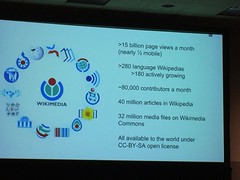
WikipediaWikipedia gets 15 billion page views per month.  Includes 280 languages. (See photo). Half of the page views per month are from mobile devices.  Approx. 80,000 contributors per month.

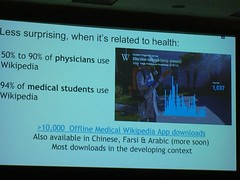
There are downloaded versions of Wikipedia for those without Internet access. Also used in K-12 settings.  There is a Wikipedia medical app for android devices.

Wikipedia runs on volunteers and references. 

They used the Wikipedia page on chicken eyeglasses as an example.  Yes, this is a real page.  In contains many footnotes.  Every citation needs to be verified.  All facts should be footnoted. References need to include offline materials.

Articles are generally written by white males from wealthier areas of the world, who understand how to do research. 

Wikipedia50-90% of physicians use Wikipedia.  (See photo). 94% of medical students use Wikipedia. They report using it as a starting point, which is perfect.  Some doctors, who said they don't use Wikipedia, did say they use it as a starting point.  Yes, doctors are contributing to it.

One problem they have on citations is the pay wall.  60 of the leading publishers in the world give Wikipedia IDs so that the editing community can improve the quality of Wikipedia.  There are checks and balances to help editors know when content is being changed and to note what may be incorrect.

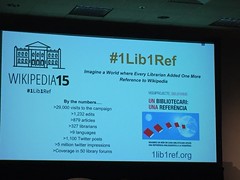
wikipedia#1lib1ref - trying to get librarians improving the references in Wikipedia. It will occur again in January 2017.

What are the opportunities for libraries to engage Wikipedia s part of improving access to the world's best information?

As students use Wikipedia, they need to learn how to evaluate it critically.  No source should be taken at face value.

Wikipedia + Public Libraries - Alex Stinson and Jake O.

Libraries are increasingly becoming the place where we document the local community.
Libraries are hosting events to document local culture.
Cultural heritage is being added to Wikimedia. 
Invite photographers to take photos of what is unique about your community.  Wiki loves monuments became the largest photography contest in the world.  Wikipedia is a repository for cultural heritage.

There are edit-athons.  For example, Art+Feminism.  Only 16% of biographies are on women. These edit-athons need to be multi-lingual and multi-cultural.  The community that has done this the best is the network of public libraries in Catalonia (Spain).

What if we trained all public librarians to edit Wikipedia and to engage others in this?

White paper at Http://goo.gl/cjF7H2

Wikipedia + Research and academic libraries - Vicki McDonald, New South Wales

They wanted to expose their content to a wider global audience.


She showed a page that they have worked on.  The number of references has pushed Wikipedia to change.  Up over 1000 references on one page!

They are getting 300K-600K page views per month.  They are getting page views in other versions of Wikipedia (non-English).  Their content on Wikipedia is getting many more page views than the content would get through their academic library.

They have been training other librarians in Australia to edit Wikipedia.  There is an ALIA training course. There is also a training manual developed by the State Library of Queensland.

One of the things they did was to create guidelines for staff, in terms of editing.

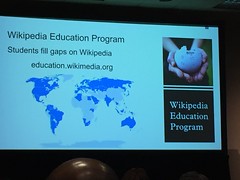
wikipediaWikipedia Education Program (See photo)
Wikipedia encourages students to do literature review. This gets students to write for the public.  There are 40-50 education programs at universities and in other arenas (e.g., senior citizens).

The paper is at Http://goo.gl/f0Fluc

Questions:
Link rot? This is a huge problem.  Approximately 25% of the citations are dead.  They have started a partnership with the Internet Archive.  They now have a bot to check to see if a reference is dead.  If it is, it checks the Internet Archive for a version of the citation.

How do we get faculty to accept Wikipedia?  Jimmy Wales said that if you're in college, you shouldn't get citing any encyclopedia.  However, we should acknowledge someone's honesty and then turn it into a teaching moment. As students edit Wikipedia, they get better at defending their use and talking to faculty about Wikipedia as a source.

There are journal articles on wikipedia's role in academia.

Wikipedia teaches students to question sources...all sources.

Question about access to references behind pay walls.  The most important thing for me is to get editors to have access to content, which then the editor can summarize.  Two initiatives they are working on are:
- connecting people to the source in their library. This is a complicated and thorny problem.
- working with an OA bot to search a page, which will check citations against open archives and add that link in the citation.  A green lock will signal that it is available in an open access site.

Noted that ISBNs in Wikipedia link to WorldCat.

They do have a bias toward open access, web sites and open newspapers.  People tend to cite what they can easily access.

Most of the media articles in Wikipedia are hard and not written at a sixth grade level. So?  They have a policy about avoiding jargon, but hard to enforce.  Wikipedia is a heavily cited medical resource.  They now that much of their technical content is too advanced.

Content in different languages may not be the same on the same topic.  How does Wikipedia promote other interpretations?  This is complex.

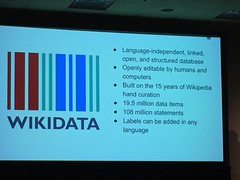
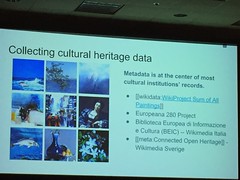
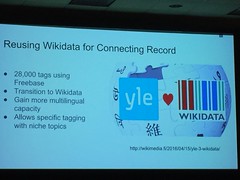
There are 285 wikipedias. Each language community is autonomously organized. In order to make information better across languages is to improve search and to have a language independent link, open and structure database.  (See photos)

#wlic2016 #wlic2016 #wlic2016

Bilingual editors are their most valuable editors, because they can be a go-between between two articles on the same topic.

They do want cultural independence for language communities.

Ethical issues in using Wikipedia - editing Wikipedia - as part of their jobs?  Conflict of interest.  It can be important to have guidelines for staff that you can point to, if there is a question. One library is focused specifically on editing things related to their collections, which may not be controversial.  Doing this rather than talking about their institution.

Wikipedia has loose rules, which you need to understand. 

Can library students get involved?  Yes.  They also notes that there is a internship program, including virtual opportunities.  Http://education.wikipedia.org

They noted that people need to be ready to stand up for the content that they have added.  People need to understand how to defend their content.