Showing posts sorted by relevance for query zeutschel. Sort by date Show all posts

Thursday, July 10, 2008

Anybody in U.S. using a Zeutschel 12000?

I've written about the Zeutschel machines before, now I have a question. Who in the U.S. has the Zeutschel 12000 book scanner installed? And can you talk about your experience with someone else? I've been contacted by a library that has one and would like to interact with another organization that has one, in order to share information. (Think of this as an informal user group meeting.) If you have a Zeutschel book scanner and are willing to talk to someone else who also has one, please email me at hurst {at} hurstassociates.com and I'll put you all in touch with each other.

Thank you!

Update, July 17, 2008: Thanks to those to responded to this "call". I received messages from several people (on two continents) and have placed them in contact with each other.


Technorati tags: ,

Thursday, May 24, 2007

Zeutschel book scanner and book copier

Announced earlier this month, the Zeutschel OS 12000 C is the book scanner and the Zeutschel OS 12000 is the book copier. Both use a book cradle and overhead scanning system. They are meant to be easy for anyone to use and seem to offer features to help those who are less skilled. Pricing is not publicly available, but I'm hearing that they are reasonably priced (considering how expensive a book scanner can be). The Crowley Company is carrying both machines in the U.S.


Technorati tag:

Monday, August 22, 2016

WLIC2016 : Digitization Vendors at IFLA

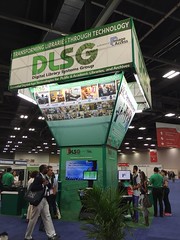
DLSG Booth
DLSG Booth
When I started this blog in 2004, digitization was a growing area in libraries. For some, it was still something new, while others had and were embarking on massive projects. New hardware and new projects/programs garnered attention. For me, Google Book Search ushered in a huge possibilities. Over the years, I've been heartened by the advances in technology, the breadth of projects (even digital collaborations like those discussed at WLIC), and the number of cultural heritage institutions that see digitization as part of what they do.

At the World Library and Information Congress, I was impressed with the number of digitization hardware vendors in the exhibit hall.  Among them were: (this list may not be complete)
For any librarian interested in digitization, this was a plum opportunity to talk with vendors and to look at hardware.  Yes, there was an impressive array of hardware on display for librarians from around the world.

In talking with a representative from one of the companies, we went over some of the acquisitions that have happened in the industry.  We also talked about where in the world the big scanners are being sold.  Not every institution can afford these large, expensive equipment but some institutions can put together programs that are large enough and funded well enough to afford a piece of equipment that costs over $100,000 (U.S.).

One positive that has happened over the years is that the technology is less expensive - more affordable - equipment has improved.  Look, for example, at the microfilm readers that are also scanners.  Look at the equipment meant for end-users (library users) which many institutions have been able to purchase.  Yes, even look at the equipment that many of us have at home. While these printer-scanners are not what a large digitization program would use, they put an ability into our hands that can be used to digitize materials and share them on a personal level.

Yes, this was an amazing opportunity for the librarians at WLIC and I hope some took the time to look, talk, ask for a demo, or obtain information to take back home.  Seeing this variety of hardware in one spot may not happen soon.

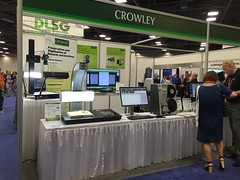
Crowley Booth at WLIC
Crowley Booth
#WLIC2016
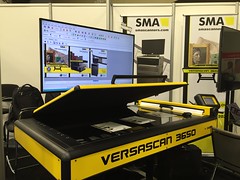
Versascan large format scanner

Friday, June 02, 2006

Long-term archiving of office documents

For many, storing data on microfilm is still the preferred method when archiving. But what about your electronic files (e.g., word processing files, spreadsheets, PDFs, etc.)? Last week, I learned of one piece of equipement that will take electronic files and write then to microfilm. The machine is the ArchiveWriter OP 500 manufactured by Zeutschel GmbH. The brochure says that it will preserve "all native digital data (CAD, e-Mail, Word, Excel, etc.) and digitized data (scanned documents, images, etc)." It can create up to 1200 images per hour in color.

I can see some institutions using this type of hardware because they recognize the need to keep some of their office documents long-term. They might try to compile the document by type, focus or subject so that similar information was stored together. I can really see this being used in industries that are heavily regulated and need to keep documents for government inspection.

It would be interesting to hear from record managers who might be using this type of equipment. How did they get started? How do they organize the files? Do they keep the electronic versions for access purposes and use the microfilm only as the archival version? (Well...that's the option I would take.)

Monday, March 13, 2006

Article: Checking Out the Machines Behind Book Digitization

If you have been reading this blog consistently, then you won't find anything that is new in this article about Kirtas, but some new information on 4DigitalBooks machines and a bit of who is using what (nothing shocking).

In talking about the Google Book Search, the University of Michigan said:
Some of the books are scanned onsite, with a nondestructive -- but non-robotic -- scanner from German company Zeutschel, or a flatbed scanner from Fujitsu that requires destroying the books' bindings. But most are sent offsite to Google for scanning, says John Wilkin, associate university librarian for library information technology and technical and access services.
4DigitalBooks now has a book scanner that will do 3000 pages per hour, making it the fastest book scanner (if that throughput holds true). The scanner costs $225,000. (Actually, I'm using the word scanning loosely, since 4DigitalBooks reportedly takes very high quality pictures of the pages, which is the same thing Kirtas does.)

4DigitalBooks will rent it equipment to a library and says that the cost per page (even if rented) can be as low as 4 cents/page. However, its equipment is large which can make it prohibitive if space is not available for it.

The article again says that Google is using a proprietary system (as is Amazon). I'm skeptical about that. Why would either company use proprietary systems given the technology that is available in the marketplace? Maybe they have added a proprietary twist to technology that is in the marketplace? Now that I might believe.


Technorati tags: ,