Tuesday, January 24, 2017

2017 EveryLibrary Area of Concern: First Sale, Copyright, and DMCA Reform

EveryLibrary logo
EveryLibrary, the nonprofit Political Action Committee chartered to work exclusively on local library ballot initiatives, has set its agenda for 2017.  On the agenda are 11 items including one on "First Sale, Copyright, and DMCA Reform."  EveryLibrary notes: (hotlinks added)
Libraries exist for two uniquely American reasons: The application of First Sale doctrine and tax policies that fund the common good. EveryLibrary is concerned that the rights of individuals and institutions to own, lend, and share what they buy are eroding and must be restored. Economic prosperity in our country depends on it. Because First Sale, copyright, and the rights of both content creators and content users in the digital area are key to thriving libraries, we will take the following actions in 2017:
EveryLibrary will educate and advocate for a digital first sale for libraries that will maintain the economy of purchases, but also emphasizes libraries’ mission to own, lend, share, and preserve digital materials.
We will join the fight to copyright changes under current law that would curtail libraries’ present exceptions to reproduction and distribution for purposes such as lending, interlibrary loan, preservation, scholarship, or research.
This is an area that is important to me and likely to you.  EveryLibrary hopes to engage allies in efforts to move its agenda forward. We could be allies. We can also be educators to help others understand why advocating for these two efforts is important.

Monday, January 23, 2017

Podcast: Eradicating Library Deserts

You've read my blog post on "Library Deserts," published on Jan. 16.  I'm grateful to the Beyond the Book for the interview they did with me on it.  If your interested, you can listen to the 14-minute interview, by playing it here.  Or you can read the transcript.

Friday, January 20, 2017

ALISE17 : Engaging Communities Through Research and Practice

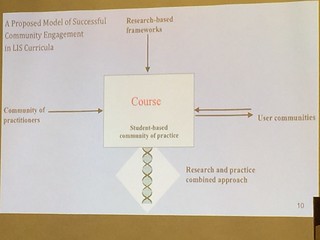
Community engagement in curricula.  Presenters: Kathleen Campana and Elizabeth Mills

How can libraries continue to built on their current community engagement efforts?
How can we prepare MLIS students to be a part of that engagement?

LIS educators need to:
  • Help students learn how to engage with user communities
  • Allow student to engage with a community of practitioners
  • ....and ...more
Classes at University of Washington:
  • LIS 571: Research in Action - which includes collecting, coding, and analyzing data
  • LIS 598: Community engagement strategies for libraries - including gathering data about the community and doing community discovery
  • LIS 567: Libraries as learning labs in a digital age - used research-based frameworks. Students had access to a community of practitioners.
One of the things these courses taught was the need for librarians to go out into the community, rather than waiting for the community to come to them.  Research-based frameworks made the interactions more structured and fruitful.

What they learned from those classes was used to develop the course LIS 564: Multicultural resources for youth. This class is focused on research through conversations with researchers and scholars.  Students had to create a diversity service project as part of the class.

Conclusion:

Untitled

Questions to ponder:
  • How do you use curricula to support MSLIS students' interactions, with other practitioners, user communities and community partners?
  • How do you bring the community into the MSLIS curricula to underscore the importance of emphasizing community focused thinking and planning when designing libraries' programs and services?
  • What other community engagement aspects are important for MSLIS curricula to emphasize?

Thursday, January 19, 2017

ALISE17 : Preparing MSLIS students for their career

ConfusedI attended a lively session on getting practitioner input on curriculum design.  What stood out to me is the continued need to:
  • Educate students about job opportunities for the MSLIS graduations.
  • Train students to dissect job advertisements so they know better how to position themselves to be seen as a top candidate.
  • Encourage students to take technology-focused classes.
  • Prompt students to have their resumes/CVs reviewed and commented on, so the students knows how to improve them.
  • Encourage students to expand and enhance their soft skills, which include communication, collaboration and leadership skills.
  • Listen to hiring managers and other members of the profession about what skills they want to see in job applicants (and new members of the profession), and use that information when modifying MSLIS classes.
  • Develop course assignments that allow students to develop and use the skills - even soft skills - that employers want.
  • Create ways for current students to network with and learn from members of the profession.
Some of this means getting students to recognize the important of an activity (e.g., developing soft skills), which likely also means getting them to acknowledge the real state of their own soft skills.  That will not be easy. (Trust me.)

ALISE17 : Juried Papers (session 4.3)

Jessica Hochman - #teachertweets: This is what democracy looks like
@jessicahochman @dorisasantoro @teachertweetspi
Where can teacher talk about their moral concerns?
Q: Who are your activist allies in your school?
A: They are all on Twitter.
How are teachers developing community on twitter, per John Dewey?
John Dewey's concept of community: homophily - people in communities share traits and values. Interact if egoistic and communal tweets make twitter interesting.  Importance of strong and weak ties.
Twitter as democratic space.  Twitter is social and user-driven.  It is a place of dialogue and connection.  Twitter can be a megaphone.
Teachers use twitter for professional development and to create personal learning networks (PLN). 

They have looked at 1.2 millions tweets to date. This study uses 550K.

Looked at words used and words not used.

They found five distinctive communities including:
  • Classroom as locus of control
  • Intersectional and instructional justice: a lens of race, class and gender
  • Civic and democratic justice
  • Communicative action

They looked at the network connections between different groups, and who the connectors were.  

What practices are people using to engage with others who do not have the same values.

Conclusions:
  • Teachers are creating demographic communities on twitter.
  • They are talking about their work and what it means to them.
  • They are using moral language.

Amy VanScoy - Listening to a diverse community to create an inclusive understanding of reference and information service

Librarians of color make up about 12% of the profession.  What is the experience of reference work for this community.  They did a small study with 8 participants with a variety of ethnic identities and library environments.  All had reference experience.
They used interpretive phenomenological analysis for their study.  Qualitative, exploratory. Interview-based methodology.
They both interviewed the participants and found it useful to have a multi-ethic team looking at the data.

Master Themes:
  • Uniqueness and difference - librarians of color saw this as a positive and negative (e.g., micro aggressions)
  • Broad range of professional skills - including counseling and listening 
  • Messiness and beauty of the human interaction - the emotions, challenges of communication, the beauty of relationships 
  • Complex job in a web of outside forces - trying to do the work in the web of outside forces, e.g., time, staffing challenges, etc.
  • Learning, growth and change - excited about learning through the work and also important professionally 
 To create an inclusive understand of RIS (reference and information service):
  • Role model, insiders counselor
  • Comfort and trust
  • User development as an information seeker
More information about this study at http://www.amyvanscoy.net/ivlc

They are interested in exploring this topic from the user perspective.

Noted that participants were not in a specific geographic area.

Kyle Jones - Learning analytics in the libraries and the emergence of professional ethics conflicts

Research with Dorothea Salo

What is learning analytics?  He used a definition from George Siemens (2012).

Why use learning analytics? Economic, political/academic,e.g.,increasing graduation rates.  There are goals for th students such as personalization, prediction, and intervention.

Learning analysitcs is a data driven practice.  Dataveillance on campus.  You look for relationships and patterns, and develop hypotheses.

Problem 1: the burden of surveillance
  • All students may be equally surveillance,
  • Some students may become the target of intense surveillance, e.g., student athletes.
Problem 2: the distribution of benefits
  • Whose interests are served and who benefits?
  • Benefits may not redound to students.
  • Benefits may not be distributed equally.
Problem 3: data politics
  • No data is raw.
  • Data empowers and disenfranchises
  • Data analytics is not a panacea
Problem 4: student privacy
  • Because we can doesn't mean we should
  • Privacy helps to build relationships
  • Privacy provides a space for making and learning from mistakes
  • Privacy is a condition that is necessary for intellectual freedom

A significant shift in library evaluation 
A shift from student experience to student achievement 
A move towards data scientism 

This means that libraries need to collect, store and analyze data.  Academic libraries are connecting their systems and data to the larger institutional repositories.

This could move us from anatomized data to data that is not, which allows for specific interventions. Do library specific interventions create more library usage that is impactful on the students?

There are important intersections with great ALA Code of Ethics: intellectual freedom and intellectual privacy.

Does this dataveillance live in harmony with our library ethics?  No.  We may see contexts/reasons that are allowing us to rational our use of dataveillance.