Showing posts with label Society. Show all posts

Monday, November 11, 2019

Random thoughts and examples: Creating accessible content

Not all disabilities are visible
As we all have, I am more aware of creating accessible content and also noticing when material I use is (or is not) accessible.  Accessibility assures that material is usable by all people.

While in Washington, DC, for the ALA Annual Conference, I went to the Starbucks near Gallaudet University.   Gallaudet describes itself as "the premier institution of learning, teaching and research for deaf and hard-of-hearing students."  Businesses near Gallaudet are more aware of the need to be accessible for all.  In the business district on H Street is the first signing Starbucks in the U.S.  "Signing" means that the preferred language in that Starbucks is American Sign Language (ASL).  The facility was built to be accessible for all, rather than being retrofitted.  It is a beautiful and peaceful (quiet) location, where all of the worker use ASL.  In this facility, accessible content is being created constantly as members of the deaf and hearing communities interact.

Question: When your create a new facility or remodel an existing facility, how committed are you to creating space that is truly accessible for all?

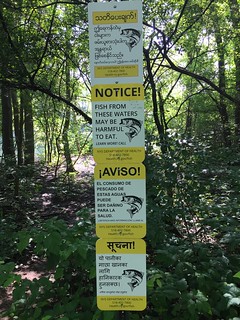
Fish from these waters may be harmful to ear
Accessibility is also something we need to consider, when we create signage. How many languages are spoken in your community? How many languages are your signs in?  While we acknowledge that many languages are spoken in our communities, we often only have signage in 1-2 languages.  (Can you guess which ones?)

I'm impressed with this sign in a park along Onondaga Lake, which is in English, Spanish, Burmese and Nepali.  Why? Because some people see the lake as a food source, but eating fish from this lake is not recommended. This sign to right is in four of the languages that are spoken in Syracuse.  I wish there was a visual representation of the message, which would be accessible to more people.

Question: Is your library's signage in language that your community members use?  Have you created frequently asked questions in multiple languages?  Is there a way for your website to be automatically translated into other languages?

Starbucks business card in English and Braille

Going back to Starbucks for a moment, here is the manager's business card in both English and Braille.  (Don't worry, there is no personal contact information on this card.)

Question: If you are interacting regularly with people who need your contact information in other languages or in a different format, have you create a business card for those situations?

Finally, I want to point out that Sabrina Unrein has written a white paper entitled “What Makes a Good Library Website?”   Sabrina is an MSLIS student at Syracuse University and is working working me as part of the iSchool Public Libraries Initiative.  Included in her white paper is information about web security and creating accessible content. 

Question: Have you reviewed your website and all of its content to assure that everyone can use it?  Is it accessible on mobile devices as well as screen readers?


Addendum (04/01/2021): If you are thinking about making your website more accessible, be sure to read this Overlay Fact Sheet.

Wednesday, May 23, 2018

Placing people in their own historical context

Between 1998-2000, I worked on a digitization demonstration project in Fairport, NY on women's suffrage.  The web site for Winning the Vote has changed since then, but it does still exist. What also still exists are the lessons I learned, and there is one that I want to talk about in a new context.
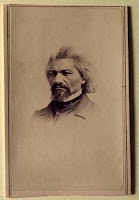
Carte de visite showing Frederick Douglass

Then...

For each suffragist profiled, we had a biography written.  As the project manager, I reviewed everything before it went online, including the biographies. As an African American, the biography of Frederick Douglass caused me to ask questions. The acceptable words used to describe an African American have changed drastically since the 1800s. While it is possible to write about Douglass without using any of them, what words should be used to describe his second wife, who was not a woman of color?  We all knew that detail needed to be stated, but what would be the correct words? I spent a long time asking people of their opinion.  I even asked the question on a couple email discussion lists. I didn't feel as if I received good answers and my choice - European American - was not yet a term that was widely used (and it still isn't).  Thankfully, our project historian located text of Douglass talking about his second wife and that text is how we talked about her.  He said:
No man, perhaps, had ever more offended popular prejudice than I had then lately done. I had married a wife. People who had remained silent over the unlawful relations of white slave masters with their colored slave women loudly condemned me for marrying a wife a few shades lighter than myself. They would have had no objection to my marrying a person much darker in complexion than myself, but to marry one much lighter, and of the complexion of my father rather than of that of my mother, was, in the popular eye, a shocking offense, and one for which I was to be ostracized by white and black alike. (Douglass, Life and Times… p. 534.)

Now...

Many weeks ago, I participated in a webinar where the first two speakers started their presentations by placing themselves in a theoretical or cultural context.  When it became my turn, I quickly did the same, although I had not planned on doing so. At this point, I don't remember what I said about myself, but it likely included that I come from a corporate background and that I'm originally from south-central Pennsylvania (and yes that does matter).  I believe the other two women included in their descriptions the theories they use for their mental models.

A few weeks ago, I was at a training session where we were asked to provide our preferred pronouns when we introduced ourselves.  This was not my first encounter with the need to do this, but the first time that one person's preferred pronouns (they/them/their) caused a bit of angst among a couple of the participants.

When we look at historical figures - those who are no longer living - we often have to put them in context, because they did not do that for themselves. Most did not publicly state what words they wanted used when describing them.  Nor did they state the framework they used when thinking about an issue.  We use whatever information we can find to try to build that context, knowing that it could be quite flawed.  A good example of this is Eleanor Roosevelt's relationship with two of her female friends.  People guess and speculate, but Roosevelt left nothing behind to put those friendships in a context, which answers the questions we have.

While we were fortunate with Winning the Vote to find text of Douglass talking about his second wife, we really don't know what words he or she (Helen Pitts Douglass) used to describe her ethnicity.  Now, however, we have an opportunity to build the context for a living individual whom we are adding to a repository (e.g., The History Makers).  What might we capture in text or metadata?  The first thoughts that come to my mind are:
  • How the person prefers to be addressed. This would include pronouns as well as  honorifics.  I think of Mrs. Medgar Evers (Myrlie Evers-Williams) who has spoken publicly on what it means to her when someone she does not know calls her first name.
  • Better information on the person's ethnicity.  With more people having their DNA tested, we should capture more than the category the person fits into for the Census.  Personally, my ethnicity is more complicated that I thought, based on my DNA results, yet I identify out of habit as being African American.
  • The words and phrases the person uses to describe himself/herself/themselves.  This might be how the person describes their work or personal life.  For example - and thinking of a family member - is the person an architect, artist, professor, or all three?
  • The person's gender, gender identity, and sexual orientation. While a person might not want to have this shared publicly, I would hope that the person would understand its usefulness, in terms of context, in the future.  I think of David Bowie, how he lived his life, and then the speculations which occurred after his death.
  • Information on what influenced the person.  This could be where the person grew up, what tradition the person was trained in, or something else.
Yes, that would be work and, yes, that would be helpful.  In 100 years, when the words we use to describe people have changed again, knowing how someone described themselves would solve a headache that I know will occur.

By the way, perhaps we each should get this started by writing this information for ourselves and placing it somewhere were it can be found (online or offline).


The photo is of a Carte de visite showing Frederick Douglass. This work is the collection of St. John Fisher College, Lavery Library.

Wednesday, February 01, 2017

The Five Stages of Grief and Information Literacy in the Streets

SculptureThis morning I read an email message from a friend, who said he was going through the five stages of grief (denial, anger, bargaining, depression and acceptance).  We don't go through those stages necessarily in order, and sometimes we loop back to a specific stage.  He noted that he was stuck on anger.

The last 12 days in the United States have put many people somewhere in those five stages, while others are experiencing joy.  If you look at any news web site, you'll see that people - who hold various points of view - are raising their voices, marching in the streets, and contacting their Congressional representatives.  While I'm heartened by all of this activity, I also realize that it is distracting from the normal work each of us needs to be doing.  Staying on task has gotten harder and I suspect that our national productivity has gone down.

One of the not-new tasks is information literacy training, which is becoming of greater importance.  Our need for accurate, verified and understandable information is crucial.  We as information professionals can be beacons of information for those around us both physically and virtually.  We know how to find the explanations that people need, in order to make sense of the actions happening around them. We can locate resources that people can rely on.  And we can not only find information, but we can also work as disseminators (keeping in mind copyright and Fair Use). Of course, we can also teach others how to find this information for themselves.

We are indeed living in an "interesting" time.  Yes, I am distracted, but I will also work to keep blogging on copyright and digitization.  I promise.


Monday, January 23, 2017

Podcast: Eradicating Library Deserts

You've read my blog post on "Library Deserts," published on Jan. 16.  I'm grateful to the Beyond the Book for the interview they did with me on it.  If your interested, you can listen to the 14-minute interview, by playing it here.  Or you can read the transcript.

Monday, January 16, 2017

Library Deserts

Harold Washington Library Center
A November 2016 iSchool@Online post notes that the United States has 30.35 libraries per 100,000 residents. That statistic is based on data from OCLC and the World Bank. When I first read that, I thought it sounds like a lot of libraries, but the reality is that the U.S. ranks 62nd. (I'm shocked!) The top 20 on the list is dominated by Eastern European and Scandinavian countries.

Ranked first, Slovakia has an estimated 5.5 million people and 7,551 total libraries:
There is 1 National Library, 8 scientific libraries, 33 academic libraries, 2,598 public libraries, 357 special libraries and 4,554 school libraries in Slovakia. (link)
Meanwhile, the United States has 325 million people (2016) and an estimated 119,487 libraries (2015).  While the math says nothing about access or if the person is closest to an appropriate library for the person's request, a library in Slovakia serves 728 people, while one library in the U.S. serves 2,719 people.1 [The iSchool@Online post stated 30.35 libraries per 100,000 residents which equals one library for every 3,295 people.  In my mind, not wildly different that using the ALA and U.S. Census data.]

More libraries in the U.S. than McDonald's Restaurants!  This is a statistic that gets tossed out because there seem to be many McDonald's.  Those modern or traditional golden arches are easy to spot and we often use them as landmarks when giving directions. You'll find a McDonald's in highly trafficked areas, with mini-locations in places like malls and airports.

The U.S, also has more libraries that the number towns and cities recognized by the U.S. Geological Survey (over 35,000).

Where are the libraries?  Often they are in the center of their town, village, campus or school. They may not be in high traffic areas and some aren't well served by public transportation.  Our libraries generally do not have flashy signage which beckon people towards them.  Rarely do you find branches in bus or train stations, or airports.  Yes, a few do exist in malls, but that is not the norm.  Yes, I recognize that libraries are not evenly distributed. 

My thought is that with a library in the U.S. for every 2,719 - 3,295 people, even if they are not in high traffic areas, libraries should stand out in our minds.  But do they? And are all of the people in a library's service area using the library? Yes, I've just stated a problem that we all know.  For me, the problem is made more real through statistics.  And sadder given our need for information literacy training, access to reliable, verifiable information, and safe space for all people.

This has also been made more real for me because in December, I joined the Board of Trustees of the Onondaga County Public Library (OCPL).  OCPL operates the Central Library and ten city libraries, and serves 21 independent libraries in suburban Onondaga County. With an estimated 468,500 residents, we have one public library for every 14,640 people. Yes, there are also school, academic, medical, law and other libraries.  While counting them makes the ratio better, not every library is open to everyone.  In addition, some special topic libraries (e.g., medical) may be difficult for someone to visit.  This is a fact not only in Onondaga County, but also in other parts of our world.  Not every library is open to everyone.  Sadly, there are areas of Onondaga County that are library deserts, meaning that there isn't an available library within a reasonable distance.
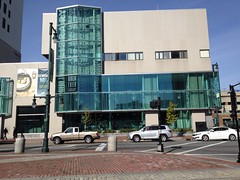
Portland (ME) Public Library
Public library in Portland, ME
Library deserts.  When I first looked at the infographic below, I thought about the strength of a country's education system or if cultural institutions - including libraries - were being destroyed due to conflicts.  I thought about the big picture, in terms of specific countries.  It was not until I sat with the data and looked at it differently that I thought about service areas and visibility.  I've spent some time thinking about towns I've driven through and realizing that their libraries blended in, unlike McDonalds.

In 2017, we have more people making decisions based on information that they do not understand and do not even know if it is accurate.  Libraries of all kinds need to make themselves better known and help people sift through fake news, verify details, and build knowledge.  Libraries need to find ways of bridging their deserts, perhaps by creating innovative information pathways.  Libraries need to create safe, multi-cultural, multi-lingual spaces.  (Our communities are multi-cultural and multi-lingual, so should our libraries be that too?)

The clock is ticking.  Let's get started.


The above infographic and data analysis was created by Syracuse University's School of Information Studies master of information management program. Thanks for prompting me to think about this!

1. Divide the population of Slovakia (5,500,000) by the number of libraries (7,551) equals one library for every 728 people.  In the U.S. (population of 325,000,000), there are 119,487 public libraries, or one library for every 2,719 people.  The iSchool@Online blog post stated 30.35 libraries for every 100,000 people in the U.S., or one library for every 3,295 people.

Friday, January 06, 2017

Article: The challenge facing libraries in an era of fake news

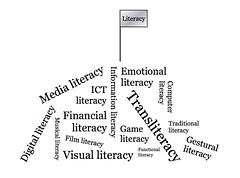
Literacy mountainInformation literacy is increasingly in the forefront of our conversations.  Among the articles on the topic is this one from Donald A. Barclay, who looks at the challenges facing libraries.  I think this quote gets at the heart of the challenge:
In such an environment, how is a librarian or faculty member supposed to respond to a bright student who sincerely asks, “How can you say that a blog post attacking GMO food is less credible than some journal article supporting the safety of GMO food? What if the journal article’s research results were faked? Have the results been replicated? At the end of the day, aren’t facts a matter of context?”
The article is worth a read and I think you'll be intrigued by the scenario he opens with. 

Thanks to Chris Kenneally for pointing me toward this article!


Friday, December 30, 2016

Reflecting Diversity

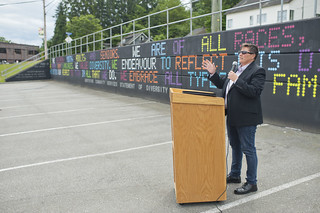
Diversity Mural unveiling 2012
Diversity Mural at the Univ. of the Fraser Valley
In many different ways, our world today has us focusing on diversity - racial, ethnic, gender, language, and geographic.  We have people talking about the benefits of diversity, as well as people who want uniformity. Uniformity is comfortable and easy. Diversity of thought and opinion, which can create innovation, comes as a natural outgrowth of having a diverse group of people.

I believe that diversity is important.  In my position as the director of an academic program, the question that I often ask myself is:
How do we demonstrate that we value diversity and that it is important?
Often you will find text on an organization's web site that talks about valuing diversity. This is especially true if the web site contains job announcements.  If you're like me, you will also look at the photographs an organization uses as a way of deciding if diversity is important to them.  If those organizations understand that diversity is important to us, they should try help us see them as valuing diversity in order to make their organizations more attractive to us.

It is then amazing to me that organizations - that want and need to attract a diverse group of people often in order to have a large pool of prospective customers - show themselves as not being diverse. Pick up a conference brochure, a trade magazine, or promotional literature.  Does it in some way show that the organization behind it values diversity?  If not, how does that make you feel about the organization? Or if yes, how does that make you feel?

The question then becomes how to communicate those feelings to the organization, especially if their text, photos, etc. show that diversity is not important to them. That is my dilemma. How do I tell an organization - especially a library organization - that in our current environment where some want uniformity, it should show that it values diversity and reflect that value in everything it does?  I had hoped that the correct words would have come to me in 2016.  The societal actions in 2016 make me hope that the right words do emerge in 2017.

Thursday, December 29, 2016

What color is your robot?

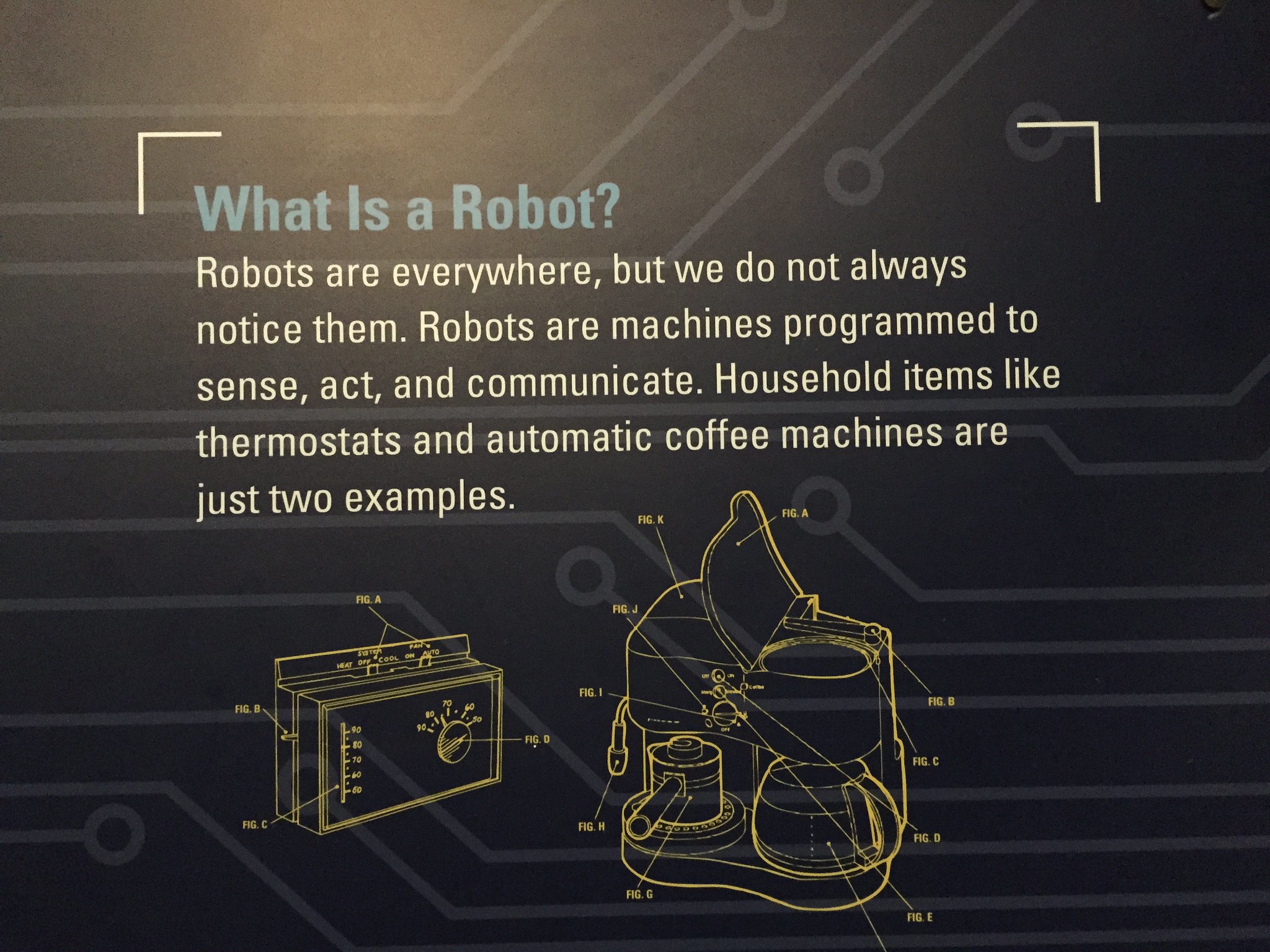
Definition of what a robot is
What is a robot?
Months ago - after the report was released about events in Ferguson (MO) and before the events in Baltimore (MD) - Paul Signorelli and I had a phone conversation about race and discrimination. As we often do, our conversation wandered and touched on several other topics and we somehow stumbled on the topic of robots.

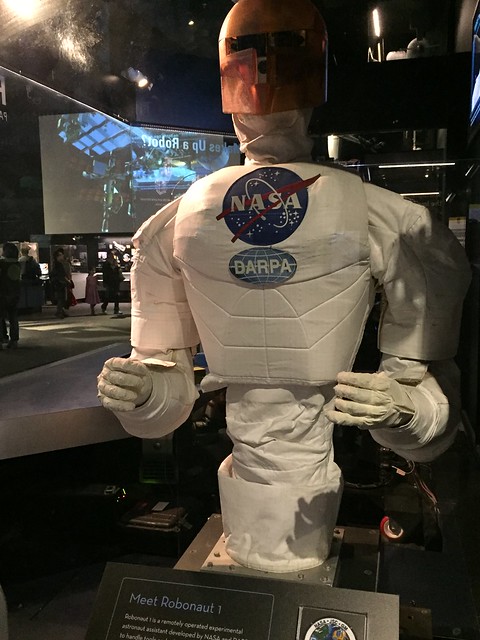
In science fiction, robots do take on humanoid form; however, the robots in our midst tend to be very machine-like.What if our robots could look like humans? What skin color would they have?

Robots
A robot
Perhaps the answer seems obvious to you. Perhaps the answer does not seem problematic. Perhaps it is because we have no robots among us that look like us.

Recent events in the United States demonstrate that we still have issues in our communities in relation to race and culture. A person's skin color can be interpreted by others as an indication of that person's value in the community or even value as a human being. Skin color can provide privilege or be a disadvantage.

What privileges do we want robots to have? How will those privileges be signaled?

Although I started this post months ago, it is still timely both because of racism in our world and because of our increased reliance on robots of all kinds. You might take a moment and think about what you want your robots to look like and, if human-looking, what color will they be?

If you haven't thought about racism, watch this video.