Tuesday, August 16, 2016

WLIC2016 : The Other Wes Moore: one name, two fates

Wes MooreWes Moore is from Baltimore, MD.  He began his talk with a story of how he became a reader.  He grew up a fan of the Michigan "fab five" basketball team.  His mother used the book about the team as a "carrot" to get him to read (and he read it in two days!).  She then got him more books about sports, which then grew into books on other topics and by a broader range of authors.  Moore grew to learn that we lived in an extraordinary world.

He wrote a book called "The Other Wes Moore."  What is inside a book is what the author wants to share.  What is on the outside of the book is what the publish wants to share, in order to get people to purchase the book.  It was the publisher who suggested the title.  He didn't like it, but recognized that there was a good reason for it. The focus of the title is on the word "other."  Our world is full of people who are considered "the other."

Moore - "Part of the beauty of your job [as a librarian]... is you create spaces where everyone knows they're welcome....you welcome them all."  "In your work, there is no others.  There's just the people you serve."

Prior to being a Rhodes scholar, he went through tough years after his father died.  As a teen, his mother sent him to a military school.  Being sent angered him and he tried multiple time to run away.  His mother told him that too many people had sacrificed for him to go to that school.  Moore realized that he had to be willing to be pushed (and to push) so he would succeed.  Moore finished high school there and went into the military.  He ended up going to Johns Hopkins University. 

Wes Moore told us the story of the other Wes Moore, of that Wes Moore's crime, and how he - the author - has come to know the Moore who is in prison.  He has come to know how that Wes Moore's fate was sealed long before the crime he committed.  He knows there is no single answer that will help all children. He knows, though, that raising children is complicated.  "Potential is universal.  Opportunity is not."

Education is what every child should do so that their future is as bright as it possibly can be. 

He believes in the importance of faith, family, policy and housing.  There is also the importance of expectations.  Are we products of our environments?  The other Wes Moore said that "we are products of our expectations."  The expectations that people have of themselves come from the expectations of others have of them.  Those expectations are internalized.

"Make sure that it mattered that you were ever even here." - wisdom from one of his military school teachers.  The future is not promised.  While we are here, let's make our time count. 

We librarians provide the tools of that can make great changes.  "There is no piece of military equipment that can combat a library."

"The world is bigger than what is directly in front of me."

"Your power...is that you control freedom more than anybody else...how does a person thinks about their own life...there is no institution that more controls that than you."

Monday, August 15, 2016

WLIC2016 : Library Engagement and Wikipedia

Natural allies growing access to the world's information together - Alex Stinson and Jake Orlowitz

We need each other.  People come to Wikipedia first and Wikipedia needs libraries to help ensure that it means the needs of our communities.

Jake began the Wikipedia libraries program in 2012.

Slides are at http://Goo.gl/DPDqUQ

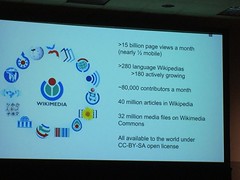
WikipediaWikipedia gets 15 billion page views per month.  Includes 280 languages. (See photo). Half of the page views per month are from mobile devices.  Approx. 80,000 contributors per month.

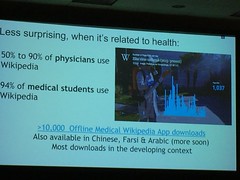
There are downloaded versions of Wikipedia for those without Internet access. Also used in K-12 settings.  There is a Wikipedia medical app for android devices.

Wikipedia runs on volunteers and references. 

They used the Wikipedia page on chicken eyeglasses as an example.  Yes, this is a real page.  In contains many footnotes.  Every citation needs to be verified.  All facts should be footnoted. References need to include offline materials.

Articles are generally written by white males from wealthier areas of the world, who understand how to do research. 

Wikipedia50-90% of physicians use Wikipedia.  (See photo). 94% of medical students use Wikipedia. They report using it as a starting point, which is perfect.  Some doctors, who said they don't use Wikipedia, did say they use it as a starting point.  Yes, doctors are contributing to it.

One problem they have on citations is the pay wall.  60 of the leading publishers in the world give Wikipedia IDs so that the editing community can improve the quality of Wikipedia.  There are checks and balances to help editors know when content is being changed and to note what may be incorrect.

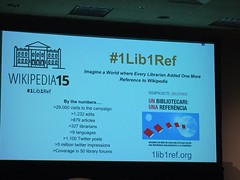
wikipedia#1lib1ref - trying to get librarians improving the references in Wikipedia. It will occur again in January 2017.

What are the opportunities for libraries to engage Wikipedia s part of improving access to the world's best information?

As students use Wikipedia, they need to learn how to evaluate it critically.  No source should be taken at face value.

Wikipedia + Public Libraries - Alex Stinson and Jake O.

Libraries are increasingly becoming the place where we document the local community.
Libraries are hosting events to document local culture.
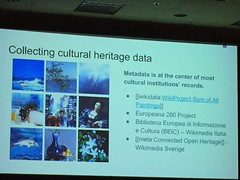
Cultural heritage is being added to Wikimedia. 
Invite photographers to take photos of what is unique about your community.  Wiki loves monuments became the largest photography contest in the world.  Wikipedia is a repository for cultural heritage.

There are edit-athons.  For example, Art+Feminism.  Only 16% of biographies are on women. These edit-athons need to be multi-lingual and multi-cultural.  The community that has done this the best is the network of public libraries in Catalonia (Spain).

What if we trained all public librarians to edit Wikipedia and to engage others in this?

White paper at Http://goo.gl/cjF7H2

Wikipedia + Research and academic libraries - Vicki McDonald, New South Wales

They wanted to expose their content to a wider global audience.


She showed a page that they have worked on.  The number of references has pushed Wikipedia to change.  Up over 1000 references on one page!

They are getting 300K-600K page views per month.  They are getting page views in other versions of Wikipedia (non-English).  Their content on Wikipedia is getting many more page views than the content would get through their academic library.

They have been training other librarians in Australia to edit Wikipedia.  There is an ALIA training course. There is also a training manual developed by the State Library of Queensland.

One of the things they did was to create guidelines for staff, in terms of editing.

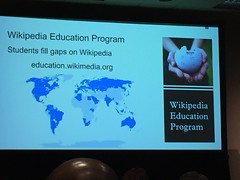
wikipediaWikipedia Education Program (See photo)
Wikipedia encourages students to do literature review. This gets students to write for the public.  There are 40-50 education programs at universities and in other arenas (e.g., senior citizens).

The paper is at Http://goo.gl/f0Fluc

Questions:
Link rot? This is a huge problem.  Approximately 25% of the citations are dead.  They have started a partnership with the Internet Archive.  They now have a bot to check to see if a reference is dead.  If it is, it checks the Internet Archive for a version of the citation.

How do we get faculty to accept Wikipedia?  Jimmy Wales said that if you're in college, you shouldn't get citing any encyclopedia.  However, we should acknowledge someone's honesty and then turn it into a teaching moment. As students edit Wikipedia, they get better at defending their use and talking to faculty about Wikipedia as a source.

There are journal articles on wikipedia's role in academia.

Wikipedia teaches students to question sources...all sources.

Question about access to references behind pay walls.  The most important thing for me is to get editors to have access to content, which then the editor can summarize.  Two initiatives they are working on are:
- connecting people to the source in their library. This is a complicated and thorny problem.
- working with an OA bot to search a page, which will check citations against open archives and add that link in the citation.  A green lock will signal that it is available in an open access site.

Noted that ISBNs in Wikipedia link to WorldCat.

They do have a bias toward open access, web sites and open newspapers.  People tend to cite what they can easily access.

Most of the media articles in Wikipedia are hard and not written at a sixth grade level. So?  They have a policy about avoiding jargon, but hard to enforce.  Wikipedia is a heavily cited medical resource.  They now that much of their technical content is too advanced.

Content in different languages may not be the same on the same topic.  How does Wikipedia promote other interpretations?  This is complex.

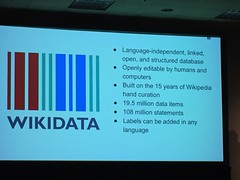
There are 285 wikipedias. Each language community is autonomously organized. In order to make information better across languages is to improve search and to have a language independent link, open and structure database.  (See photos)

#wlic2016 #wlic2016 #wlic2016

Bilingual editors are their most valuable editors, because they can be a go-between between two articles on the same topic.

They do want cultural independence for language communities.

Ethical issues in using Wikipedia - editing Wikipedia - as part of their jobs?  Conflict of interest.  It can be important to have guidelines for staff that you can point to, if there is a question. One library is focused specifically on editing things related to their collections, which may not be controversial.  Doing this rather than talking about their institution.

Wikipedia has loose rules, which you need to understand. 

Can library students get involved?  Yes.  They also notes that there is a internship program, including virtual opportunities.  Http://education.wikipedia.org

They noted that people need to be ready to stand up for the content that they have added.  People need to understand how to defend their content.

WLIC2016 : IFLA Presidents Session - Answering the Call to Action: How do we respond to the challenge presented in the IFLA Trend Report

The 2016 update is available on the IFLA web site.  There were five original trends, and they are trends that are still continuing.  Two of the speakers contributed to the report on those original trends.

Mark Surman - Mozilla Foundation - Libraries, Internet and Society

How the Internet is changing:
  • How it is being controlled by various empires.
  • With librarians, there is always of good chunk of people who were on the internet early in its development.
  • Anyone who can get an Internet connection can be a consumer and a creator.
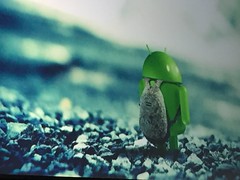
AndroidCell phones: android 58% / other 42%. (Note - In hindsight, not sure if the is US or global.)
There is competition among smart phones in the US and Europe, but android is more popular in other parts of the world.  In India, android 91%.

Major app producers are in specific areas of the world - North America, China, Japan and Europe.  Meaningful app economies in US and China.

Where is the Internet growing?  Smartphone growth is in South America, Africa and Southern Asia.  We're quickly moving to a small number of centers of power with the Internet. 

Quartz - "Millions of Facebook users have no idea they're using the Internet."  (2015)
Some people do not know what the Internet is or the diversity of apps that exist. Mathis means that they do not know what is imaginable. 

The growth of the open internet movement:
  • Part of Mozilla's mission is to "guard the open nature of the Internet."
  • We need to be vocal about this issue.
  • We should use the environment movement for clues to what we should be doing.  They have made the health of the planet a mainstream issue, everywhere.  Most countries now have environment regulations and a minister of the environment.  We are seeing people coming into the market with environment products, because this is a mainstream issue.
  • We need to make the health of the Internet a mainstream issue, everywhere.  This is a core social issue that impacts everything.
Issues:
  • Privacy and security
  • Decentralization
  • Open innovation
  • Digital inclusion
  • Web literacy
We must do work on this consistently and actively.  Look at the work that occurred with SOPA.

Being open source means also supporting hackers who build things and teachers who are digging into digital literacy.

Libraries and librarians are a critical part of this. 

The issue of copyright:
  • What is an example of an action?
  • Mozilla is focusing this year on copyright. 
  • Most of the copyright laws we have were written before the Internet.  Most of the laws don't make sense in this digital age.
  • There is an opportunity right now in the EU. They are rewriting the European copyright frameworks and it could be written to inhibit what we take as being normal on the Internet.
  • Now is the time to dig into specific issues.  It is also time to talk about how the laws don't current support how we live our lives a public citizens.
  • In Europe, for example, there is no protection for parody. 
  • Can we get a public conversation going?
Going to do a Maker Party this year to get people together to teach people about the Internet.  Want to make copyright the focus of it.  Part of it will be to get people to publish things that might start a larger conversation.  Contact Melissa Romaine, melissa@mozillafoundation.org if you want to get involved in the Maker Party.

Question: Information literacy versus digital literacy?  He sees it as a semantic debate.  He does have many opinions.  Web literacy includes read, write and participate.  They do have an advocacy agenda around this.  Yes he is willing to be flexible about language.

Comment: Ingenious groups need to be a part of this conversation because of differences in copyright and public access.   He agrees.

Fred Von Lohmann - Google - Copyright now and tomorrow

Why so much copyright?  Why do we talk about it so much?
Historically the obstacle to the mission of libraries has been technology and physics.  Today Thea has changed quite a bit.  Technology is no longer the chief obstacle, even though it is still an obstacle.  There are now obstacles that are latent and which were not as important before.

Copyright is standing at the center of information technologies.  In Europe, copyright is already part of larger conversations.

Copyright
  • Broad exclusive rights given the the copyright owner
  • Narrow, specific limitations and exceptions given to users
  • That made sense when copyright was about a few industries and a few commercial contexts. Copyright helped them organize their relationships to one another.
  • For most of history, the specific exceptions were enough.
  • Copyright historically had nothing to say to the individual library patron.
Is copyright still fit for purpose?  Does copyright make sense in the world of today, where everyone owns a "printing press?"  Copyright is with us even more because every digital device makes copies and transmitting them.  Copyright has a say in all of those activities.  Copyright also regulates all of the services that we take for granted.

In a world where every online interaction is governed by copyright, what comes next?  Can we change copyright to have a set of flexible limitations and exceptions?  He means an exceptions that is not predefined, but can change with technologies.  Librarians are part of a larger ecosystem and copyright needs to support that ecosystem.

Two principles for flexibilities:
  • Different purpose
  • No harm
Copyright should not apply when the use of the work is different than the original (transformative).  And it should not harm the original market.

Countries that have some thought around fair use including US, South Korea, Canada and Singapore.

Examples of Fair Use and flexibility:
  • Google Book Search
  • HathiTrust Digital Library
  • Work of the Internet Archive to make news broadcasts searchable and available
  • Machine Learning
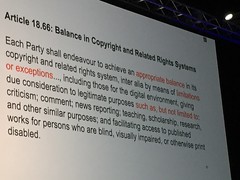
article 18.66 A flexible limitation is not about diminishing the market for publishers.  It is about finding those opportunities that are a new source of value.

An opportunity - the Trans-Pacific Partnership (TPP) which is a multi-lateral trade agreement.  He sees article 18.66 as a a step in the right direction, "Balance in Copyright and Related Rights Systems."  ( see photo). This creates a template and an opportunity to go to government officials and state that this is something that 12 leading countries agree to, and this is no longer an alien idea.  This is part of today's trade agenda.

An international discussion has begun and libraries must be a part of it in Australia, New Zealand, Singapore, South Africa, Japan, and in other places. 

He agrees that we must build a broad coalition/alliance.  We all know there is enormous new value available in these works.  We need to update copyright law to take advantage of new technologies and these new values.

He believes that policy makers may be ready to listen.

Question: How do we work with content creators who seem to believe that librarians are part of a network that flaunt copyright laws?  How do we improve our relationship with content creators?  Traditional publishers have had a difficult time understanding why the limitations and exceptions exist.  TV shows are recognizing the need for flexible exceptions.  Can others also loosen their grip on unlimited exclusive rights?  He sees that book publishers make be the last to get on board.  Start with the parts of the community that are amenable to copyright reform.

Comment: Australia is having success in getting people to think differently about copyright.  The squeaky wheel has been successful.

Jack Cushman - Harvard Innovation Lab - Chewing on Digital Objects

Book themselves are not an obvious technology.  It took 200 years before children's books began.  It was 400 years before public libraries began. 

We have new technologies now in our hands and we need to figure out how to build our civilization using them.

Some unusual projects:
If it's not broken, break it.
- PDF/A with an embedded animation, which will break as software changes.
If it is complicated, make it simple.
- Sheep coin
If it's boring make it weird.
- Case law limerick generator.

Perma.cc - why:
- link rot.  Digital objects do not stay published as the same way as books. Digital objects stay published as long as their owners are interested in them.  See http://ssnat.com 50% of links in Supreme Court decisions suffer from link rot.  70% of law reviews links have rotted.

Perma.cc allows you to create a copy of a web page that will not rot.  It has quickly Bren picked up a number of law school libraries.  65% of law schools are using it, and others including the Library of Congress.  Perma is built using a private LOCKSS network.

Power of libraries:
  • Distributed preservation
  • User education
  • Trust
They use a mixed funding model for their projects.  Perma has received some IMLS funding, once it demonstrated that it was successful.  Long term it may have some commercial users.

Perma relies on the safe harbor provision in US copyright law. 

Perma is about taking our "shelves" in the library and opening them up to the world.

The Caselaw Access Project:
Harvard has case law going back to before the US was founded.  10 million cases.
They do live in commercial databases, but they do not live in a form that is open.
They have been working with a company called Ravel, which is funding the scanning. They can scan 8000 pages per hour.  A vendor OCRs them (case XML).  500,000 pages per week.

Their funding model makes bulk data immediately available for academic research.
Free individual access through Ravel.
All restrictions lifted after eight years.
Public any court that publishes its prospective opinions online gets its retrospective cases released.
You need the same skills with these objects as you need with books - access, preservation, provenance, cataloging, versioning, research...

They have built a topic modeling tool that uses the case law. 
He has also experimented with word clouds focused on specific years and states.

H2O casebook publishing platform - how do we publish new things?  They are specifically working on textbooks and law books. At Harvard they are using some self-published case books which are printed on demand.

Each of the three projects above uses the unique skills of libraries in different ways.  Each is funded in a different way.  Each of these come out of a curiosity of what we can do together.

Maura Marx - IMLS -
Whoever wins our presidential election is coming into a time of turbulence in our society. We're experience this turbulence up close because of the cell phone videos that are being shared. Other countries are experience turbulence, too.  For example, look at the high number of refugees.

We in the US have been having more conversations around equity.  Equality does not mean equity. 

Example of activism - DERAIL - diversity, equity,race, accessibility, and identify in LIS

Activist librarianship - it is important that we define our activism.

Trends that she sees as activism:
1) New technologies with both expand and limit who has access to information.  For example, ebooks:
  • Copyright / licensing
  • Bandwidth
  • Devices
  • Wealth
She is excited about the open e-book initiative.  (OEB) It is an app that contains thousands of books that are available through adults for children.  Adults must request a code to unlike the library.  It includes:
  • Free unlimited simultaneous reads
  • No personal identifiable information is kept
  • Has great accessibility features
  • Supports IOS and Android devices.  Will be available  for chromebooks soon.
Specifically available for children in low income families.
IMLS funded the software for this.
We need to build library technology based on library principles.

10 publishers participated in this.  However, the content is not multicultural.  This is now a priority.

2) Online education with democratize and disrupt global learning.

3) The boundaries of privacy and data protection will be redefined.  The Internet is not distributed the way it used to be. 

4) Hyper-connected societies will listen to and empower new voices and groups.

The Mukurtu CMS for indigenous communities.  This honors other stands of privacy and power.
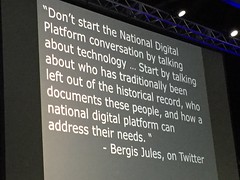
#Bergis JulesIMLS is challenged to bring more voices into the historical record.   (See photo). Are our collections a fair representation of our society?

Why are more people from different backgrounds not selecting the library profession?  We need diverse voices in our profession in order to ensure that diverse voices are listened to.

Exciting examples of embedded librarianship today - librarians and archivists.  Documenting the now is one such project.  It is a tool for collecting and saving Twitter messages. (DocNow) What are the ethical and social aspects of collecting social media?  What happens to original order when you're collecting tweets?

A People's Archive of Police Violence in Cleveland - This uses technology to go beyond disciplines and to facilitate conversations.  This archive is not part of a library, but does use software originally funded by IMLS.

Art+Feminism - a rhizome-tic campaign to improve coverage of women and the arts on Wikipedia. 

5) she feels that trend five acknowledges that things continue to change.  We need to push back against ignorance and systems of privilege.

Question: What is keeping them awake at night?
  • "Truthiness" - are we in a post-truth world?
  • How many children are being left out.  If children are behind by third grade, they will never catch up.
  • The future of the web.  In five years, could the web be to the Internet what Usenet is to the Internet?  Is the web becoming eclipsed by an app world?  We cannot take the web for granted.
Sunday, August 14, 2016

WLIC2016 : Copyright Matters! Libraries and National Copyright Reform Initiatives

This session had multiple presenters and a ton of content.  I types as fast as I could and also took photos when I knew I couldn't type fast enough. If something doesn't make sense, you may need to do a bit of research or contact the presenter for more information.  Honestly, some will likely make more sense, if you understand that nation's laws.  Every presenter did a good job laying out their country's copyright history, but each did it very quickly.

Limitations and Exceptions for Libraries: The WIPO Study - Kenny Crews

Why copyright?
The scope of copyright is tremendously broad and its lasts for many, many years.
The mission of libraries relates to the mission of copyright.
  • creation and dissemination on new creative works
  • preserve and provide access to the full range of information services
Many library activities overlap with copyright

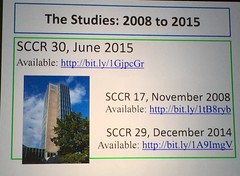
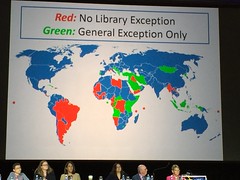
Three WIPO StudiesHe has done three studies for WIPO [World Intellectual Property Organization].  (See photo) 2015 was an examination of exceptions that are in the law which related to the Berne Convention [Three step test, article 9(2)]

188 member WIPO countries.  32 did not have specific library exceptions.  31 countries had general exceptions only, but not to specific activities.

Scope of exceptions:
    WIPO Countries
  • Preservation and replacement
  • Private study and research
  • Copy  machines  in the library
  • Limitations in remembers
  • Technological protection measures
Diversity of Exceptions:
  • Who - libraries, archives, museums?
  • What - published, unpublished? Articles, cull works?  Music, movies?
  • When - during the term of  copyright protection?  After?
  • Why - conditions and proof?
  • How - analog or digital?
In those countries where there are library exceptions, there is a lot of diversity to those exceptions. 

Crews noted that the British model of copyright has impacted countries that were British colonies, even after they stopped being a colony.  (The Imperial Statute Model)

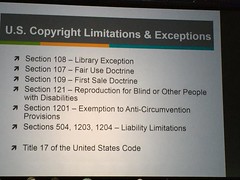
In the US, we will in gaps of Section 108 (library exceptions) with Section 107 (Fair Use).  Very few countries in the world have innovated their statutes related to library exceptions.

Innovations in Statutes: The European Union
  • Orphan works directive, 2012
  • Information society directive, 2001
Innovations in Statutes: United Kingdom
  • Expended provisions
  • Copies for research and study
  • Expanded technologies
Innovations in Statutes: Poland
  • Digital preservation of unpublished works
  • Digital access on dedicated terminals
  • Orphan works directive
  • MOU for out of commerce works (Memorandum of Understanding)
  • Quotation right
  • Incidental use
The challenge ahead:
  • Application to digital technologies
  • Expansion of library services
    • ILL
    • Services to the visually impaired
    • Mass Digitization for preservation
    • Relationship to licenses
    • Use of orphan works
  • First sale and digital exhaustion of rights
  • Cross-border delivery of works
The US Experience - Nancy Weiss, Executive Office of the [U.S.] President
The Statute of Anne (1710) - required delivery before publication of copies of books for the use of the Royal library, university libraries....

The public is the ultimate beneficiary of copyright law.
#WLIC2016List of exceptions (see photo)

How is the US government helping in this area?
Key court cases are impacting libraries
  • Kirtsaeng
  • Hathitrust
  • Georgia State
Congressional review of Copyright Law
- House Judiciary Committee
US Copyright Office policy studies
The Executive Branch is also involved in advising the President on copyright policy
- Marrakesh Treaty has been sent to the Senate for ratification
Commerce Internet Policy Task Force
- did not recommend extending first sale doctrine to digital works

Work being done:
  • IMLS Copyright Review  project at University of Michigan
  • Open educational resources
  • Open ebooks initiative
The Australian Experience - Jessica Coates
A snapshot of what's happening now.
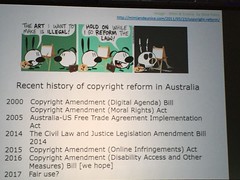
Recent history of copyright reformRecent history of copyright reform (See photo)

Copyright amendment - response to the Marrakesh Treaty
Improving access to materials for people with disabilities
Low hanging fruit (see photo) - not controversial
Ending perpetual copyright on unpublished works will - if passed - place millions of works in the public domain on the same day.  They drew attention to this problem by digital recipes, placing them online and asking people to cook them!  A radical act by librarians.

APA (Australian Publishers Association) and ALIA (Australian Library and Information Association) book cover agreement, August 1, 2016. Makes it easier for libraries to use book covers to promote books and authors. This was a cooperative approach and they hope to do more cooperation.

Their copyright act is over 700 pages.  41 minor amendments since 1996. Most exceptions are complex.  Exceptions needed because they do not have fair use.  They are in fair of expanding fair use.  She believes they are closer than before of enacting something on fair use.

The Myanmar Experience - Ma Mya Oo
2015 - first democratic election after 50 years of military rule
New constitution, new courts, new trade agreements, new legislation

Current copyright law:
  • Copyright Law of 1914
  • Joined WIPO in 2001
  • Have no Berne convention and no WIPO Internet treaties
  • Have some regional and bilateral trade agreements
  • No explicit library exceptions
  • Fair dealing for private study, research, criticism, review
  • Copying for certain educational purposes
  • Terms of protection- life of the author plus 30 years
  • No protection for foreign works
A new law has been drafted and is now being reviewed.  It has not been submitted to Parliament.

The future includes:
  • Copyright education essential for librarians
  • Librarians need to be involved in policy-making
All libraries did not have access to the internet until 2013, however, the electricity supply is unreliable, which impacts libraries and their users.

The Polish Experience - Monika Mitera
She points their beginning with copyright law as being in the late 1400s.
Poland regained its independence in 1918. It's new copyright law was passed in 1926.

Copyright law of 1926
The core concept and basic assumptions shared with protection against unfair competition law.  Copyright as a single, comprehensive right.  Priority given to moral rights.

Poland had a positive impact on the Berne Convention.

The copyright law of 1952 was less friendly to authors.

Another copyright law replaced the 1952 version in 1994. Amended in 2002 and 2004.  The amendment of 2004 (I think) affects libraries.  Having had public consultations on copyright law since 2011.

Copyright act of 2015.  Law was passed on Sept. 11, 2015.  It still does not cover all libraries, since the wording is specific to education institutions. 

What is the definition of a "copy"?

She quickly went through a number of slides, including slides on orphan works. Is a good faith search for the rights holder the same as a diligent search?

WIPO Regional Meetings - Eve Woodberry
  • All issues discussed at the national level can impact WIPO.  Since 2003, they have been focused on issues related to libraries. 
  • We need to educate ourselves about copyright, then educate our governments and lobby our governments.
  • Finally, not everything is law or treaties.  Look to develop partnerships.
Question -  Is there a best model for copyright?  Crews, no.  There a good pieces in many legislation.  We all fall a little short on the new issues: mass digitization, data mining, orphan works.  We need to pick the best from many different countries.

Wednesday, August 10, 2016

Article: Carol Highsmith Sues Getty for $1 Billion But Can She Win?

Trading floor room of the Milwaukee Grain Exchange, Milwaukee, Wisconsin
Photo by Carol Highsmith
Likely you have heard that Carol Highsmith has filed a $1 billion lawsuit against Getty Images.  Highsmith's images are available through the Library of Congress with the rights advisory of:
No known restrictions on publication.
Art Law Journal has a fascinating article about this lawsuit, how it came about, and if the $1 billion is justified. Go ahead and read it. And then look at Highsmith's photos on the Library of Congress web site (and maybe use one).