Sunday, November 06, 2016

NYLA2016 : Dr. Daniel M. Russell - In the library of the future

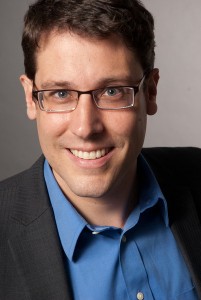
Photo from NIH Library of Dr. Daniel Russell
Photo from NIH Library
Dr. Daniel Russell works for Google.  He is a Senior Research Scientist focused on Search Quality and User Happiness.  He describes himself as a cyber-tribal-techno-cognitive-anthropologist.  He is both a research scientist and a software engineer.  His web site is https://sites.google.com/site/dmrussell   His presentation is available here.  His presentation went quickly, so the notes below are incomplete, but may provide information that you might not glean from the slides themselves.  .

He said that we adapt the technology we're using for whatever we're trying to find at the time.  That technology changes the way we think and how we interact with information.

Learning to use the tools, for example:
  • Using google translate in a novel setting
  • Finding help on academic assignments 
What do we need to know about finding information in the Internet age?

Students use google to answer simple questions.  More difficult questions go to the reference desk.

The card catalogue was a static index.  Indexes now are more flexible because  they are digital.

Knowing cultural convention genres/media helps you define the questions.  

We need to be able to find tools that help us define the question, e.g., Metadata EXIF viewers.

He noted that people need executive skills which will keep them on task, and not get distracted.

As searchers, we need to know what is possible.

Google has public data for use at http://www.google.com/publicdata/

Informacy:
  • The literacy of information
  • Knowing what the information is...
  • How to use and interact with the information 
  • Knowing how to use information in "hand to hand" combat

Finding text on a page is fundamental online reading skill.
  • Survey of 2225 US-English Internet users, 90.5% do not onion how to "find" on a page.
  • 51.1% of 545 US-English Internet using teachers do not know how to "find" on page.

Spoof sites, e.g., Pacific Northwest Tree Octopus.  Sadly students don't have enough life information to help them spot spoof sites.

We live in a time when extraordinary videos need extraordinary evidence.  We need to know if a video could be true.

Emoticons and abbreviations can get in the way of understanding the question or understanding the answer.

Google image search will allow you to upload an image and search using it.

We live in a world where content change, and can radically change quickly.

YouTube - every minute 200+ hours of video are uploaded.  3 billion videos are watched each day.  70% of the traffic is international.

1.8 papers are published in ~28,000 journals.  What percentage are vampire journals?

Where are you supposed to learn these literacy skills?

The underlying information space is growing. More answers are available.

The creation of time lapse videos made by taking many photos of the same location,   The photos are sorted by time before the video is made. Assembling the collocation on content.

Question everything and be curious.  Do one more search!  Many things are trivial to look them up, so do look them up!

We need to learning how to ask questions.  It has always been a skills.  Now it's a critical skill. 

Dig into who owns a web site. Check the address.  Who else uses that address?

There is a web site that allows you to clone an article and then alter the article.

We have vastly more content, but what is its quality?

Basic skills include:
  • Learn how to ask the right questions.
  • Know what tools are available.
Informate:
  • Understand space of information available
  • Can search effectively
  • Can understand how to interpret the results
How to become informate:
  • Take a class...continue to learn more
  • Become more aware
  • Subscribe to 
  • Understand
  • Play a serious game 
  • Teach a class
He has an a class online, Power Searching with Google.  Check his web site for other resources.   The site also contains a link to his blog.
NYLA2016
Dr. Russell's contact info

NYLA2016 : Garry Golden - Tap your inner futurist: Libraries and the future of sustainable communities

Photo of Garry Golden from his web site
Garry Golden
The keynote was given by Garry Golden, @garrygolden.  His presentation is available at  http://garrygolden.com/nyla2016 along with additional resources.   Below are my notes.

Foresight 101: Foresight is routed the studying social change. We associate thinking about the future with prediction. It is impossible to make predictive statements about the future. Rather futurists use a framework called the cone of plausibility. What is plausible? What are a set of scenarios? What signals of change then make one scenario more plausible than others?

Paying attention to the signals of change is the first task. Not being surprised by the future is your first measure of success.

"Everyday make an effort to move toward what I do not understand." - Yo-Yo Ma

The mechanisms of change to watch:
  • Trends - continuities - they give us our plausible futures 
  • Events - discontinuities - they give us our possibles futures. Events cannot be forecasted. 
  • Choices - discontinuities - they give us our preferred futures. 
Drivers of change for sustainable communities:

Demographic transitions
  • Aging populations is the most significant unprecedented change coming in the world. 
  • This is the biggest sustainable change in terms of demographics. 
  • Sustainability from a personal standpoint is going to include wearable technology. 
  • Wearables are compelling and creepy.
The demographic transition model
  • Some populations are starting to contract, meaning that they have fewer children than adults. 
  • The U.S. Demographic dividend - the impact of the baby boomers 
  • The challenge is the transition from the boomers to the millennial. 
  • Not enough Gen X for them to make a difference. 
  •  And the boomers are still working, so Gen Xers aren't getting the high paying jobs. 
  • Libraries need to take the demographics of their local communities and frame it as a story. 
  • Create a population pyramid (visualization).
What does sustainability mean for an aging population? It is about it a personal sense of resilience. What percentage of your population is aging?

Aging strategies:
  • Aging in place 
  • Active aging 
  • Creative aging 
Universal design: libraries and beyond
  • How do libraries need to design their services for an aging population?
  • MIT has developed a suit that allows you to understand what it like to experience a day as an older person.
Mobility: libraries and beyond
  • Equity and access 
  • Autonomous self driving cars could make a huge difference. 
  • Ollie has created an engaging people mover. 
Substance use disorders
  • Resilience and regeneration 
  • Versus the  "silent epidemic" 
  • Aging populations are particularly vulnerable to this.
Can/should the library be the first stop for aging services?
What does sustainability mean to millennial adults?

Libraries and the reframing of social justice issues: equality and equity
Everyone gets the same things versus everyone gets what they need.
How can we get millennials to see us (libraries) as partners?

Transforming energy:
  • Climate change has its own cone of plausibility. 
  • The Yale Climate Change Conversation Project
  • Policy changes everything in the energy world. 
  • New York has arguably the best framework for transforming energy use.  REV 2030. 
  • How do we integrate energy systems? 
  • Beyond solar: fuel cells as foundations for community micro grids. 
  • Can the library be the central power generator for a local micro grid?
Blockchain + trusted transactions:
  • Hard to describe. 
  • The Internet of trusted transactions. 
  • It rethinks transactions. 
  • It's just a decentralized database plus process automation. 
  • It is a way of verifying who owns what. 
  • It uses math to mediate transactions. 
  • There are public and private blockchain systems. 
  • Smart contracts disperse payments 
  • Distributed marketplace 
  • Peer to peer interactions 
  • A shared economy - the Napster for everything 
  • Dubai and the U.K. are leading the blockchain in the public sector.
Next steps:
  • Start conversations 
  • Ready for urgency graph 
  • Follow smart and informed people. 
  • Follow memes and events. 
  • Use killer questions. These are questions that people have to research in order to answer.

Wednesday, November 02, 2016

Podcast: Pallante Leaves the Copyright Office

Last Friday, Christopher Kenneally and Andrew Albanese discussed the recent news of Maria Pallante leaving the U.S. Copyright Office.  Given that a few days had passed since the news, Albanese provides a useful take on the situation.  You can listen it it here (14 minutes).

Friday, October 28, 2016

UNYOC - Jill Hurst-Wahl: Reach Out Across Your Organization with Information and Compassion

Shequaga Falls in Montour Falls, NYYesterday I had the pleasure of being one of the speakers at the Upstate New York and Ontario Chapter of the Medical Library Association (UNYOC) Annual Meeting in Watkins Glen, NY.  My talk was entitled "Reach Out Across Your Organization with Information and Compassion."   Over the course of an hour, I talked about:
  • Reaching out to our communities community and to meeting them - physically, mentally, emotionally - where they are...with emphasis on creative ways of being physically with them or in their space.
  • Seeing the human-ness of each person and serving the human-ness in each person.
  • Showing compassion and care for yourself, so that you can serve your community well.
In that last area, I provided five tips which I want to share with you. Those tips are (and I embellished on each in my talk):
  • Use an external brain.  If you decide to use paper or some digital device to help you keep track of your to-do's and other information, your brain will thank you.  And when your brain is happy, the rest of you will be happier.  It really is an act of self-care to give our brains some relief.  And rather than trying to remember a ga-zillion things, you can use that brain power on something else.
  • Seek clarity of purpose.  You might also use the word "goal." What is your purpose for today?  For this week?  For this year? When you're clear, everything else can fall into place.
  • Take a pause.  There is an old "B" movie called "The House of God" which is about a hospital.  In the movie, the young doctors are told to take their own pulse before taking the pulse of a patient.  Later there is a funny scene of them taking their pulse while standing around someone who is having a heart attack.  However, the idea is that they needed to know that they were okay and they needed to be calm.  You do that when you take a pause.
  • Find a partner.  Find someone whom you can confide in and you can give you advice about whatever.  It may be a friend or colleague.  It may be someone who is geographically far away.  It needs to be someone you can trust and who can keep your confidence.  And it needs to be someone who can be in it for the long haul.  That person can help you ground you, even when you're not sure where the ground is.
  • Create rituals.  Rituals calm us and create structure.  And I'm not just talking about religious rituals, but also rituals around how you start and end your day, or even how you prepare for a meeting.  Structure is actually freeing.  For example, the structure of a Japanese tea ceremony is meant to be relaxing.
I heard afterwards that those tips truly resonated with people, and I'm glad!  May the also resonate with you.

UNYOC - Elizabeth Stellrecht: Using Focus Groups to Make Effective Changes to a First-Year Evidence-Based Dentistry Course

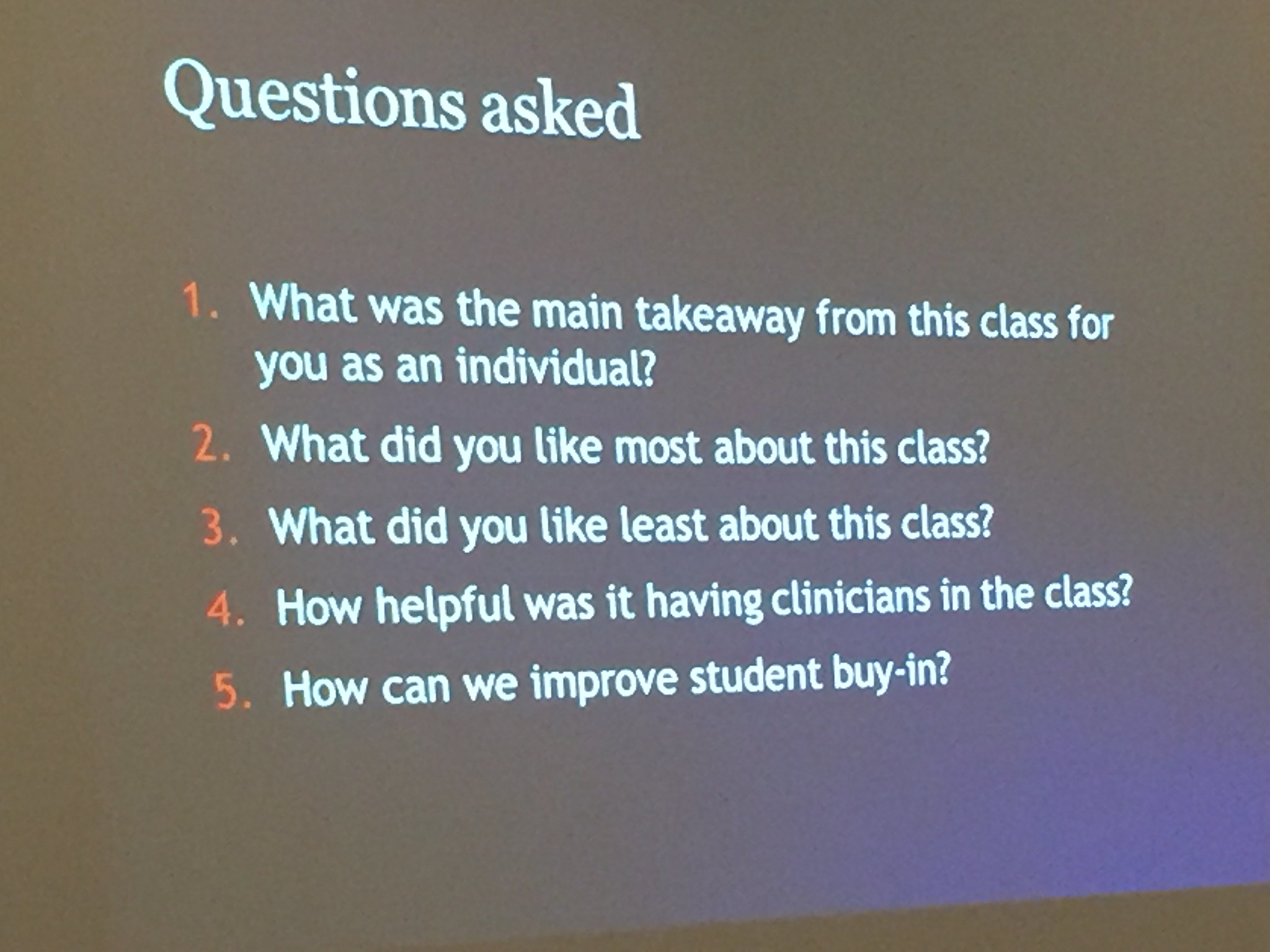
Focus group questionsElizabeth Stellrecht, who works at the University at Buffalo School of Dental Medicine, did a short presentation about a class she co-taught with Elaine Davis and how they used a focus group to gather feedback on it. That focus group occurred with students after the class was over.

The questions asked during the focus group were simple, yet provided valuable and actionable feedback. The questions were:
  • What was the main takeaway from this class for you as an individual?
  • What did you like most about the class?
  • What did you like the least about this class?
  • How helpful was it having clinicians [practitioners] in the class?
  • How can we improve student buy-in?
Clearly these are questions that could be used to help evaluate and improve any class.