Showing posts with label Syracuse University. Show all posts

Monday, February 18, 2019

Aritcle: Working To Give Libraries More Actionable Information | Peer to Peer Review

In December, I wrote here about the iSchool Public Libraries Initiative (IPLI), which I began earlier in 2018. On February 7, Library Journal published an article by me about the IPLI, with contributions by MSLIS student researchers Heather Elia, Georgia Westbrook, and Sabrina Unrein (Unmanaged Mischief on YouTube).  The LJ articles gives a peek into what we have been doing. 

In the coming weeks, we'll be building out our website, with the goal of placing the results of our work there.  Yes, we will also be using social media, and are deciding which social media platform will be the best. (We do not want to spread our social media efforts to thin.)  I encourage to bookmark our website and check it for updates. 

text reads iSchool Public Libraries Initiative

Wednesday, December 19, 2018

iSchool Public Libraries Initiative (IPLI)

Sometimes one forgets to share good news. As the saying goes, better late than never!  This announcement was originally posted on the SU iSchool web site on Nov. 9, 2018.


A new School of Information Studies (iSchool) initiative is serving as a discovery zone for public library innovation, a hub for student inquiry on librarianship topics, and a means to circulate new ideas and research findings to public library professionals.

The newly established “iSchool Public Libraries Initiative,” (IPLI) led by Associate Professor of Practice Jill Hurst-Wahl as director, has several key purposes. She says it creates an intellectual home for iSchool faculty and students who want to research public library topics and apply the knowledge they discover. Secondly, the initiative offers iSchool master’s-degree Library Information Science (MSLIS) students and others a faculty-supported research hub focused on topics in their field. In a third vein, students and faculty are helping public libraries build added capacity for innovation by sharing the information research projects uncover.
Jill Hurst-Wahl

Ideas Are Welcome

At a time when public libraries face mounting operational and community-support challenges, ideas on how to innovate new offerings are most welcome, according to Hurst-Wahl. “Public library staff often lack time and resources, and consequently they may make decisions with a limited amount of information. Many times, especially with smaller libraries, they don’t have the luxury of sitting around and doing deep thinking about what they can offer. I felt that a group of researchers could provide better information and distribute it so that it is available to libraries, providing information about projects and programs that are in use and that are successful.”
 
The initiative’s goals include:
  • Researching the state of public libraries and their communities, with a focus on information needed by decision-makers and advocates
  • Compiling and disseminating information about how libraries are innovating, helping them build their capacity to do so
  • Applying iSchool research (such as issues about information privacy and the use of technology in marginalized communities) to the public library setting
  • Developing white papers, trade and scholarly articles, webinars, and presentations on innovation for the public library community’s use
  • Offering classes and professional development programming for library staff, administration and trustees on various topics, including collecting and using data to support public library activities.


Student Projects Underway

Two iSchool MSLIS students are each working 20 hours a week there as research assistants through Wilhelm Library Leadership Award scholar funds, and they have several projects underway.

Heather Elia’s main focus is a national survey of innovative public library programs, especially those that don’t involve books and that are conducted outside of the library building. She’s scouring news articles, library newsletters, academic journals, conference agendas and other sources to source ideas that have been tried, tested and importantly, documented so that others can reproduce them.

Elia and first-year MSLIS student Sabrina Unrein also are working with EveryLibrary Institute, the non-profit research arm of the EveryLibrary, a national organization dedicated to building voter support for libraries. They have obtained information from state libraries and library associations across the United States about the array of legal (governance) structures public libraries use, and are producing a catalog of those models. That information will be used to help libraries understand which legal structures have more stable funding and better funding increases over time.

A third effort, now in the literature-review phase, looks at the creative ways libraries are supporting the health and wellness needs of their communities, from providing information to hiring nurses and social workers on the library staff. Unrein, who has experience as a web developer, also is designing content and a web presence for the initiative and looking at ways to distribute project findings.

The IPLI also has several other projects under consideration and is in discussion with potential collaborators.

Student-Led Agenda

Hurst-Wahl says the Initiative is designed to let students lead the research agenda. “I’m really empowering them to look at this as ‘our’ research and not just ‘my’ research, permitting them to tackle the subjects that are of interest to them, then having them figure out the ways they want to push out what they’re learning.”

Both Elia and Unrein are happy to be involved in the startup effort of the governance model project. “I would have expected something like this would have already existed, so it’s filling a big gap in resources,” Unrein reflects. “Anything to make public libraries better is a good thing. I’m looking forward to seeing what shape it takes because it’s so new, and it can go anywhere and that’s exciting.”

Elia says the initiative is widening her professional scope at a good time, just before she begins work in the library field. “I want to go into public librarianship. I think it’s important that there’s a way for public libraries to share with each other and I’m hoping that’s what this will be. Most people may only have opportunity to get to know one public library. With this initiative, we get to know a lot of different things about a lot of different libraries, and that’s only going to make the experience richer and give me a broader perspective.”

Tuesday, November 06, 2018

Lee Rainie and Trust, Facts, Democracy and Technology

Lee Rainie at Syracuse UniversityLast week, Lee Rainie - director, internet and technology, Pew Research Center - spoke several times at Syracuse University, including two public talks.  On Oct. 31, Rainie spoke on "Trust, Facts and Democracy: What the public is thinking in these tense times" (#TullyCenterRainie) and on Nov. 1 he spoke on the "Reckoning of Technology Companies."  As always, Rainie came loaded with facts, graphics, and stories.

There is much that I could write about what Rainie said, however, I encourage you to look at the research on the Pew website under "Internet & Technology".  There you will find publications, presentations, datasets and more.  What I do want to focus this post on is Rainie's response to a specific question.

Lee Rainie has been a frequent speaker at library conferences. With that in mind, I asked him a generic question about "access to information" and encourage him to take that question in any direction he wished.  Rainie listed off several things (not necessarily in order of importance):
  • People are turning to their mobile devices first for information.  Some of that information is being delivered with a geographic context to it.  In other words, you are receiving was is important to you in the geographic spot you're in.
  • People are relying on alerts to inform them of what is going on. Alerts are a big part of the systems we're now using.  Relying on alerts means that people are doing less browsing.
  • This is a rise in app usage (which goes along with the two points above), which also means that people trust apps. Trust was something Rainie returned to again and again in his presentations.
  • People are engaging in multi-screen experiences.  This might mean watching the news on one screen, for example, while surfing/searching on another in an effort to make sense of what is happening ("meaning making").
  • We're engaging in synthesized media experiences, which means that what we are receiving is being synthesized by someone or something.  "Someone" else is curating for us and deciding what we will see.
  • We are interacting with technology more by voice (voice interfaces). 
  • Print books - and to some extent print journals - have had a staying power that we did not anticipate. We assumed that digital books (ebooks) would become dominant, but that has not been the case.
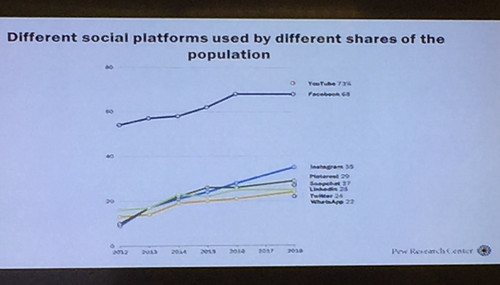
One of the take-aways from Rainie's talks was that which social media platforms we're using is changing.  Usage is different by age group and area of the world (e.g., WeChat).  Some platforms, which we think are heavily used, aren't as popular as we think (e.g., Twitter).  Pew is starting to collect data specifically on YouTube and we can see from this chart how popular it is (U.S. data). If we are trying to deliver a message that we want heard, we need to seriously think of which platform the "receivers" are using.  For example, young people are turning away from Facebook, so if we're trying to reach them, we need to go where they are now.

Lee Rainie

My apologies for not having a clearer image of this slide.

Wednesday, August 08, 2018

Building a Team

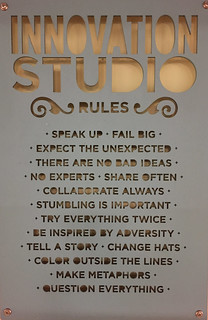
Innovation Studio rulesThis fall, I am embarking on research related to public libraries and am building a small (for now) research team (The iSchool Public Libraries Initiative). Often teams form quickly with no forethought in regards to team building and creating the best environment for thriving.  This team is still in its forming stages and I know it would be good to provide some foundation for it. Part of that foundation needs to be understanding what is important to each one of us and how we each normally work.  Rarely do we discuss our normal work habits or what habits we expect from others. And rarely do we share those tips or thought processes that led to our habits, or what we wish our habits were.

This blog post is my attempt to list those things that influence me, in terms of getting work done and interacting with others. Do I do all of these things perfectly?  No.  Do I do them all the time?  No.  But I aspire.  As my team comes together, I hope they will share what influences their work habits with me.  Just talking about it, I'm sure, will make us work better together.

By the way, I have slowly worked on this post for a couple of months as I have remembered, found, and pulled together resources.  I suspect that it still isn't complete.  If you were me, what would you add?  Please leave that information in a comment. Thanks!


Productivity


Personal Interactions


 Team Building

Monday, August 06, 2018

Updated! August - November 2018: Jill's Presentation and Travel Schedule

Breakfast of eggs, salmon and fruitThis is an updated list of my activities from August through November.  If you see something that interests you, please follow the link for more information.


Webinars

  • Sept. 4 & 5, 2:30 - 4:00 p.m. ET - Understanding and Defending Copyright in Your Library: An Introduction Workshop for ALA Editions.  This is a two-part webinar.  Additional information, including learning outcomes, is available on the ALA Editions website.
    Series Description: As a librarian, you are a defender of copyright and of proper and ethical access to information. In this two-part workshop, you’ll learn all about copyright, so you can help discern how your library and community can use print and digital materials within the confines of copyright law.
    Part 1: In the first 90-minute session, learn the basic rules of copyright law in ordinary terms and how to put its usage into context.
    Part 2: In part two, we’ll build upon part one and tackle two important areas crucial to libraries: Fair Use and e-books. Did you know there’s an actual test to determine if the use is fair? You’ll learn about that test and how e-books and other digital materials intersect with U.S. copyright law. Given that digital works are generally licensed and not sold, we’ll also look at how we can advocate on behalf of our libraries and community members.
  • Sept. 18, 10:30 - 11:30am ET - Assuring Library Materials Can Be Used by Your Community for PCI Webinars.
    Having materials in a library’s collection is good; having those materials in the formats needed by the library’s community is much better. The act of supplying content in the formats that community members require is critically important to meeting their information needs.
    This informative webinar will delve into ways of discerning the format needs of a community, including using the census and other data, along with existing reports, to discern the best way of provisioning material for the community.
  • Oct. 23, 10:30 - 11:30 a.m. ET - Moving Your Services into Your Community for PCI Webinars. (Registration is not yet open.)
    We’ve heard the refrains of eliminating the reference desk, embedded librarians, and the like. We also hear of the need to get out into our communities. Yet meeting our community members where they are – not where we are – is still a challenge. If we are free to move about our communities, and deliver services outside of the library, what might that look like? What innovative or imaginative twist can we use, which will spark the community’s attention and interaction? How can we assure that our efforts are accomplished in both safe and respectful ways?


Courses at Syracuse University

At Syracuse University, I will be teaching the following courses.  If space is available, non-matriculated students can enroll in them.
  • Management Principles for Information Professionals (IST 614) - Aug. 27 - Dec. 7 (on campus, graduate course)
    Basic ideas, concepts and perspectives of management as they apply to the information professions. Students learn to understand and apply basic principles of organization theory and behavior and managerial techniques needed to improve organizational effectiveness.
  • Copyright for Information Professionals (IST 735) - Aug. 27 - Dec. 7 (online - asynchronous, graduate course)
    Geared for library and information professionals, this course provides a firm foundation in the fundamental rules of American copyright law, and equips them with the tools to make informed decisions about copyright issues.
  •  Collection Development & Access (IST 635) - Sept. 28 - Dec. 19 (online - asynchronous and synchronous, graduate course)
    Advanced investigation of collection building, acquisition, and maintenance in libraries and information centers; user and collection analysis, collection development policies, digital resource acquisition and licensing, consortium collaboration, and ethical issues.
  • Syracuse Reads Program - Late September for five weeks (on-campus, freshmen, not open to others)[updated 11:10 a.m.]
  • This is part of an expanded first year experience for all incoming freshmen.  As part of this, all freshmen are reading and will be discussing Trevor Noah's book Born A Crime: Stories from a South African Childhood. This is a wonderful book, that is about a mother and son, race, identity, poverty, and more.  I'm thrilled to be one of the substitute discussion facilitators. 
Cafe au lait and Beignets at Cafe du Monde
Coffee and Beignets


Travel

In September, I will be representing the SU iSchool at the Joint Council of Librarians of Color Conference, Sept. 26-28, in Albuquerque, NM. Look for me at the Exhibit Hall at the SU booth. If you're at the conference, I hope you'll stop by.

I'll be attending the New York Library Association (NYLA) Annual Conference, Nov. 7-10, in Rochester, NY. I'm very excited about the location, which is relatively close to Syracuse.  Also the keynote speakers - a social worker who works in a library and someone who links patrons with community resources - seem very timely.  If you will be at the NYLA conference, let's find time for a cup of coffee.


The Great New York State Fair

Rooster at NYS FairEvery year, the Central New York Library Resources Council coordinates library workers to staff the New York State library booth at the New York State Fair in the Science and Industry Building.  This is fun, hot, tiring, and a great way to interact with people who are (or should be) using their local libraries.  Coming to the Fair? Stop by and talk to whomever is working.  (I'll be there on Aug. 23 in the afternoon.)

Wednesday, January 24, 2018

Webinar: Getting the Most Out of Your MSLIS Program

Graphic promotion of Nov. 15, 2017 webinar
In November 2017, I gave a webinar on how to get the most out of your MSLIS program.  After the webinar, one MSLIS student, Allison Keough, listened to it and create a blog post with all of the resources, etc., I had cited.  So if you are in an MSLIS program or considering entering an MSLIS program, this one-hour webinar recording and companion blog post have good information for you!

Webinar Description: 

In our November [2017] webinar, join Professor of Practice Jill Hurst-Wahl for advice on how to make the most out of your time in an LIS program. This webinar is for both current and future LIS students at any university.
Congratulations, you are now in a Master’s of Library and Information Science program and working quickly towards becoming a professional librarian.  The time you are spending in your MSLIS/MLIS/MLS program will go by quickly. What do you need to be doing to ensure that you get the most from it? 

This webinar will give you actions to take to position yourself for success in your program and afterwards as an LIS professional.  By the end of the webinar, you will have a series of tried and true steps on which to embark.

Monday, October 02, 2017

Fall 2017: Jill's Presentation and Travel Schedule

Cafe au lait and Beignets at Cafe du Monde
Coffee and Beignets
As we head into autumn, this is where my speaking and traveling schedule is taking me through the remainder of 2017.  As always, if you're in the same location as me, I hope you will say hello. If time permits, let's have a cup of coffee together!
  • Oct. 17 - Attending "NDP at 3: Envisioning the next 3 years of the National Digital Platform" hosted by IMLS, Arlington, VA. (Part of the IMLS Focus Series.)
    Description: As IMLS concludes its third year of NDP funding through the National Leadership Grants for Libraries Program and the Laura Bush 21st Century Librarian Program, we will revisit what has been accomplished so far and explore future directions for this work. Meeting attendees will include a broad range of representatives of the country’s libraries, museums, and affiliated organizations. We hope to capture input that will help us move forward together, and to highlight areas where federal investment can most effectively support broad access to digital materials for the American people. We aim to identify concrete insights, including priority areas for funding, topics for future research, opportunities for collaboration, and other tangible outcomes. 
  • Nov. 9-11, New York Library Association Annual Conference, Saratoga Springs, NY
    • Nov. 10, 11:00 a.m.-12:00 p.m. - Presenting "Recruit, Retain, Repeat...Again" with Barbara Stripling.
      Description: The number of school librarians available is not keeping pace with the need. Enrollment in graduate programs leading to school media certification has substantially declined over the last decade, but school library vacancies are abundant throughout NYS. During NYLA 2016, participants noted many barriers to recruiting prospective school librarians and suggested courses of action. This session will provide an update on efforts since then. Participants will brainstorm additional ideas that can be used to recruit school librarians. Participants will also discuss possible advocacy efforts which might have a positive impact on the pathways to certification.
    • Nov. 11, 9:30-10:30 a.m. - On a Women's Leadership Panel to discuss "Nevertheless, She Persisted" with Lauren Comito, Carol Anne Germain, Mary Fellows, and Sandra Michele Echols.
      Description: A forum for women in all areas of librarianship to discuss their experiences and challenges in the profession, and how to empower the next generation of female library leaders.
  • Nov. 15, 12:00 p.m. ET - Presenting "Getting the most out of your MSLIS program" (webinar) for the Syracuse University iSchool.
    Description: Congratulations, you are now in a Master’s of Library and Information Science program and working quickly towards becoming a professional librarian. The time you are spending in your MSLIS/MLIS/MLS program will go by quickly. What do you need to be doing to ensure that you get the most from it? This one-hour webinar will give you actions to take to position yourself for success in your program and afterward as an LIS professional. By the end of the webinar, you will have a series of tried and true steps on which to embark.
  • Dec. 6, 2:00 p.m. ET - Co-presenter of “Oops: Embracing Training Failures and Learning From Them” (webinar) for Southwest Florida Library Network. I'm pleased to be presenting with T is for Training colleagues Maurice Coleman and Paul Signorelli.
    Description: While every one of us who serves as a trainer-teacher-learner in our library settings dreads that moment when something goes wrong, we also know that what goes wrong often leads to something tremendously right: effective learning. In fact, we realize that failure is an integral part of the learning process. In this highly-interactive webinar focusing on the importance of “failure” in learning, the panelists will discuss real-world common and uncommon training mishaps and pitfalls; encourage participants to focus on what has come out of their own failures and those of their learners; and help participants walk away with concrete strategies to implement as they prepare their next learning sessions.

Saturday, September 30, 2017

You and the Internet of Things

 This fall, the SU iSchool has begun to offer Graduate Immersion Milestone Seminars. The first one is on the topic of "You and the Internet of Things."  Graduate students across the iSchool's graduate programs are in attendance, including MSLIS students.  

From my perspective, the the pros, cons and pitfalls of Internet of Things (IoT) is not a topic that is widely discussed in library circles.  Yes, we recognize that devices are capturing information, but:
  • Do we think deeply about what data is being captured by or in the library? 
  • Have we thought about how the Internet of Things can make libraries better?  
  • Have we thought about how the collected data is being stored and secured in the cloud?  
  • Have we thought about what could happen if our data is hacked?
The speakers this morning were not focused on libraries, but that doesn't mean we can't apply their topics to our library environment.  Below you'll see I've inserted some "library thinking" into my notes.  Please add comments if you have information to add or questions to ask.
 
Megan Snyder - Internet of Things and Cyber Security

Concerns:
"Things" can live long, software does not.
  • New vulnerabilities are addressed with new software
  • While you might replace your phone, for example, every two years, it will receive several software updates during that period.  Of course, people might not apply all of the updates, which could leave a security gap.
  • Imagine people being able to hack into a car or other things, which could be used to do harm
Things with sensitive data are connected
  • While you immediately think of banks, there are low tech devices which can capture sensitive data
  • Securing sensitive data
    • proactive ethical data stewardship
    • end to end security processes
    • innovate with new technologies 
Things are making decisions
  • Think about smart locks, smart homes, and smart grids
    • need built-in monitoring and then identifying of risks
  • There have been attacks on infrastructure worldwide, which was done by attacking the software
The future of securing IoT
  • Both customers and businesses need to focus on this
  • Need to look at the entire supply chain
While Snyder did not talk about libraries, consider that libraries are using software which is stored in the cloud or software as a service (SaaS).  That software could be storing information on library users/patrons, including private information such as books borrowed.  A security breach could make that information public.  Or a security breach could be used o alter the user data or alter the information on the library's collection.

Is the personal data stored in libraries a vulnerability that needs more attention?
  • Imagine a child changing his/her personal information so the person can check out adult books.
  • Imagine someone hacking an library system and wiping out fines.
  • Imagine a library's collection information being altered or deleted.
  • Imagine the software being delivered as SaaS being altered at the source, rendering all of its implementations useless.
Snyder noted that the U.S. Is behind in passing laws which would cause non-for-profits to pay attention to their cyber security concerns.

Radhika Garg (@gargradhika) - Does privacy disappear with IoT?

Are the implications that we as consumers are not aware of, in terms of cyber security?

IoT is not a single technology,  it is a combination of sensors, devices, networks, and software that work together to unlock valuable, actionable data.  If you are interacting with any part of that ecosystem, you should be concerned with cyber security. 

Garg asked if people use Dropbox and then asked if people know where the data is actually stored.  We use Dropbox to store a variety of different data, but we have no idea where that data really is and how it is being secured.

Data in the cloud can be used by the cloud service to learn about you, and then use that data, for example, to send you advertisements.

IoT dilemma - the information collected by sensors can be used for services that benefit and simplify people's lives, or it can be used for data mining and other use cases that raise security and privacy concerns.

Imagine the habits that your sensors know about you.

Garg noted that a sensor may only collect data, but then transmit the data to the cloud where it can be analyzed, shared, used, and abused.  Once the data is in the cloud, you have no idea what third parties that data might be shared with.

Although we do anonymize data, data gathered on a person from different sources may contain enough information to de-anonymize all of the data.

Can we collect less data?  Is there a minimal amount of data that is needed for a specific function?

While Garg talked about sensors, it occurred to me that video cameras in our cities and buildings are collecting our images.  Software can be used to identify people in those videos and it can be done automatically.  Software can also then track where people are traveling and when.  Imagine combining that information with sensor data, which could disclose more about your state/health when you were traveling through and between locations.

Garg noted that companies assume that people do not read privacy policies.  She also asked how are we expected to read the privacy policy on sensors, if sensors do not have screens?

Both Garg and Snyder noted that the privacy rules in the EU are better than in the U.S. The EU rules do affect U.S. residents because of U.S. companies doing business in Europe and needing to comply with EU policies.

In the U.S., state and federal laws are not harmonized on what is personal data.  We need to harmonize our laws in the U.S. and then harmonize our laws with the EU.

Next steps for organization in IoT ecosystem include:
  • privacy by design
  • privacy notice and transparency 
Garg ended by talking about the right to be forgotten, which has been written into EU law.

Kim Rose - How hospitals are embracing IoT

Rose talked about privacy legislation related to healthcare, such as the HITECH Act.

Medical devices inside the hospital
  • vital sign monitor
  • surgical procedures
  • intelligent bed
  • medical imaging
Outside the hospital
  • home sleep study
  • CPAP machine
  • cardiac monitor
  • diabetes blood sugar monitor
IoT has changed how medicine is being practiced.

Rose didn't connect her talk to libraries, but I can imagine a patient opting in to having their medical data shared with the hospital's medical library.  That would allow the library to deliver information to a patient which relates to the person's reason for being in the hospitals. Yes, that would raise huge privacy concerns.  Would the benefits outweigh the risks?

The talks this morning have made we wonder about cyber security, the Internet of Things (IoT), and libraries. Is this an area that we're really talking about?  Who are the library leaders in this space?  What conferences are talking about this?

On Twitter (#IoTSUiSchool), Jason Griffey said he is writing a library tech report right now on sensors.  It should be available late 2017 or early 2018.

Thursday, August 24, 2017

Personal: "Long Days Held Close to the Heart" & What's next for Jill

Three MSLIS students and Jill Hurst-Wahl
After five years, I have stepped down from being director of the MSLIS program at Syracuse University.  If you work in academia, then you'll recognize this as being quite normal.  If you're not in academia, let me tell you this is quite normal!  No one stays the director of a program forever. At some point, that person returns to being "just faculty."  I am making that transition joyfully!  In celebration of the change, I wrote an article for the iSchool blog and print publication entitled "Long Days Held Close to the Heart."  If you want to know more about what I've been doing, that will give you a peek. You might also read this post, which I wrote after my first semester as director.

So what's next for me, besides fewer emails and fewer meetings? 
  • My teaching load is lighter this year, in order to give me time and space to dig into my areas of interest.  However, teaching-wise I've been developing a graduate class title "Collection Development and Access", which I will teach in October and then April.  (This class had been irregularly taught in the past and will now be taught twice per year online in 11-week quarters.)  I've developed this class from scratch and have put more work into it then you can imagine!  
  • I have scheduled webinars and workshops beginning in December on a variety of topics including copyright, advocacy, providing services outside of the physical library, and training failures.  I am especially looking forward to the events on copyright, because I'll be speaking to library staff, who really need that knowledge.
  • I'll spend time doing things in the community, which I've not been able to do.  Last week, it was working a Multicultural Fair for children. This Sunday, it will be working the NYS Library Booth at the New York State Fair.  After that, who knows!
If you have been wanting to talk with me about a project idea or a workshop idea, and haven't done it, now is the time! Visit my web site and use any of those methods to contact me.

Thursday, June 26, 2014

Sit With Me Advocacy Campaign: Recognizing the value of women's technical contributions

Earlier this year, the Syracuse University iSchool recorded videos for the Sit With Me Advocacy Campaign and I was one of the women recorded.  The campaign as people to “sit to take a stand” and recognize the value of women’s technical contributions by sharing their own stories and thoughts. The campaign was launched by the National Center for Women in Information Technology (NCWIT).  Below is my video and two others from the iSchool.  You can view all of the videos here.


Yes, there is an unfortunate typo in my name within the video itself and it's not easy to fix. Honestly, my name is misspelled frequently, even by people who know me.  C'est la vie!  It does not change the message of the video.


Wednesday, December 18, 2013

Using Big Data for Library Advocacy (webinar recording)

Erin Bartolo
Yesterday, Dec. 17, Erin Bartolo and I did a one-hour webinar entitled "Using Big Data for Library Advocacy."  This webinar was based on the presentation that we did at the New York Library Association Annual Conference in September.   A recording of the sessions is available on this page, which also contains a link to our handout.  Since this was so what we did at NYLA, I'm placing below the slides from NYLA.


One question that we did not receive was about how libraries are currently using big data/data science. I know from the NMC webinar that we did that we don't have good library examples yet, because we (libraries/librarians) are just thinking about how to use data science in our work.  I expect that those examples will come, as we begin using big data to help us with assessment and advocacy.  For now, we need to talk about what is possible and get people interested in using these techniques, which are already widely used in business.

Wednesday, July 10, 2013

What I'm reading this summer

Often at conferences there is that "what are you reading?" moment, when people talk about what they are reading for work or for pleasure. (Beth Tribe is a good one for starting that conversation.) Since that conversation didn't happen at my conferences so far this year, I thought I'd start the conversation here.  This is what's on my table or device this summer...

First, Dave Lankes has created a MOOC (massive open online course) on new librarianship that opened on July 8 and I'm one of the instructors. (Details) The book being used for the MOOC is Expect More: Demanding Better Libraries For Today's Complex World, which is available in digital and paper formats.  This is a very readable book geared primarily for library supporters and the communities that libraries serve.  Library staff, who read it, should recognize the challenge that they are being given.  That challenge?  Meet the expectations of your communities, because they expect more than what you are likely offering.

To go along with  Expect More, I've also got Dave's The Atlas of New Librarianship  in front of me.  I'm not reading it from cover to cover, but doing as many others have...referring to it as we talk about "new librarianship."  [BTW Ruth Kneale and I wrote the agreement on special libraries that is in the book.]

The avid gardener is me is reading - slowly -  Mike McGrath's Book of Compost.  This is actually a quick, short read, but I'm stretching it out and thinking about the sections as I deal with my own compost.

On the audio front, I've been listening to podcasts by RN Future Tense as I walk from my car to campus, which is much further distance than you can imagine. Future Tense covers a wide range of topics and I find the format engaging.  I often refer people to specific podcasts because of their excellent content.

I'm also got Testimony queued up on my iPhone.  This is the first album that I've purchased purely in digital format, which is a huge move for me.  (Remember when we would intently read album covers, and marvel at their cover and label art?)  Mayo - composer, arranger, singer, saxophonist - has produced a nice companion for those long walks back to my car after a full day at work.

So...your turn!  What content - books, podcasts, etc. - are you consuming?

Thursday, December 27, 2012

2012 Year in Review: My life as teacher and director

A friend asked me recently if - when I began teaching at Syracuse University - I thought I would become the director of its library and information science program...and the answer was "no!"  In 2001, teaching graduate students was something I was going to do for a couple of years.  But then, I kept doing it part-time and then...well...I realized that it was what I really wanted to do.  But be the program director?!  It wasn't until Dave Lankes became the director that I saw something that I wanted to do and so here I am.  [BTW Dave and I are like "two peas in a pod" as well as like "ying and yang."  It can be quite interesting, especially for the students!]

My SU officeTeaching - I now teach four different graduate courses over the course of an academic year, two each semester.  In addition, I co-teach the graduate gateway course in the iSchool, with several other faculty members.  Teaching dominates my weeks during the academic year.  Besides class prep and time in the classroom (or on the computer for my online classes), there is time grading assignments.  Grading assignments is not something that goes quickly, so when you multiply the time for each student's assignment  by the number of students in the class, and then by the number of assignments in the class, it can be overwhelming.  Yet it is the feedback on assignments - whether individually or en masse - that makes a difference, so all of those hours sitting, reading, and commenting are worth it.  (I do have to remember to get up occasionally and exercise, as well as get another cup of tea!)

Directing - Add to the hours of teaching the task of directing the program, which is not a trivial task.  Which is more important?  That depends on the moment - literally. Some days are filled with meetings, emails and tasks that must be done then in order to keeps things - recruitment, marketing, course scheduling, new initiatives, etc. - moving forward.  And there are evenings when I come home with the best of intentions to grade papers, only to be faced with a slew of emails that need to be answered. My colleague Dave Dischiave says that email is not communication tool, rather it is a to-do list because every email requires an action.  True.

[By the way, my school does not have departments, so no one has the title of "chair."]

Jill, Nick Berry, Loranne Nasir, Colin Welch & Topher Lawton. Photo by Sara Kelly Johns
Jill & LIS students at NYLA 2012
What does the director do?  What don't I do!
  • Meet and communicate with prospective students.
  • Get involved in admission and scholarship decisions.
  • Meet and advise current students.
  • Write letters of recommendation.
  • Hear complaints and hear words of praise.
  • Arrange...stuff.
  • Run and attend meetings.
  • Email...about...stuff.
  • Meet with prospective employers.
  • Explain the program to....
  • Assist with course scheduling.  (This is more work than you think!)
  • Represent the program/school at events/conferences. Juggling conference attendance with teaching is an interesting act.
  • Oversee accreditation related activities.
  • Care about...everything.
  • In the face of all adversity and disenchantment, stay calm and try to smile.
  • Try to maintain a home life and stay healthy.
The last is important to mention because academic institutions do not have a start or end time to their days.  Things are happening all the time (literally) and that often translates into long days (and weeks).  I learned from Kenny Crews the importance of engaging in activities where you cannot do work at the same time.  Thank goodness then for bowling, gardening, canning, and walking.

The March Toward 2015 - For every director, chair or dean of an LIS program, the re-accreditation of the program is a huge responsibility.  Our next review is in 2015 and it has already been on my mind since I said "yes" to this position.  Look at my to-do list and you'll see tasks that are tied it.

I'm not sure where to put this...so...For those that are critical of LIS programs (and who isn't), a hint...understand the accreditation activities that the program is involved in, whether that's ALA or NCATE (which is changing to CAEP) or something else.  Can you turn your criticism into a help as the program prepares for re-accreditation? Yup, that will get their attention!

Aldo LeopoldAs I look ahead to 2013 - two years before 2015! - I see a full year in front of me...teaching, conferences, admitting new students, graduating current students, meetings, email, and more. (Can you say accreditation tasks?) Hard to believe that in May, I will be one of the people to shake hands with our graduating LIS students as they walk across the stage.  Yes, another duty of the director and one that I will do with great joy! In the end, it is seeing them graduate, land jobs, and become members of the profession that makes everything else worthwhile.

Here is hoping that your 2013 is as full, challenging and rewarding as I believe mine will be!

Friday, December 14, 2012

T is for Training (podcast): In Theory or But Really In Practice

For the last several years, I have participated in a podcast called T is for Training hosted by Maurice Coleman. Begun in 2008, T is for Training is a podcast (or "call" as we often say) by library trainers for library trainers.  However, sometimes the conversation isn't about training, but rather about other things that affect libraries. 

Two weeks ago, it was just Maurice and I on the call, and Maurice turned his interviewing skills on me and asked me lots of questions about my role as director of the library and information science program at Syracuse University. If you're interested in knowing what I'm up to, this will clue you in (60 minutes).


T is for Training's Talkshoe  page, http://www.talkshoe.com/tc/24719
T is for Training's web site (not up to date): http://tisfortraining.wordpress.com

Monday, May 14, 2012

It Matters! (Jeffrey Katzer Professor of the Year Award speech)

Photo courtesy of J.D. Ross, (c) 2012.
On Saturday, graduating library & information science student Sylvie Merlier-Rowen presented me with the Jeffrey Katzer Professor of the Year Award.  Established in honor of former Professor and Interim Dean Jeffrey Katzer, this award recognizes a full-time faculty member for outstanding teaching, advising and service.  This year, the recipient (me) was selected by iSchool graduate students.

I was thrilled, shocked and humbled when I heard that I had been selected, especially since it also meant that I would have the opportunity to speak at the iSchool's Convocation, which honors all of its graduating students.  What could I say that would be appropriate and memorable in three minutes?  Below is my written text and yes I did deviate from the text in a few spots, including the addition of a little audience participation ("repeat after me...").

Since the Convocation, I have been heartened by the number of people - including students, parents and grandparents - who have commented on the speech, including people that I had not met before.  Clearly it resonated and I hope it is remembered.

Addendum (5/18/2012): Diane Stirling wrote a blog post about my speech.  If you're curious, you can read it here.


I want to thank all of the graduate students for this award. It has been an honor to stand before you in the classroom and to help prepare you to be leaders in the information profession.

I have been allotted three minutes in order to impart some words of wisdom. I have been wondering what I can say in three minutes that will be important and memorable.

In three minutes?!

Well...this is it…

It all matters! Every class you took – even the ones that you didn’t like –…every assignment that you did, every ah-ha and oh-no, every late night and every early morning.

All of it. It matters.

You will argue, of course, that some of what you did here didn’t matter. You can likely think about something that you did that didn’t seem to make a difference in your life. To that, I would add the word “yet”. It hasn’t made a difference in your life yet.

The full impact of what you have done here at Syracuse and what you have learned in your classes is not immediately apparent. In fact, the importance of some things you have learned may not become apparent until you have become a seasoned professional.

Remember that we were not trying to prepare you for your first day of work, but for your career. Thus some of the lessons you have learned will not become apparent until the time is right.

I have stood in your shoes. Wondered why. And then seen the fruits of my academic efforts come…in…due…time.

And that brings me to a second message for you.

Everything you will do from this day forward also matters. You will make a difference in the world, both in large and small ways. You will connect people and organizations with the information that they need. You will develop new tools and technologies. You will help us finally eliminate the digital divide. You will even help your parents understand how to use their mobile devices!

What you will do – with all that you have learned here – will matter. And we will all be proud of you!

Thank you.

Friday, February 24, 2012

David Smith: Inferring and Exploiting Relational Structure in Large Text Collections

This week, I heard David Smith talk about "Inferring and Exploiting Relational Structure in Large Text Collections."  Interesting that digitized books in the public domain are becoming testbeds for these research endeavors.  He is also using translated text (e.g., books that have been translated into several languages) in order to discern the words used to describe specific concepts across languages.


I am so used to thinking about the digitization effort, that I rarely think about all of the ways that these now digitized texts can be used.  That is one of the reasons why I found Smith's talk to be of interest.

Abstract: The digitization of knowledge and concerted retrospective scanning projects are making overwhelming amounts of text in diverse domains, genres, and languages available to readers and researchers. To make this data useful, our group is working on improving OCR, language modeling, syntactic analysis, information extraction, and information retrieval. I will focus in particular on problems of inferring the relational structure latent in large collections of documents, such as books, web pages, patent applications, grant proposals, and social media postings. Which books or passages quote, translate, paraphrase, and cite each other? This research requires improvements in modeling translation and other forms of similarity, as well as improvements in efficiently comparing large numbers of passages. Finally, I will discuss how passage similarity relations can be used to improve tasks such as named-entity recognition and syntactic parsing.

Tuesday, November 23, 2010

What I want LIS students to know

100_0488Every fall, a new group of graduate students arrives in the classroom on their way to becoming librarians and information professionals.Each group is full of energy and ideas, and ready to take on the world. Each student believes in the power of information, even before they fully realize the power that information holds. Every person is willing to make sacrifices in order to reach his/her goal. While the wide-eyed "this is awesome" attitude remains during the semester, it often becomes tempered as students attend to the details of their classes and their lives as graduate students. We're at the point in the semester where stress and elation are hand-in-hand.  The end of the semester is in sight, but there is so much to do before then!

With that as a backdrop, this is what I want LIS students to know (no matter where in the world you are)...

You have selected a noble professional, no matter what name you use to describe it. Every organization and person needs help locating and using information, and you are becoming poised to assist them. You can help them with its organization and retrieval. You can help with its interpretation and dissemination. You can work to ensure that information is available to those who need it, no matter who the person is or where the person is located.

Yes, what we call ourselves is in flux.  We do seem to be hung-up on labels, which is unfortunate.  What really matters are the knowledge and skills that we have.  Your knowledge and skills will open doors for you, and land you in positions that you might not have imagined when you first said, "I want to be a librarian."

100_0539Your coursework won't teach you everything you need to know. While you will learn a tremendous amount during your coursework, LIS programs are not apprenticeships and we're not like medical schools where students do full-fledged residencies as part of their programs.  We aim to teach you theory and introduce you to practice.  We give you opportunities to learn and to dive into your practice through specific assignments and your internship.

Although there are some thing that you'll need to pick up on the job (and this does happen in every profession), you can take opportunities that present themselves to extend your learning outside of the classroom.  If you see an opportunity, grab it!  And if you don't see an opportunity, create one!

Every information professional you meet during your graduate program is a person who can connect you to a job.  It doesn't matter if you see the person in the classroom, at a conference, or on a library tour...that person has connections that could help you, if only you asked. mmm...and there is the problem...you have to engage the person in order to ask about opportunities. I know that it isn't easy talking to strangers, but your joining a profession that likes to share information and be helpful (those really are our traits), so just start with "hi" and let a conversation start.  Remember to exchange contact information and then, when you're comfortable, ask about the opportunities that person sees on the horizon.

SculptureYour reputation, CV/resume and portfolio matter.  I believe in having a portfolio of work that you can share with a prospective employer, as well as your resume/CV.  Many people are creating their portfolios online and including in them samples of their work (e.g., papers and presentations).  Keep in mind that your portfolio doesn't need to be fancy; it just needs to be a good representation of you.  Placing this information online -- either on a web site, in a blog, or in LinkedIn (perhaps with a connection to SlideShare) -- allows you to present what you want people to know about you and your work.  It also makes you more findable.  Someone searching on a topic of interest may stumble upon something you have and then be interested in you as a professional. And - yes - you want to be findable.

As you think about your resume and portfolio, also think about your reputation.
According to a Microsoft survey of more than 1,200 hiring managers in December 2009, 79% of companies and recruiters reviewed online information about job applicants and 70% had actually rejected candidates based on what they found. - Information Today, Nov. 2010, p. 1
Take time to clean up that information that is online about you in Facebook and other social networking site.  Review the photos that you're in and make sure that they reflect the you that an employer would like to hire.  And check your profiles - even in places like Twitter - to ensure that they say what you truly want to communicate.   

The bottom line is - Don't lose out on a job opportunity because you either were not findable or what was found wasn't deemed professional.

By the way, this guide can help you think about your resume/CV, cover letter and job interviews.

Use all of the resources that are available to you.  I suspect that you haven't explored all of the resources that are available to you on campus that will help you prepare to find a job as well as ensure that you're prepared for that job.  Have you stopped into Career Services?  Have you done mock interviews?  Have you check out other resources that have been mentioned on syllabi, in classes or during orientation?  Odds are that you haven't and that's a shame.  Those resources are there to help you (and you've paid for them), so you should be using them.

I need some me time. Please do not disturb.There are also resources on campus to help you when your stressed or when your world seems to be crashing around you.  If you need them, please - please - please use them.  If you don't know what those resources might be, please ask. (Think you have no one to ask, then ask me!)

Yes, there are also fun resources on campus. We tend to get caught up in all the work that needs to be done and forget that relaxation is important.  So do schedule time to walk through a building that you think is interesting or to check out an art exhibit.  Those few moments will help to refuel you.

Ingest more content about the profession.  That includes reading blogs as well as the professional literature, watching videos and presentations, and listening to podcasts.  You might start with:
Of course, these are a few of hundreds of resources available to you!  So explore and find those that challenge your thinking as well as inform you. Develop an informed opinion about the profession and what we do (or should be doing).

If you haven't joined a professional association, do so and then read its discussion lists, blogs, and journals as well as attend its meetings.  (I'm partial to SLA, but you should join whichever you believe will help you reach your goals.)

St. Charles Ave. trolleyYour view of your future depends on where you are sitting.   Where are you sitting?  By yourself? In a group? With movers-n-shaker? With those that are fearful of the future? With those that are innovative and entrepreneurial? Are you in a vehicle that is moving forward, staled, or headed in reverse?  Think about those questions and, if necessary, switch your seat!

Finally, no matter the day or the time, there are people who are supportive of you and your desire to be a librarian (or knowledge professional or information professional or...).  Grad school is a stressful time for everyone, so do reach out to family and friends and allow them to heap words of encouragement on you and maybe a little help to get you through a rough spell (e.g., dinner, a game of cards or help with laundry).  Don't worry...at some point, you'll repay their efforts by being there to give them or someone else needed support.  Who knows...you might find yourself lending support to a stressed LIS student.

Wednesday, March 18, 2009

Event: Announcing “Conversants :-) A Participatory Conversation,” a new idea in professional development for challenging economic times

I am part of the group that is organizing this global event. Please read this "call" and think about how you can participate. Everyone who is involved will have a part in shaping Conversants. There is also a video about the event, which you can access at the bottom of this blog post.


Call for Participation and Collaboration:

Announcing “Conversants :-) A Participatory Conversation,” a new idea in professional development for challenging economic times.

We invite you to join the movement to create and share information through worldwide coordinated conversations. Library communities and organizations are uniquely poised to employ the latest collaborative resources; the conversations that result from these collaborations hold great promise for students and practitioners across the information professions. Sharing knowledge and expertise via these collaborative conversations as part of a united effort is both beneficial and necessary, so we invite you lend your voice and join us in this unique event. Become a Conversant!

This effort is spearheaded by R. David Lankes with support from the Information Institute at Syracuse University, librarians and library students.

Theme: Participatory Librarianship

Save the date: Session Proposals are Due April 16th and Ongoing Virtual Sessions will begin April 30th, 2009. A Hybrid Event will take place at ALA in Chicago.

Call for participation:

Virtual sessions will be coordinated through the conference site, but can take place anywhere on the Internet. Blog posts, Second Life presentations, FriendFeed rooms, videos, etc., are all encouraged.

We need participation in the following two areas:

Proposal submissions

We will be soliciting involvement at many levels of participation. Some ways that you can contribute include:

Papers – Traditional long-form papers will be considered for publication in Conversants, an online open-access journal. These papers will use CommentPress to allow participants to comment upon and discuss the paper on a paragraph-by-paragraph basis.

Events – We are also seeking time- and/or place-based events that can be archived and shared. Examples might include a SecondLife presentation, which can archived as a streaming video and shared with participants, or a podcast of a workshop or discussion that took place at a physical library.

Cases – Do you have an example of something that you did at your library that worked really well? Or that flopped spectacularly? Share your experience with your fellow Conversants! Creativity in format is encouraged.

Posters – Present your research, tackle an idea or controversial topic, or present conflicting viewpoints of a current event. Everyone is welcome to submit poster proposals, but library students are especially encouraged to participate at this level.

Postings – Blog postings, open Facebook posts, etc., that will carry a conference badge (that links to the conference hub with an associated conversation).

Conversations – All Conversants will be encouraged to participate in the conversations that will be happening throughout the event. In addition, special “water cooler” threaded conversations on a topic or issue of your choosing will be encouraged. Proposals should include an overview of the topic, starter questions, and a core of at least 5 people to seed/start conversation.

Conference Facilitators

In addition to the above, in order to ensure that this global conversation goes smoothly, people are needed to assist the core group in the following ways:

  • Technical support – Assist with the managing the Conversant web site, which will include pointers to the various conversations.
  • Participant support – Create tutorials, pathfinders, publicity, etc.
  • Reviewers – Review and qualify papers and posters.
  • Session moderators – To act as hosts or conversation facilitators.

Please send Proposal submissions and Conference Facilitator offers to:

conversants@gmail.com

For Proposal Submission, please include “Proposal for Conversants” in the subject. For Conference Facilitators, please include “Facilitation for Conversants” in the subject.


Introducing Conversants from R. David Lankes on Vimeo.


Technorati tags: , ,

Wednesday, April 30, 2008

Syracuse University's School of Information Studies

As you likely know, I teach part-time in Syracuse University's School of Information Studies (also known as the iSchool). Over the course of the last 2+ years, the School has been moving into a newly renovated building called Hinds Hall. The grand opening (or iOpening) will be on May 10 as part of graduation weekend. The local newspaper shot video of the facilities. While the video is showing off the technology that is geared more towards the non-library sciences programs in the School, it is important to realize that all of that technology is also available to the library and information science faculty and students.

Library schools all over are including more technology in their programs. The must -- our libraries contain more technology and the methods that our patrons are using to access information are often reliant on technology. And what would digitization be without technology?

As we engage new professionals in our programs, I think it will be important to look not only at the classes they have taken, etc., but also at the environment they were in. Were they in an environment that really understood and used technology? Were they in an environment that gave only a nod to technology? And what technology was present? We will benefit if the new professionals have been immersed and can use what they have learned to move our programs forward.


Technorati tag:

Monday, July 23, 2007

In Memoriam, Ray von Dran, Dean of SU's School of Information Studies

Ray von Dran
Ray von Dran
Many in the Syracuse University community were shocked this morning to hear that Dr. Raymond von Dran, Dean of the School of Information Studies, had died suddenly this morning in New York City at New York Presbyterian Hospital. (He had taken ill over the weekend.) Ray leaves behind his wife, Dr. Gisela von Dran, and a daughter, as well as many colleagues and friends.

Ray came to SU in 1995 after being Dean of School of Library and Information Sciences, University of North Texas. In August -- yes, in just a few days -- Ray was stepping down as Dean and was going on a year's sabbatical. After traveling extensively for a year with his wife, he was going to return in August 2008 to SU to teach, do research, and assist with fund-raising activities.

Under Ray's leadership, the School of Information Studies grew and flourished. The number of faculty increased as did the number of students. The number of courses also grew and new Certificates Advance Studies were implemented, including one in digital libraries. Within the last couple of years, the School had moved into a beautifully renovated building on campus, right on the quad (prime real estate).

Ray was a delight. Always smiling...always with a kind word. I last saw him on June 20 on a flight to Washington, D.C. Ray waited for me after we deplaned and we were able to chat for a few minutes as we walked to get our baggage. He was very happy and was so looking forward to his sabbatical. It sounded like the perfect vacation, and now one that he will not be taking.

Ray's death reminds me of two lessons. First, be sure to tell those people around you what they mean to you. Thankfully, at his going away reception in May, I did tell Ray about the positive impact he had on my life. Second, don't put off those things you want to do. Tomorrow may never come.

Related post from Remaining Relevant.

Addendum (7/26/2007): The family is not planning to hold calling hours or a formal service. There will be a memorial service on campus (SU) in September. In the meantime, there will be "Our Sorrowing for Ray von Dran” on July 30 in the I-School at 4 pm. The following day, which would have been Ray's 61st birthday, there will be “A Celebration of Ray’s Life” from 3 - 5 p.m. in Helroy. Both events will allow for memories to be shared and sorrow expressed with each other and the family.

Cards may be sent to the family in care of the I-School (c/o SU School of Information Studies, 343 Hinds Hall, Syracuse, NY 13244)