Friday, October 28, 2016

UNYOC - Nancy Fried Foster: Understanding Work Practices to Improve Information Services in Health Science Libraries

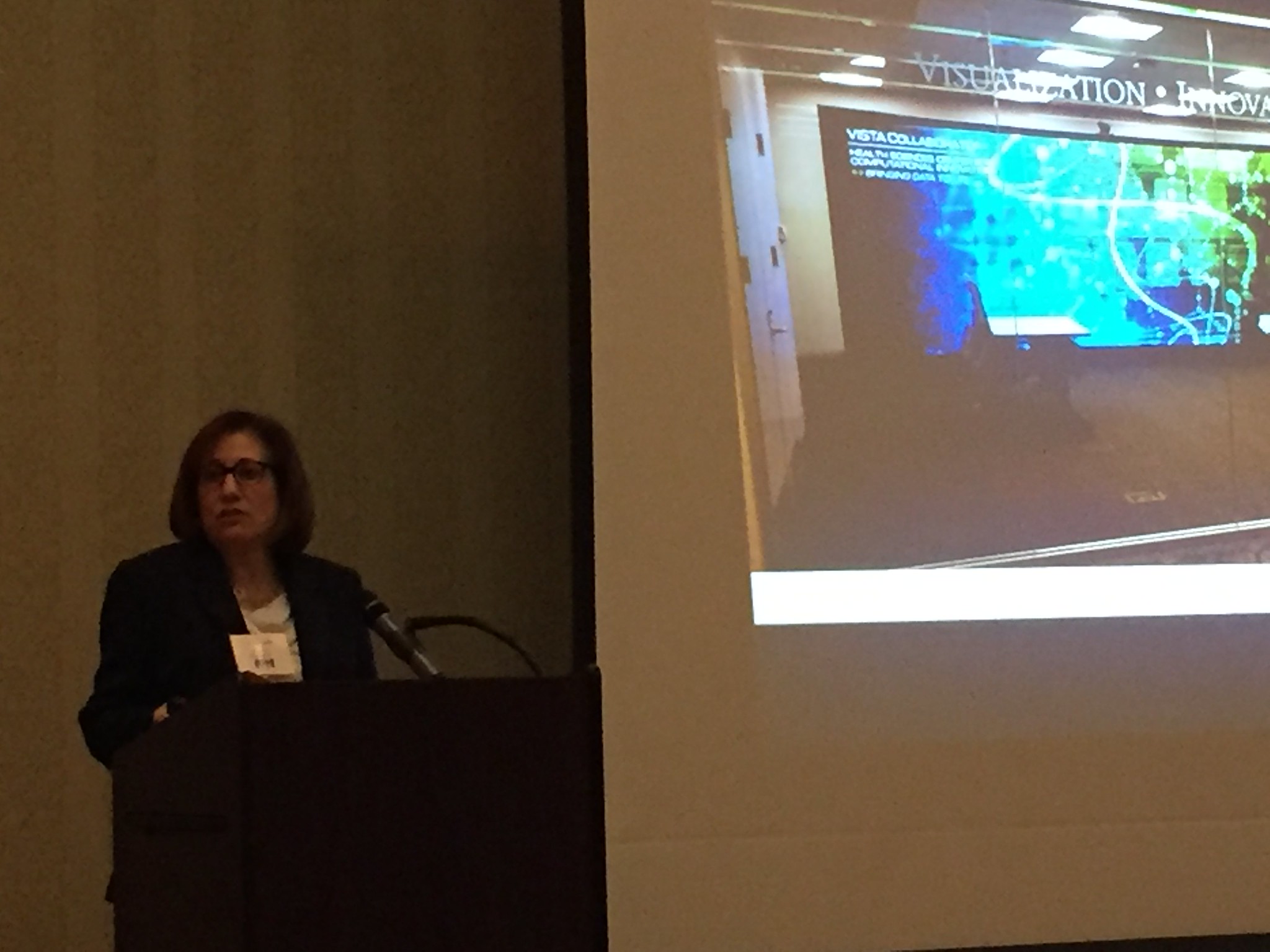
Nancy Fried FosterNancy Fried Foster provided the keynote presentation at the 2016 Upstate New York and Ontario Chapter (UNYOC) of the Medical Library Association Annual Meeting in Watkins Glen, NY.

According to Foster, library design can be done at a low risk, while responding to the needs of your community and being relevant for the future.

Driving library change with research (her agenda):
  • User centered design is based on current evidence. 
  • It is participatory and inclusive. 
  • Solutions are not based on assumptions or outdated information. 
  • It is a research based approach.
People understand their own jobs and can contribute that knowledge to the design of new spaces and processes (i.e., whatever is being built).

Methods:
  • One way of collecting evidence is a work practice study. What tools are people using? Where do they keep things? Can you video people doing their work, then review the video with them in order to gather more information.
    • In looking at classroom space, what will the work patterns of the students be in that space?
  • Can you get people to draw solutions and then talk to them about what they've drawn? That would allow you to annotate the drawing. That could be done in a design workshop.
  • Another method is observation. Observation can take many forms, depending on your project. This methods allows you to slow down, look, and listen.
  • In doing retrospective interviews, you ask people how they completed a piece of work. You annotate the story as the person tells it.
  • Workplace interviews allows you to gather information from the person while they are in their world. You might consider video recording the interview,which will might give you information about the space and how the person uses the space.
  • In photo elicitation interviews, you have people take photos based on prompts. For example, have students take a photo of what they have in front of them when they do homework. .
  • You can use a map diary to have people map or log their movements over the course of a day. The next day, the map prompts them to tell you the story of the day, what they did where and what resources they used. .
  • Reply cards are like a mini survey. Samples questions include:
    • What is the person doing? 
    • If the person had to work elsewhere, where would that be? 
    • What resources is the person using?
  • Snapshot interviews can be done anywhere and are brief. Are good to get quick input from people outside of the library.
 All of these help to answer: What do people need? What do people need to do? You might discover emerging practices and be able to anticipate new practices.

A few examples of analysis:
  • Co-view - videos, photos, transcripts 
  • Coding - with software or manually. Allows you to analyze transcripts and data.
  • Compare - visually inspect,categorize, compare and contrast.
For her, analyze means organizing and clustering the data.

Interpretation:  Foster noted that the process can be lengthy. In some instances, it can take years. She cautioned to start small and get a "win", if possible.

She noted that there was a 2015 presentation entitled "A day in the life of a medical student: applying ethnographic methods in academic health sciences settings."

She said that interesting work at the Miner Library at the University of Rochester (NY). [Lorraine Porcello is involved in this.]

Ethnographic research is not enough. It is also necessary to build collaboration all along the way. In other words, you cannot do this work in a vacuum. You need to understand what else is happening in your organization.

Tuesday, October 25, 2016

Abrupt Changes in the U.S. Copyright Office

Maria Pallante
Pallante before Congress
Friday (Oct. 21), the Registrar of Copyrights, Maria Pallante, was moved into a new position within the Library of Congress (LOC). Reports say that she was surprised by the move. She was also surprised to learn that her access to LOC computer systems changed that morning.  Removing someone's access to systems sends an unsettling signal both to the person and to those around her.  In this case, the unsettled signal is reverberating throughout the copyright community.  Today Pallante resigned her new position and left the LOC, leaving us to ask many question including:
  • Pallante was supportive of both creators and musicians.  Did this cause problems that could only be fixed by her removal?
  • Pallante had embarked on several initiatives to update Copyright Law.  Was this seen as too ambitious?  Did these initiatives cause problems with an industry that then lobbied for her removal?
  • Since we all love conspiracy theories...is this somehow Google's doing?
  • Did the fact that Pallante called for the Copyright Office to be separated from the Library of Congress cause her demise?
Clearly we'll need to wait for these answers (or rumors of answers).  We will also need to wait to see what impact this has on copyright reform.

There are numerous articles on this, including these:

Tuesday, October 18, 2016

Trying to learn a three-dimesional language

Ever since the IFLA conference (#WLIC2016), I have been thinking more about digitization. It perhaps helped, too, that I guest lectured in a class last week talking about digitization and digital preservation, which means I've been mentally preparing for that for a few weeks.  Also last week, a colleague stopped by and showed me the not-final-version of two projects, one of which includes 3D images, which can be rotated on the screen. And that got me thinking about a language that I'm trying to learn which is three-dimensional.

Many people suffer a hearing loss (statistics). It is estimated that 2% of the U.S. population is deaf.  Given the number of people who could benefit from communicating in American Sign Language (ASL), I've been trying to learn some.  It is not an easy language to learn because word use and sentence construction is definitely different from oral English.  It is also a three-dimensional language that uses space and distance to communicate concepts as being in the past or future, or having a specific relationship.  Thus learning ASL from static photographs is difficult.  Imagine not understanding that a sign has movement to it or how the movement is to executed.  It can also be difficult to learn ASL from videos, since videos are also flat. You cannot see a standard video from the front and then watch it again from the side!

Having now seen images (example) that can be rotated, I am imaging people "digitizing" ASL so that signs can be seen from every angle.  That would be a huge undertaking, but then digitizing books was a huge undertaking and we're doing that.  This would could have the ability to improve communications and that would be a good thing. Anybody interested in getting started?

If you've never considered learning ASL, listen (and watch) Amber Galloway Gallego below. 

Monday, September 26, 2016

2016 SEFLIN Virtual Conference: Links, Citations and Other Fun Stuff from Presenters

SEFLIN Virtual Conference Logo
I am pleased that I was a part of the 6th annual virtual conference hosted by the Southeast Florida Library Network (SEFLIN) on Sept. 16, which had the theme "Embracing Innovation: Creative Disruptions in Libraries."  Over 100 locations viewed/participated in the online event, with some of the sites hosting several people (perhaps a roomful!) which means that the reach of this event was tremendous.  While the conference was recorded and those recordings will be available to those that registered for the event, anyone can access the handouts and other materials through the conference LibGuide at http://nova.campusguides.com/c.php?g=534449&p=3655907

As you can see my topic was "Storming Towards Innovation." The description:
Many staff meetings become informal periods for quickly generating ideas which can be acted upon. This session will provide tips, techniques and tools for creating an atmosphere where everyone can contribute effectively to spawn concepts, plans and solutions.  Creating that atmosphere means building practices which become part of the workplace.  It also means understanding the role that each person can play in ensuring that the best ideas emerge. 
If you're curious about what I covered, the slides are available here and the handout is here.  I do know that there are topics I discussed which are not on the slides and the recording also captured the questions which were asked, such as how to weed through ideas that are generated. 

I do not know if SEFLIN will ever release the recordings for general consumption.  If there is a topic that interests your organization, let's talk about how to satisfy that curiosity.

Tuesday, September 06, 2016

Jill H-W interviewed - Making Space for Innovation

Vitamin K your dailt dose of positiveMy colleague, Kelvin Ringold, does a Daily Dose of Positive email (called Vitamin K) and this year expanded into doing podcasts that are informative and motivational.  Knowing my interests, Kelvin asked if he could interview me.  The result is a 39-minute podcast below on what innovation is,  how to make room for it, and tips for brainstorming and getting started being innovative.  The episode page includes links to relevant resources.  If innovation and brainstorming interest you, take a listen!