Tidbit from the innovative pedagogues session - Nicole Cooke (UIUC) used the StoryCorps app for a student assignment, where students interviewed each other. Besides turning in the assignment, students were encouraged to submit their recordings to StoryCorps.
Wednesday, January 06, 2016

Tuesday, January 05, 2016
ALISE16: Pre-Conference Workshop: Education to Innovate
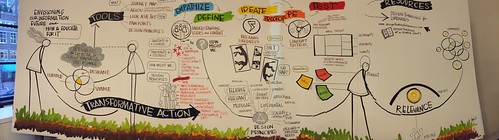
The workshop's main goal was to explore design thinking principles and processes that can be used for reenvisioning our courses and curriculum. We were tasked and pushed to rethink the familiar more deliberately in order to generate innovative ideas for change. We were provided a number of tools and processes, which we got to test out. All of them are guides for making observations and insights. They included:
- Journey map - where to look? The journey map (an IDEO tool) charts the experience of a user through time and across place.
- AEIOU - activities, environments, interactions, objects and users - what are you looking at?
- Look-ask-try - how to look?
- Pain points - can be explicit or latent (unrecognized by the user)
- Design principles - the attributes that a solution needs to have to respond effectively to the identified pain points.
The sweet spot for something to be innovative, it needed to get desirable, feasible and viable. (IDEO)
When we design we need to empathize, define, ideate, prototype, test and repeat.
Concept poster contains:
- Background and insights - pain points, design principles
- Basic concepts - description, functional benefit, emotional benefit
- Key assumptions - desirability, feasibility, viability
Throughout the workshop, each table turned its attention to a course, including:
- Describing the anatomy of a course.
- Putting ourselves in the shoes of the student. (In the real world, we would need to take in account numerous stakeholders.)
We were asked to frame the problem - how might we...? - and then design a possible solution. We were asked to consider the design principles in relation to the problem. In addition to:
- Go far! Go for wild ideas.
- Stay close - "break fixedness" - SIT - systematic innovative thinking
There was a quick mention of the IDEO's guidelines for brainstorming from "10 Faces of Innovation"
Interesting idea of having students do their "plan of study" as part of their introductory courses, after interviewing professionals in the field and talking to their advisor? Perhaps also have them attend a career fair, where they can hear from professionals talk about their careers?
Design Thinking for Libraries, http://deaignthinkingforlibraries.com - three parts freely accessible.

Monday, January 04, 2016
Law360 Blog post: Copyright Cases To Watch In 2016
The web site Law360 has a post on five copyright cases to watch in 2016. Those cases are:
- Oracle v. Google
- Capitol v. Vimeo
- 'Blurred Lines'
- Fox v. FilmOn
- Fox News v. TVEyes
Wednesday, December 30, 2015
Text of the Trans-Pacific Partnership Agreement (Proposed)
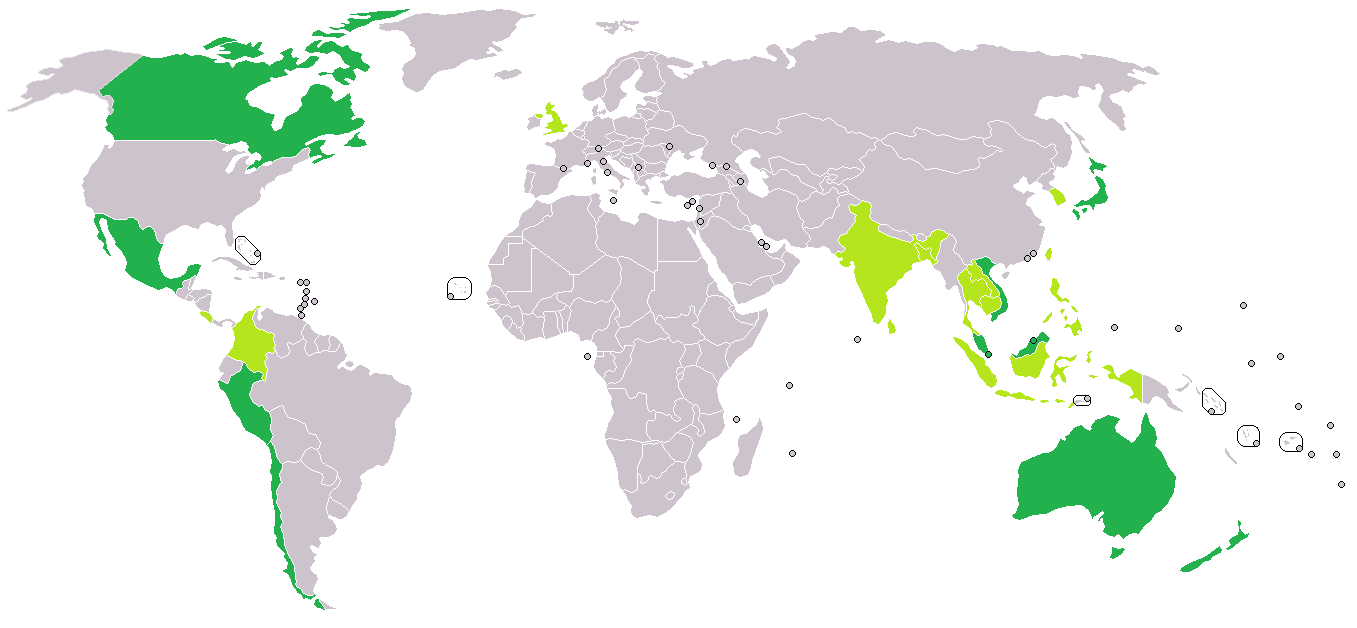 |
| 12 countries in dark green are currently part of the TPP. |
Tuesday, December 29, 2015
Data Mining and Copyright
With increased activity on data analysis, big data, text mining, and the like, you might wonder if copyright law covers this type of use. U.S. copyright law has no specific exceptions related to text mining. However, in the U.K., there is guidance on this. The guidance says:
Could this be something the U.S. might provide guidance or specific rules on? If yes, is this something that might happen soon, or will we catch-up in 5-10 years?Text and data mining for non-commercial research
Text and data mining is the use of automated analytical techniques to analyse text and data for patterns, trends and other useful information. Text and data mining usually requires copying of the work to be analysed.
An exception to copyright exists which allows researchers to make copies of any copyright material for the purpose of computational analysis if they already have the right to read the work (that is, they have ‘lawful access’ to the work). This exception only permits the making of copies for the purpose of text and data mining for non-commercial research. Researchers will still have to buy subscriptions to access material; this could be from many sources including academic publishers.
Publishers and content providers will be able to apply reasonable measures to maintain their network security or stability but these measures should not prevent or unreasonably restrict researcher’s ability to text and data mine. Contract terms that stop researchers making copies to carry out text and data mining will be unenforceable.
Subscribe to:
Posts (Atom)