Showing posts with label Book Digitization. Show all posts

Friday, May 12, 2023

Controlled Digital Lending and Libraries: A follow-up to Hachette v Internet Archive

Right now libraries are under pressure from several different forces including those who want to limit access to specific topics (e.g., critical race theory, LGBTQ, parts of U.S. history, etc.) and publishers who are focused on what a library is, digitization, and digital books. You might feel like hiding your head in the sand, but not is not the time for that. Knowing what has happened and what is happening is important.  

It is with that in mind that I'm sharing these posts/articles that provide links to articles/commentary on the on Hachette v Internet Archive decision. Read them, skim them, save them for later...just don't ignore this, because we can't have publishers using this decision as a further step in limiting what libraries can do.


Friday, March 03, 2023

Sumposium: Exploring the Future of Digital Library Loans: Controlled Digital Lending, March 10 (in-person & virtual)

Details are below and at https://wnylrc.org/cdl. Note that registration will close on March 7.


Exploring the Future of Digital Library Loans: Controlled Digital Lending

 March 10 @ 10:00 am - 3:00 pm (EST)

Register here for the virtual only version of the symposium

Register here for the in-person version of the symposium. Lunch will be provided only to in-person attendees.

Join us in person or online for a one day symposium on controlled digital lending. You will learn what controlled digital lending is, where the concept came from, the technical aspects of how it works in the library, and the legal frameworks of controlled digital lending.

This symposium is being offered in a hybrid format. There are two registration pages - one for in-person, one for online. Please ensure you are on the correct page for the format you desire before registering.

The in-person version of the conference will be hosted at the Western New York Library Resources Council (Airport Commerce Park East, 4950 Genesee Street, Suite 170, Cheektowaga, NY 14225). Lunch will be provided.

Online registrants will receive the Zoom information one day prior to the event taking place. Live transcription and closed captioning will be provided via Otter.ai and Zoom.

Presenters:
Tom Bruno (University of Pennsylvania Libraries)
Charlie Barlow (Boston Library Consortium)
Reed Jones (State University of New York at Buffalo)
Sui Mei Grierson (State University of New York at Buffalo)


Friday, February 17, 2023

Vermont State University to move to a digital-only library

Academic libraries are becoming places that contain many different things to support the academic life of the campus, and that means books need to be moved. Many academic libraries are moving physical books out of their open stacks, placing those books in closed stacks, and then often delivering materials digitally to students and faculty upon request.  So the move to digital is happening. That means the news from Vermont State University should not be a surprise.

Vermont State University seems to moving to digital as a way of cutting costs (i.e., financial sustainability).  As this article states, this move:

...involves eliminating all physical resources in the university’s libraries and transitioning to a digital-only library. Books, collections and other materials are set to be redistributed, in part to community members, according to an FAQ published by the university

The FAQ states:

This was a data-driven decision. The libraries of Vermont State University have seen year-over-year declines in circulation of physical materials. We also met with and surveyed students. What we heard was that students need and want access to library resources where they are, whether on or off campus. Students also want to see physical libraries repurposed to better suit their needs.

Sadly, I suspect that all of the works the academic programs need will not be available in digital format. I wonder how VSU will handle that?

Question: As you digitize materials and license more digital assets, is a digital-only library in your future? If that is a possibility, are you preparing your leadership, staff, and patrons for the transition?  Have you spent time envisioning what a digital-only library might be like, perhaps as a way of thinking about the "distant" future? If yes, how is that informing what you're doing today?

Friday, December 16, 2022

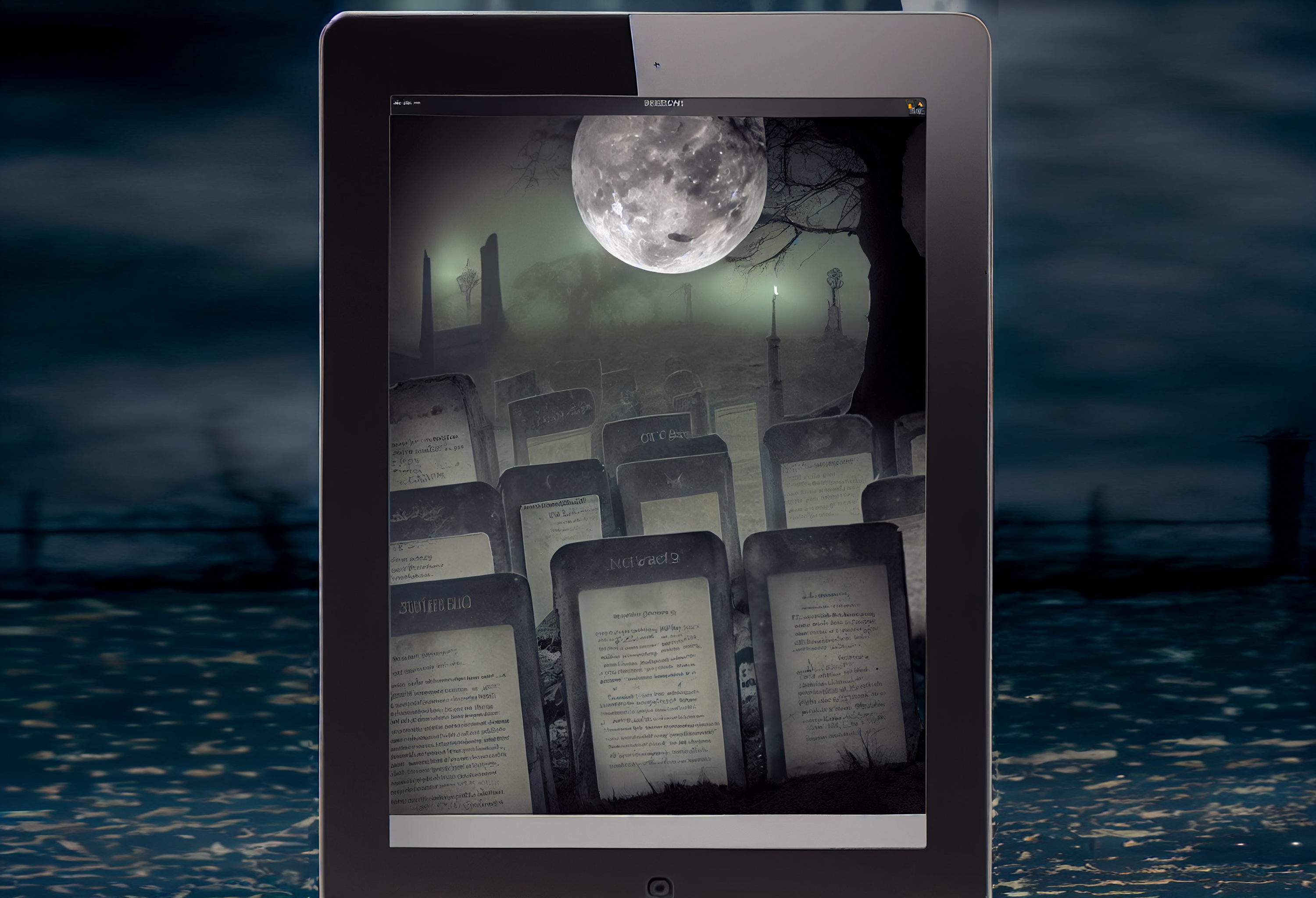
Blog Post: Digital Books wear out faster than Physical Books

midjourney AI generated
Published on Nov. 15, this blog post by Brewster Kahle has been read by many and if you haven't read it, you should. Kahle begins by writing:

Ever try to read a physical book passed down in your family from 100 years ago?  Probably worked well. Ever try reading an ebook you paid for 10 years ago?   Probably a different experience. From the leasing business model of mega publishers to physical device evolution to format obsolescence, digital books are fragile and threatened.

He then goes on to talk about what the Internet Archive and others do to keep digital works available and accessible. Yes, it takes a concerted effort of people and machinery, and that requires money. 

Looking back at my own blog posts, I know that I've written about digital preservation for a LONG time. It is not my constant focus, but I'm glad it is the focus of other folks who have the knowledge and fortitude to help our digital assets last for years to come. If you are able, support their work...if by no other way than helping them make the need for the work visible.


Tuesday, February 15, 2022

Free Webinar for ALA Members: Digitization and Copyright: Lending Digitized Content in a Controlled Manner

Head full of gears

I'm pleased to be part of this webinar on Feb. 28, 2:30 p.m. ET, which is for current ALA members only, as a benefit their ALA membership.  If you're an ALA member and want to know more about Controlled Digital Lending, register for this webinar!


Digitization and Copyright: Lending Digitized Content in a Controlled Manner


Since the start of the pandemic, the library profession has seen an increased emphasis on digitizing collections to lend to patrons in a controlled manner. But libraries have been digitizing content for years as a way to expand access, increase equity of use, support teachers and learners, and maximize a library’s investment in its collection. Some libraries have worked with larger institutions or consortia, while others have quietly engaged in digitization on their own.


This has raised many questions about copyright, including fair use, the first sale doctrine, and digital rights management. During this webinar, the panelists will discuss what it means to lend digitized content in a controlled manner (a.k.a., controlled digital lending), the copyright foundations for this work, what “controlled manners” need to be put in place, and other choices which must be considered when working towards a digitize-and-lend model.


As a benefit of your ALA membership, you have access to this complimentary 60-minute webinar as part of the ALA Special Access Series


REGISTER TODAY!
February 28th starting at 2:30 ET, 1:30 CT

Panelists

Kyle K. Courtney, MSLIS, J.D. is currently the Copyright Advisor for Harvard University, working out of the Harvard Library Office for Scholarly Communication. He works closely with Harvard Library to establish a culture of shared understanding of copyright issues among Harvard staff, faculty, and students. He founded the “Copyright First Responders” and Fair Use Week, which has become an international celebration. He recently won a Knight Foundation Grant to develop technology for crowdsourcing copyright and fair use decisions. He is a founding board member of Library Futures.


Jill Hurst-Wahl, MLS is a consultant, speaker, writer, researcher, and educator. She is a president of Hurst Associates, Ltd. and professor emerita in Syracuse University’s School of Information Studies, where she taught graduate M.S. Library and Information Science (MSLIS) courses, including “Copyright for Information Professionals.” Prior to joining SU, Jill worked as an IT professional, corporate librarian, and information consultant. She is a founding board member of Library Futures. She blogs at Digitization101.com.


Tom Blake, MSLIS is a library digitization consultant and former digital projects manager of the Boston Public Library’s (BPL) Digital Services department. At BPL, he worked to digitize, catalog, preserve, and provide online access to BPL’s extensive collection of rare, nonlending materials. In addition, Tom partnered with the Internet Archive (IA) to provide library books and BPL’s vast genealogical collection to IA’s Open Library, giving the public access. He is a 2014 Library Journal Mover & Shaker.

Sunday, November 14, 2021

NDSL - Digital Initiatives: Hardware & Software

A colleague asked me recently about digitization equipment. I don't follow equipment as closely as I used to, but I know that equipment has become less expensive and more versatile. I looked quickly for a good list of equipment and found this from the North Dakota State Library. This list contains a wide range of hardware and software. It is not dated, but seems up to date and could be a good starting point.

Tuesday, September 21, 2021

NISO Awarded Mellon Funding for Controlled Digital Lending Project

Yesterday the National Information Standards Organization (NISO) announced that it has received funding support for "the development of a consensus framework for implementing controlled digital lending (CDL) of book content by libraries." Developing a framework was approved by members of NISO as a new initiative.  The announcement goes on to say:

Libraries exist to serve their communities, to distribute information and knowledge of all kinds to users of many types, abilities, and resources; circulation of content in all formats is a core feature of what libraries exist to do, and they have been doing so legally for centuries. CDL is an emerging “lend like print” approach, which enables libraries to loan digital versions of their print books while using technical controls to ensure a consistent “owned-to-loaned” ratio. This allows a library to lend the exact number of copies of a specific title it owns—regardless of format—with controls to prevent users from redistributing or copying the digitized version. The need for standards and best practices related to CDL was one of the three top ideas identified during the NISO Plus Conference that took place in February of this year.

Every library will benefit from NIO's efforts regarding digital lending in a controlled environment. I look forward to what they develop and I thank the Andrew W. Mellon Foundation for supporting this effort.

You can read their entire statement on the NISO website.

Wednesday, July 21, 2021

Webinar: Past, Present, and Future of Digital Libraries, August 3, 2021

This webinar, Past, Present, and Future of Digital Libraries, is free and open to all. It will be on August 3, from 1:00-2:00 p.m. ET.

Libraries have historically been trusted hubs to equalize access to credible information, a crucial role that they should continue to fill in the digital age. However, as more information is born-digital, digitized, or digital-first, libraries must build new policy, legal and public understandings about how advances in technology impact our preservation, community, and collection development practices.

This panel will bring together legal scholars Ariel Katz (University of Toronto) and Argyri Panezi (Stanford University) to discuss their work on library digital exhaustion and public service roles for digital libraries. They will be joined by Lisa Radha Weaver, Director of Collections and Program Development at Hamilton Public Library (Canada), who will discuss how library services have been transformed by digital delivery and innovation. The panel will be moderated by Lila Bailey of Internet Archive and Kyle Courtney of Library Futures and Harvard University.

Friday, February 12, 2021

Digitizing Books at the Internet Archive

The Internet Archive has been digitizing books for many years and recently passed two million volumes. To do this work, the Internet Archive invented a scanner and the software which runs it. The Scribe scanner is used at their scanning centers around the world.  The Archive notes:

We never destroy a book by cutting off its binding. Instead, we digitize it the hard way--one page at a time.

They have posted a 40-second video of one of their Scribe scanners in action. The video is available on Facebook and Twitter. A big smile crossed my face watching it, given the beginnings of this blog was in digitization. Sadly, I could not get it to embed here.  

I've written about the Internet Archive in the past, including their digitization efforts. You can access past Internet Archive posts here.


Tuesday, March 31, 2020

The Internet Archive and the National Emergency Library

The announcement from the Internet Archive got lost in the other news I'm receiving, but perhaps you had seen it.  The Internet Archive said:
To address our unprecedented global and immediate need for access to reading and research materials, as of today, March 24, 2020, the Internet Archive will suspend waitlists for the 1.4 million (and growing) books in our lending library by creating a National Emergency Library to serve the nation’s displaced learners. This suspension will run through June 30, 2020, or the end of the US national emergency, whichever is later.
Although this archive uses the word "national," it is available to everyone around the world.

Okay...so I missed that announcement, but then articles like these caught my attention:
The Internet Archive responded with "Internet Archive responds: Why we released the National Emergency Library." This has an FAQ and includes information on controlled digital lending (CDL), which they use.  The FAQ is an informative read, including information on the age of the books, the quality of the images, and more. And, yes, the National Emergency Library will sunset, once the emergency is over or on June 30, 2020, whichever is later.

While controlled digital lending is not new, this is likely the first time so many news outlets and people have taken note of it or been impacted by it! (Congratulations!)

I'm glad to see many people - not just the Internet Archive - release content during this period, when people are being asked to stay home. The music, the films, the books, etc. are helping us all survive social distancing and stay at home orders.  Some of the content releases have been bold, like the Internet Archive, while others have been low risk, like unlocking subscription content.  With all of content, I think the "couch potatoes" will get through the pandemic and be a little smarter when it's all over.

Tuesday, February 04, 2020

Position Statement on Controlled Digital Lending by Libraries endorsed by COSLA

At the 2019 ALA Annual Conference, I learned about the Controlled Digital Lending Program, which 37 libraries have implemented thus far.  On January 30, the Board of the Chief Officers of State Library Agencies (COSLA) endorsed the position statement on this program.  What is controlled digital lending? Their press release says:
Originating conceptually from the copyright community and pioneered by the Internet Archive through their Open Libraries program, Controlled Digital Lending (CDL) allows libraries to digitize older in-copyright print books. In this ‘lend like print’ model, participating libraries choose to circulate either the print or the digital copy of a title. The model supports libraries in making 20th century materials available digitally while respecting copyright laws. The Internet Archive has been circulating a collection of over one million books using this model since 2008.
The press release contains more information and I've placed a resource list below.  If you are interested in digitally circulating your older in-copyright print books, I encourage to you look into this.

Resources


Tuesday, July 09, 2019

#ALAac19 : Digitization

Among the 701 exhibitors at the ALA Annual Conference were several digitization vendors; however, I only took photos of two of the booths.  Interestingly, there is no way to search the exhibitor list on the ALA website to locate all of the digitization vendors. (Trust me, I tried.)  With that as a introduction...

What stood out to me?


First, I continue to be pleased that digitization vendors such as SMA, DLSG, Backstage Library Works, and others continue to exhibit at library conferences.  For some in our industry, digitization is still "new" (even though it isn't). So having a presence and being willing to talk about the technology and its uses is important for those thinking about digitization for the first time (or thinking about digitization in a new way).

Second, the technology is changing.  Scanners are getting bigger.  Complete systems are available for use by library patrons.  Digitizing is being integrated with systems to help students study and help community members create their own works (e.g., photo albums).

By the way, if you have not looked at digitization equipment in a while, don't make decisions based on your old knowledge.  While no one is screaming this from a mountaintop, you should know that these vendors are continuing to develop their technology and systems. They are not standing still.

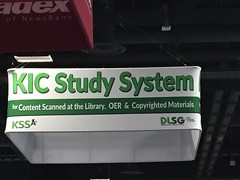
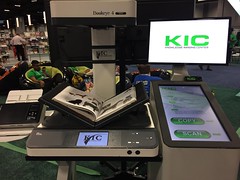
Third, speaking of complete systems, DLSG offers the Knowledge Information Center, which allows patrons to scan materials and have the output in several different formats, including searchable PDF, JPEG, MS Word, KIC Study System, and others.  These complete systems allow users (patrons, students) to control what they digitize and how they are going to access the material.  While I've mentioned DLSG,  I'm sure other vendors are offering similar technology.

Fourth, what vendors display at conferences isn't always what they have available on their websites.  DLSG had two interesting publications at their booth:
  • Digitization Technologies for Public Libraries
  • Digitization Technologies for Academic Libraries 

While I cannot find these publications on the Internet, these seem to be similar (but not the same) to some of DLSG's online content, such as this about using KIC in K-12 education.  This is a reminder that if you're interested in a company or technology, it can be good to pick up material from their booths, even if you don't talk to anyone.  What you pick up may be a unique and helpful marketing piece.

I should note that I skimmed the 701 exhibitors, rather than taking a deep dive into any particular area.  I did not have as much unstructured time as I would have liked, and so did not really spend as much time in the exhibit hall as I likely should have. The time I had was spent getting a feel for the entire exhibit hall, going to a couple specific meetings, talking to library colleagues, and resting my feet.  (Thanks to those companies that had seating available that could be used without feeling that a marketing pitch was eminent.)

Photos


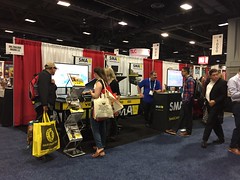
Below is a photo of the SMA booth, which contained large format scanners. There are also three photos of the DLSG Knowledge Information Center (KIC) booth, which was massive.


SMA V3D Flatbed Scanner booth


ALAac19


Knowledge Imaging Center


DLSG Knowledge Imaging Center Study System

Tuesday, July 25, 2017

Podcast: Fighting the Information Famine

Beyond the Book logoChristopher Kenneally recently did an interview Brad Turner, the Benetech Vice President, who is overseeing the company’s Global Literacy Program.  Benetech's mission is to help people with print disabilities and other learning challenges have access to materials in an accessible format.  Turner notes that 3% and 5% of the general population need material in an accessible format, which translates into millions of people in the U.S. and worldwide.

I found this conversation to be quite interesting. First, it interested me because because I had not heard of Benetech before. Second, I know how important meeting the accessibility needs of our community is.  Acquiring material for your library does not automatically mean that everyone in your community can use it.  The person may not be able to use the material's native format.  Third, I know that this work has become easier because content can be placed in a digital format or is being created in a digital format.   In fact, Benetech was founded by someone interested in pattern recognition, which is the foundation of OCR.

If you're interested in accessibility or how a rocket scientist got involved in making print accessible, then I hope you will listen to or read the interview. This 15-minute interview is available as audio and text on the Beyond the Book website.

Tuesday, May 09, 2017

How Do You Digitize a 357-Year-Old Atlas That’s Nearly 6 Feet Tall?

According to Atlas Obscura:
If you’re the British Library, you get creative and set up a special studio to photograph the titanic Klencke Atlas.

The British Library has a video of the process:


Tuesday, April 25, 2017

Article: Torching the Modern-Day Library of Alexandria

This quote seems to be all anyone needs in order to be tempted to read this article:
...the idea that somewhere at Google there is a database containing 25-million books and nobody is allowed to read them. It’s like that scene at the end of the first Indiana Jones movie where they put the Ark of the Covenant back on a shelf somewhere, lost in the chaos of a vast warehouse.

Monday, December 26, 2016

Visit to Scanarkist in NYC

Image from Wikimedia
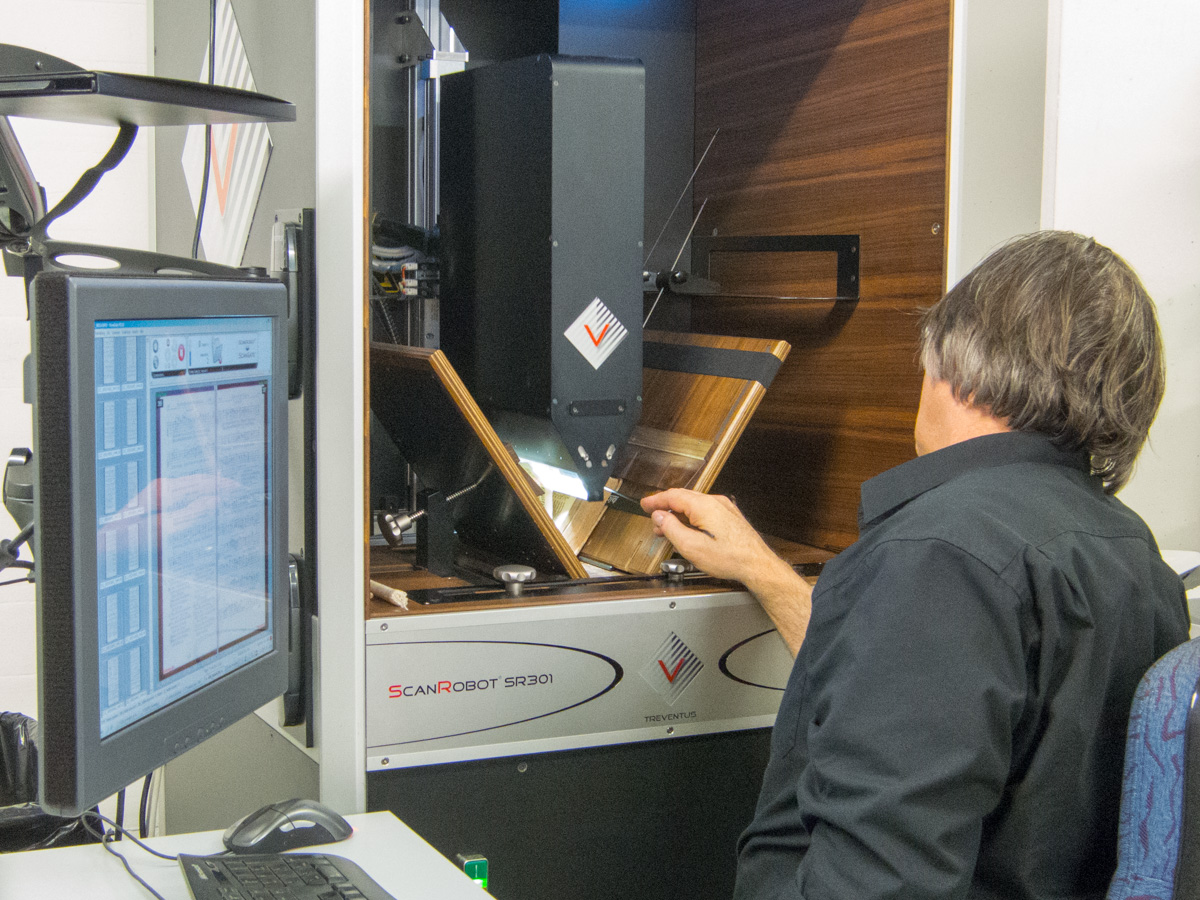
Last Monday, I had an opportunity to visit Scanarkist, which is both a digitization service bureau and an authorized business partner for Treventus Mechatronics.  They are also a sales partner for the Bookeye and WideTek scanners from Image Access.  It was the Treventus ScanRobot that I had come to see and I also got a peek at Nainuwa and other software solutions.

Scanarkist had exhibited at the IFLA conference in August, where a number of digitization vendors had their equipment on display.  While I had seen the equipment at IFLA, it was good to have an opportunity to sit down with them.  (I must thank my schedule which placed me in NYC walking distance from their location.)  I want to note a few things from that visit:
  • ScanRobot 2.0 MDS:
    • The ScanRobot can scan up to 2,500 pages per hour.  Watching it work, this page count seems quite do-able.  (I say that because often the count is based on optimum conditions, etc.)  
    • It will scan with very little human interaction, although they recommend having someone nearby in case the ScanRobot detects an errors (e.g., flipping two pages at once).  In  service center, I believe a person could watch a couple machines at once.
    • The 60° V-shape book cradle means that it is gentle on a book's spine.
    • The machine uses prism capturing technology, which creates an undistorted image.
    • The machine is on wheels and can be moved between locations or taken into the stacks.
  • Nainuwa (software):
    • The Nainuwa will handle a variety of different media, including images from the ScanRobot.
    • It is possible to search within a document and then use information displayed to go directly to where the search term is mention.
    • A part of an image and its OCR content can be copied and pasted.  While this is a useful feature, it can be associated only with specific types of users if copyright/ownership is a concern. 
    • Content can be zoomed and bookmarked. Bookmarks can be organized so you can retrieved related images.
    • The software has a responsive design, which means that it works on a wide variety of computing devices.
  • Other software mentioned were:
    • Scan Gate
    • Scan Flow
    • Customized tools
So who needs a book scanner these days?  Not everything that should be digitized has been digitized, even when it comes to books. Yet not everyone can purchase a book scanner which costs over $100,000.  Institutions with limited budgets - or institutions who need to scan books but don't have enough materials to warrant their own book scanner - need to be able to partner with someone. That partnership would allow for the purchase of an automated book scanner, which could then be shared.  I can see the Treventus - or similar technology - as a consortial purchase.  In fact, we have consortia who are sharing software and equipment already. They may not, though, have thought about a hardware purchase like this because of its cost.  Justifying the purchase would be important, as well as knowing that the consortium would "get its money's worth" or be able to sell the equipment once they are done (as a way of recouping some of the cost).

By the way, Scanarkist will lease the ScanRobot.  We did not talk about what that meant in terms of cost, but it sounds like an option that could ameliorate some of the cost concerns.

Finally, it was wonderful that several vendors were at IFLA and were able to bring their equipment.  I don't think it is clear to vendors, though, which conferences they should attend and why.  Clearly they cannot go to all of them. And any conference will pitch themselves as "the place" to be.  I wonder if there is a place for library vendors to receive unbiased advice on where to exhibit?

Monday, August 22, 2016

WLIC2016 : Digitization Vendors at IFLA

DLSG Booth
DLSG Booth
When I started this blog in 2004, digitization was a growing area in libraries. For some, it was still something new, while others had and were embarking on massive projects. New hardware and new projects/programs garnered attention. For me, Google Book Search ushered in a huge possibilities. Over the years, I've been heartened by the advances in technology, the breadth of projects (even digital collaborations like those discussed at WLIC), and the number of cultural heritage institutions that see digitization as part of what they do.

At the World Library and Information Congress, I was impressed with the number of digitization hardware vendors in the exhibit hall.  Among them were: (this list may not be complete)
For any librarian interested in digitization, this was a plum opportunity to talk with vendors and to look at hardware.  Yes, there was an impressive array of hardware on display for librarians from around the world.

In talking with a representative from one of the companies, we went over some of the acquisitions that have happened in the industry.  We also talked about where in the world the big scanners are being sold.  Not every institution can afford these large, expensive equipment but some institutions can put together programs that are large enough and funded well enough to afford a piece of equipment that costs over $100,000 (U.S.).

One positive that has happened over the years is that the technology is less expensive - more affordable - equipment has improved.  Look, for example, at the microfilm readers that are also scanners.  Look at the equipment meant for end-users (library users) which many institutions have been able to purchase.  Yes, even look at the equipment that many of us have at home. While these printer-scanners are not what a large digitization program would use, they put an ability into our hands that can be used to digitize materials and share them on a personal level.

Yes, this was an amazing opportunity for the librarians at WLIC and I hope some took the time to look, talk, ask for a demo, or obtain information to take back home.  Seeing this variety of hardware in one spot may not happen soon.

Crowley Booth at WLIC
Crowley Booth
#WLIC2016
Versascan large format scanner

Thursday, August 18, 2016

WLIC2016 : National Libraries and Digital Collaborations

All of these papers are available through the digital program on the IFLA web site.

Julia Brungs and Vincent Wintermans - Digitally reassembling scattered collections

Commons terminology:

Restitution - Each term means something different.  Often used for physical materials.
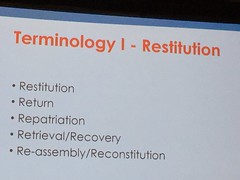
Terminology - Restitution

Unification - some of these terms are used with digital collections
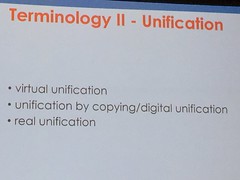
Terminology - Unification

Digital unification - what role can IFLA play?
Yes, documentary heritage items are in countries or institutions different from the county of origin.
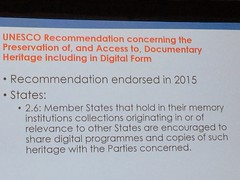
UNESCO recommendations


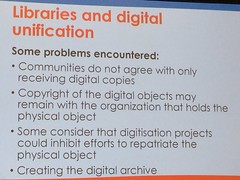
Libraries and digital unification

People are positive about the fact that this conversation is happening.
What should IFLA's role be in this? What role can each of us play?

UNESCO and the Memory of the World:
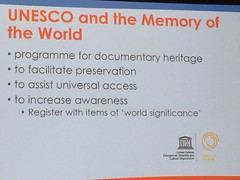
UNESCO and Memory of the World>

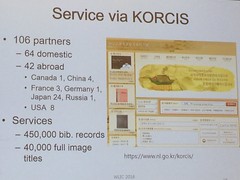
Jaesun Lee - Digital Reunification of Dispersed Collections: National Library of Korea Digitization Project

Over its history, Korea has been overtaken and people have immigrated to other countries.  Korea's cultural items became scattered across many countries. Korea is currently a divided country.

The National Library of Korea began in 1945.  It began digitizing in 1996.  (See photo below.) Digitization has helped the library save the content of items which were deteriorating.
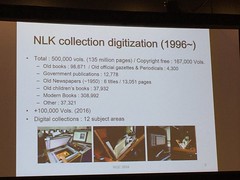
NLK collection digitization

Digitization of rare books held abroad. There are five steps:
  • Planning: Target materials list preparation (photo)
  • Planning: Prior consultation at the working level - this is part of the selection prices
  • Visit / examination - this is also part of the selection process
  • MOU/agreement between NLK and partner institution (Memorandum of Understanding)
  • Digitization - both NLK and the partner institution play important roles
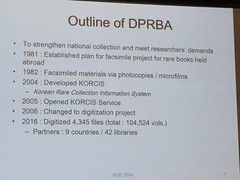
Outline of DPRBA>

#wlic2016

NLK is also collaborating with overseas Korean studies librarians, oversees Korean cultural heritage foundation, the a Cultural Heritage Administration, and others.  NLK is working with the Korean Association for the Preservation of Old Books.

She noted that many materials on Korea have been digitized by NARA in the United States, and which are available online. 
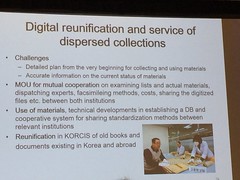
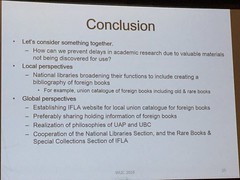
Digital reunification and services of dispersed collections

Conclusion

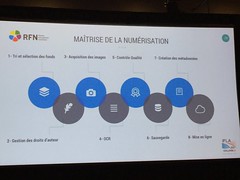
Driss Khrouz - Digital preservation and access on collaborative platforms
Please note that you can use Google Translate to obtain a translation of this paper. The paper is available on the IFLA web site.

Why this project?  The answer can be found in a quote in the paper, where it is stated that the presence of the French language in the digital space is at stake.  This project has brought together people from 19 countries.  Please read the paper for information on it.
What is at stake, right now, is the presence of the French language the digital space. Tomorrow, which will not be digitized and made ​​accessible online risk to simply be overshadowed, if not forgotten. Now our community has large wealth sharing and to share. -  Abdou Diouf
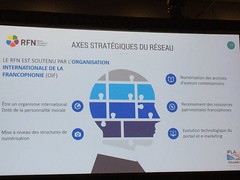
Axes strategiques du Reseau

Maitrise de la numerisation

Caroline Brazier - Digital access and cooperation of shared collections: The British Library and its international collections

The British Library collections reflect global history, not just British history.
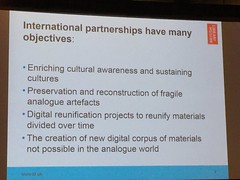
Objectives

Some collaborators are small scale, yet they can still have a large impact.  Some collaborative projects come out of support from philanthropic support provided to other national libraries.  She noted that sometimes the digitization project is part of a larger project.

The impact of mass digitization  project can take time to be realized.  As an example,she spoke about a digitization project of Hebrew manuscripts where a copy of the digital files will be given to a library in Israel.

One of their largest partnerships is with the Qatar National Library which is interested in materials on the Gulf region.  This partnership has included technical collaboration and the creation of school/academic materials.

Digitization allows access to be given to fragile items that are physically housed around the world.

They have also done 3D digitization/modeling which has allowed people then to engage in 3D printing.

She noted that they are entering into a partnership with the National Library of Korea, its newest partnership.  This will help to provide digital reunification of Korean materials held in the British Library.

They are part of the endangered archives program.  The physical items remain in situ.  A coy of the digital file is given to the owner of the physical item.  She noted that digitization does not need to use high tech setups.
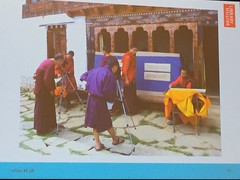
You don't need a high-tech setup

Future priorities:
  • Shared priorities for mass digitization
  • Continually improve the service of discover, access, and reuse
  • Realize the full potential of digital research technologies (future proofing)

Isabelle Nyffenegger - A national library, a universal heritage
Again, you can use Google translate to read this paper (which is available on the IFLA web site), which is written in French.
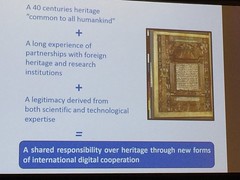
A shared responsibility

Monday, April 18, 2016

Article: Supreme Court Rejects Challenge to Google's Online Library

According to ABC news, the U.S. Supreme Court today let stand the lower court rulings which favored Google.  Rather than Google's book digitization being "epic scale" infringement, the lower courts have said "that Google can provide small portions of the books to the public without violating copyright law." 

How many years has this been winding its way through the courts?  11 years.  I hope the publishers will talk about what they gained from this effort or what changes they have already made based on it.

Tuesday, September 15, 2015

Article: What Ever Happened to Google Books?

Digitization in progressTim Wu writes:
Today, the project sits in a kind of limbo. On one hand, Google has scanned an impressive thirty million volumes, putting it in a league with the world’s larger libraries (the library of Congress has around thirty-seven million books). 
I remember when everyone was talking about Google Books. It grabbed our imaginations. As a digitization consultant, I thought it was something we'd be able to learn from. However, the ability to scan millions of books ran into the reality of authors' rights.

If you've not thought about this project for a while, this article sums it all up nicely. Of course, what it doesn't say is whether we'll ever get the access to those 35,000,000 volumes in the way that we want.